


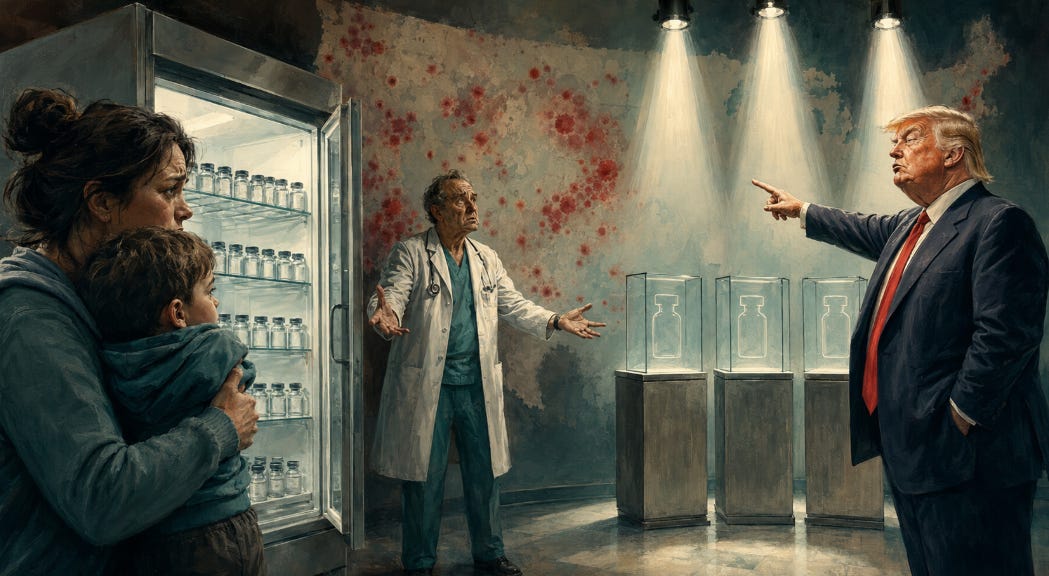
On October 21, 2009, Merck appeared before the Advisory Committee on Immunization Practices and told the federal government it would not resume production of its single-disease measles, mumps, and rubella vaccines.
The products had names. Attenuvax for measles, Mumpsvax for mumps, Meruvax II for rubella. Merck had stopped making them the previous year, and in that meeting the company explained why it was not going back.
It had consulted the American Academy of Pediatrics’ Committee on Infectious Diseases, among others, and the position was that separating the three antigens would delay protection and add both injections and office visits for every child. So Merck kept making the combined shot, the one Maurice Hilleman had assembled at that same company in 1971, and stopped making the parts.
That was seventeen years ago. It was a question that got asked, examined, and answered in public, by the manufacturer, in front of the federal committee that exists to consider exactly this.
On August 10 of this year, the President of the United States signed an executive order directing that the combined shot be split into three.
What the order does
It calls for the measles, mumps, and rubella vaccine to be administered as three separate single-disease injections.
It recommends childhood vaccines be given one at a time, at separate visits.
It cuts the list of universally recommended childhood vaccines from eighteen diseases to eleven, moving the remaining seven into a category called shared clinical decision-making.
It presses states to rewrite their school vaccination requirements around the narrower federal list.
And it directs the Attorney General to challenge state limits on vaccine exemptions.
The White House fact sheet describes this as delivering gold standard childhood vaccine recommendations for Americans.
The part where the order admits it
Here is the sentence that makes this different from an ordinary bad policy.
The order conditions the MMR split on those products becoming domestically available.
That clause is in the text. Somebody wrote it, and somebody reviewed it, and it is there because everyone involved knew the thing being ordered cannot currently be done.
There are no approved United States monovalent measles, mumps, or rubella vaccines. Merck says so directly, and Merck manufactures one of the only two MMR vaccines licensed in this country. GSK, which makes the other, confirms the same gap.
Reviving them is not a matter of restarting a line. Each of the three would require its own clinical trials in children, its own reconfigured manufacturing, and its own Biologics License Application review at the FDA. Merck’s estimate is that it could take years, potentially as many as ten, before approval, manufacturing, and commercialization. A public health educator asked about it this week gave the same figure: at least ten years.
The order gives the Department of Health and Human Services ninety days to present plans for offering single vaccines, including by working with the private sector and with other countries.
Ninety days to produce a plan for a thing that takes a decade.
What a parent can actually do
Consider somebody who reads the news, believes the President, and wants to comply.
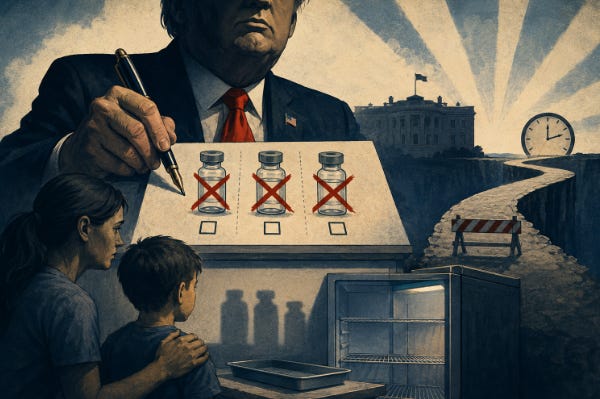
She takes her four-year-old to the pediatrician and asks for the measles shot alone, as recommended by the federal government of the United States.
There is nothing to give her. Not because the practice is refusing, and not because of any political disagreement between her doctor and the White House. There is no such product in the country. There is no vial. There is no code to bill it under.
Her options are the combined MMR she has just been told to avoid, or nothing.
Sue Kressly, who recently completed her tenure as president of the American Academy of Pediatrics, put the underlying problem plainly. Nothing changed in the last week or two, she said. There was no new study, no new evidence, no new data saying something has changed and we need to look at the schedule differently.
The CDC’s own position, on its own website, is that there is no published scientific evidence showing a benefit to separating the combined vaccine. An HHS spokesman told reporters that standalone vaccinations can potentially reduce the risk of side effects and maximize parental choice. He offered no evidence for the first half of that sentence.
Even Fox News’s senior medical analyst said the vaccine should not be separated, that it has been tested this way for decades, and that there would be a compliance problem if it were split.
Japan already ran this experiment
This is the part that should end the argument, and it will not.
Japan withdrew the combined MMR in 1993 and moved to single-disease shots. That is the closest thing that exists to a real-world test of what the order proposes, and it has been studied.
A 2004 analysis published in Vaccine found that the withdrawal reduced immunization rates and increased disease rates, and that this happened despite monovalent vaccines being available. Japan had the separate shots. Coverage still fell and illness still rose, because every additional visit and every additional needle is another opportunity for a child not to get one.
There is a second finding from Japan that is worth recording, since the entire American conversation about the MMR has been shadowed by a claim about autism for twenty-seven years. After Japan switched to individual shots, autism rates there continued to rise.
The order does not mention autism. The President has continued to raise it separately.
What this actually accomplishes
Nobody has banned a vaccine. That matters, and it is why this is difficult to write about.
What the order does is create a gap and then hold it open.
It tells parents the available product is the wrong one. It names a preferred alternative that does not exist and cannot exist for years. It cuts the recommended list by seven diseases. It pushes states to narrow their school requirements to match. It sends the Justice Department after the states that limit exemptions.
A parent who believes all of that has exactly one action available, and it is to not vaccinate.
That is the whole mechanism and it does not require anyone to prohibit anything. You recommend a product that is not for sale, you make the existing product sound like a compromise, and you wait. The ninety-day planning requirement and the language about working with other countries are the parts that make it look like motion. They are also the parts that guarantee the gap stays open, because the plan will be delivered, and it will describe a process measured in years, and in the meantime the recommendation stands.
Where this lands
There have been 2,371 confirmed measles cases in the United States through July 30 of this year, across thirty-four outbreaks. Last year’s total was a thirty-five-year high. Three people died, including two unvaccinated children in West Texas, the first American measles deaths in a decade.
In November, the Pan American Health Organization will rule on whether the United States retains the measles elimination status it has held since 2000.
The vaccine that would prevent all of this has existed since 1971, costs almost nothing, and is sitting in refrigerators in every pediatric practice in the country.
The President has recommended a different one.
It has not been invented.
That might be the whole point. Remove access to a proven vaccine and promote one that doesn’t exist. Result: no vaccine.
What does this accomplish? I usually can see the trumpian end goal, but not this time. I don't get it.
And then the stephen-miller-ghoul chimed in that childhood vaccines have not been studied. What an ignoramus. Does he not read Tom Wellborn?