


There is a particular kind of person who, when confronted with a specific complaint about Donald Trump, does not answer the complaint. They diagnose you. You mention the tariffs and what they have done to the price of everything in your cart. You mention the January 6 pardons and what it means that the men who beat police officers with flagpoles are now free and celebrated. You mention a specific cruelty, named and dated, said out loud at a podium. And the reply you get is two words and an acronym. TDS. Trump Derangement Syndrome. Conversation over.
Notice what just happened, because it happens so smoothly, you can miss it. You brought a fact. They brought a diagnosis. And the diagnosis was designed, with some care, to make the fact disappear.
That is the whole function of the phrase. It is not a description of anything real. It is a rhetorical instrument, and a clever one, because it borrows the authority of medicine to do the work of evasion. By dressing a political disagreement in the white coat of psychiatry, it transforms the person who objects to Trump from someone with an argument into someone with a defect. And here is the convenient part, the part that makes the phrase so beloved by the people who use it: you do not have to refute a defect. You do not owe a symptom a counterargument. You just point at it and shake your head. The labeler gets to skip the entire burden of proof and walk away looking like the calm one.
This is a thought-terminating cliché in the most precise, textbook sense of that term. It ends the conversation at exactly the moment the conversation should begin. The facts are sitting right there on the table, sourced and specific and waiting to be addressed, and “TDS” is the answer that addresses none of them. It is, if you look at it honestly, a confession. It is the sound a person makes when they would rather not defend the indefensible thing, and have found a way to make their refusal sound like superiority.
So let me say the unfashionable thing plainly. The intensity is not the problem. The intensity is the appropriate response.
The label survives only by smuggling in a lie, and the lie is this: that calm is the same thing as reason, and that anger is the same thing as disorder. It is a seductive equation because it flatters whoever stays quiet. But it is false, and you know it is false the moment you say it out loud. Anger can be the most rigorously reasoned thing in the room. It can be the precise, measured, entirely proportionate output of a functioning conscience doing exactly what a conscience is for: looking at consequences you can name, tracing them to a cause you can identify, and responding with feeling that matches the size of the harm. Strong revulsion at policy that reaches into your healthcare, your grocery bill, your family’s legal standing, the independence of your courts, is not a glitch in your wiring. It is your wiring working. A person who could survey all of that and feel nothing is not healthier than you. That person is a number, and numbness is not a virtue. It is frequently just a failure of attention, or a failure of nerve.
And now we arrive at the irony, and it is worth slowing down for, because it is the heart of this.
If we are going to reach for the vocabulary of pathology at all, if we are genuinely going to talk about behavior that resembles a syndrome, then we should be honest about which behavior actually fits the description. Because it is not the opposition. A syndrome, in any meaningful sense, is a cluster of symptoms that persists regardless of input. It does not update. It does not respond to evidence. It runs the same program no matter what the world does.
Look, then, at the devotion. Look at the loyalty that survives every contradicting fact, every reversal, every promise broken in plain sight. Look at the reflexive defense of statements the defender privately, visibly knows are absurd, the cognitive scramble to retroactively justify whatever was said this morning. Look at the merchandise, the flags, the gold sneakers, the trading cards, the rituals, the treatment of one fallible elderly man as a figure beyond the reach of criticism, beyond satire, beyond accountability, beyond the ordinary scrutiny we apply to every other person who has ever held power. That is the pattern that maps, point for point, onto what we actually mean when we say cult. Devotion that no fact can dent. Belief that takes contradiction as proof of its own righteousness. An attachment that has severed itself entirely from the evidence and feels stronger for the severing.
That is the thing that looks clinical. Opposition that changes when the facts change is the healthy organism. Devotion that cannot be moved by anything is the one that should worry us.
So the meme inverts. Run it honestly, and it turns inside out in your hands. To hold a fierce, specific, well-sourced contempt for a public figure, based on conduct you can document and consequences you can measure, is not derangement. It is judgment. It is precisely the faculty that citizenship is supposed to produce, sharpen, and reward. It is the thing a free people are meant to do: look hard at power, evaluate it against reality, and arrive at a verdict.
And a verdict you reached by looking is one you are allowed to be proud of. You should be proud of it. There is no shame in despising arrogance, cruelty, and thoughtless contempt for the people whose lives you are gambling with, and despising it with force. The shame belongs to the indifference. To hate this well is not a symptom. It is a sign that you were paying attention.
Let me hold one honest caveat, because an argument that cannot survive its own strongest objection is not worth making.
Not every anti-Trump reaction is reasoned, and pretending otherwise would make me guilty of the same lazy move I am accusing the other side of. Some opposition does harden into pure reflex, reaching to oppose a thing only because he was the one who proposed it, inflating every ordinary act to the level of maximum villainy, regardless of its actual scale. That exists. It is real, and it is not admirable. And “cult,” deployed carelessly, is itself a pathologizing label doing the very same evasive work in the other direction, ending a conversation instead of having one.
But notice that the caveat does not rescue the phrase. It refines the real principle, which is this. Hatred is not automatically virtuous, and feeling something strongly is not the same as being right. What is legitimate, fully and without apology, is contempt that is grounded in conduct and anchored to evidence. That kind of contempt is not a disease. It is a conclusion. And when someone meets that conclusion by calling it a syndrome, they are not making a diagnosis.
They are telling you they lost the argument and have decided to change the subject.
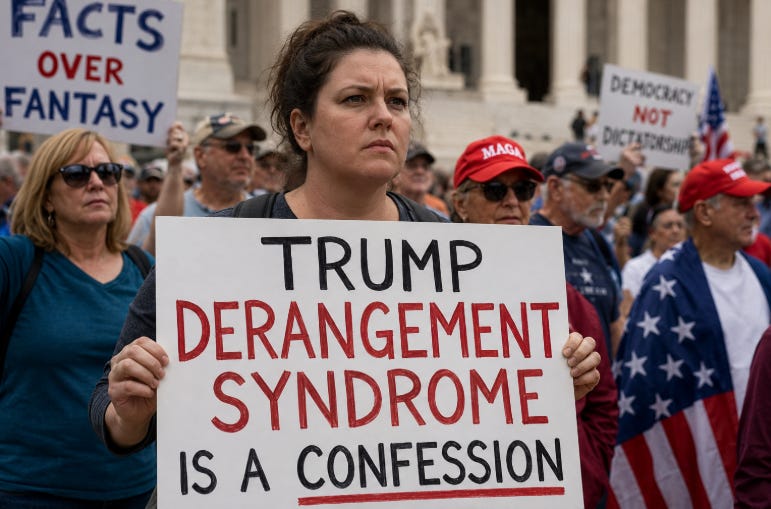
Yeah, they think “Trump Derangement Syndrome” is so clever (🙄). Another one MAGA loves is “Orange Man Bad” which they use in the same way: to imply that you can only criticize Trump (and lamely, by calling him “orange”). My response is, “Well, he _is_ orange and he _is_ bad, so… 🤷♀️”.
That was good, my Man... Well written and applicable to so many other aspects of life.