


A subscriber named Tony Wright wrote in with a question I have been turning over for hours. He asked whether Trump could use rhetoric around Xi’s visit and rare earth supply chains to generate volatility in critical minerals stocks, creating openings for allies, insiders, or connected businesses to profit.
I am going to answer a narrower question than he asked, and I want to explain why before I do.
The question as posed requires knowing what is in a man’s head and whose brokerage account moved when. Neither is available to me or to anyone outside a subpoena. Asserting it would be an accusation of securities fraud built on a hunch, and it would be the kind of claim that lets a reader dismiss everything around it.
The narrower question is answerable, fully documented, and worse. It is whether the structure exists for that to happen, whether anyone would be able to tell if it did, and what the calendar looks like. All three have real answers.
The calendar is unusually specific.
Xi Jinping is expected at the White House on September 24. Trump announced the date publicly in late July during remarks at the EPA, and Xi is reportedly arriving late on the 23rd and departing on the 25th, skipping the United Nations General Assembly opening in New York the same week to make a single tightly scoped trip about one relationship.
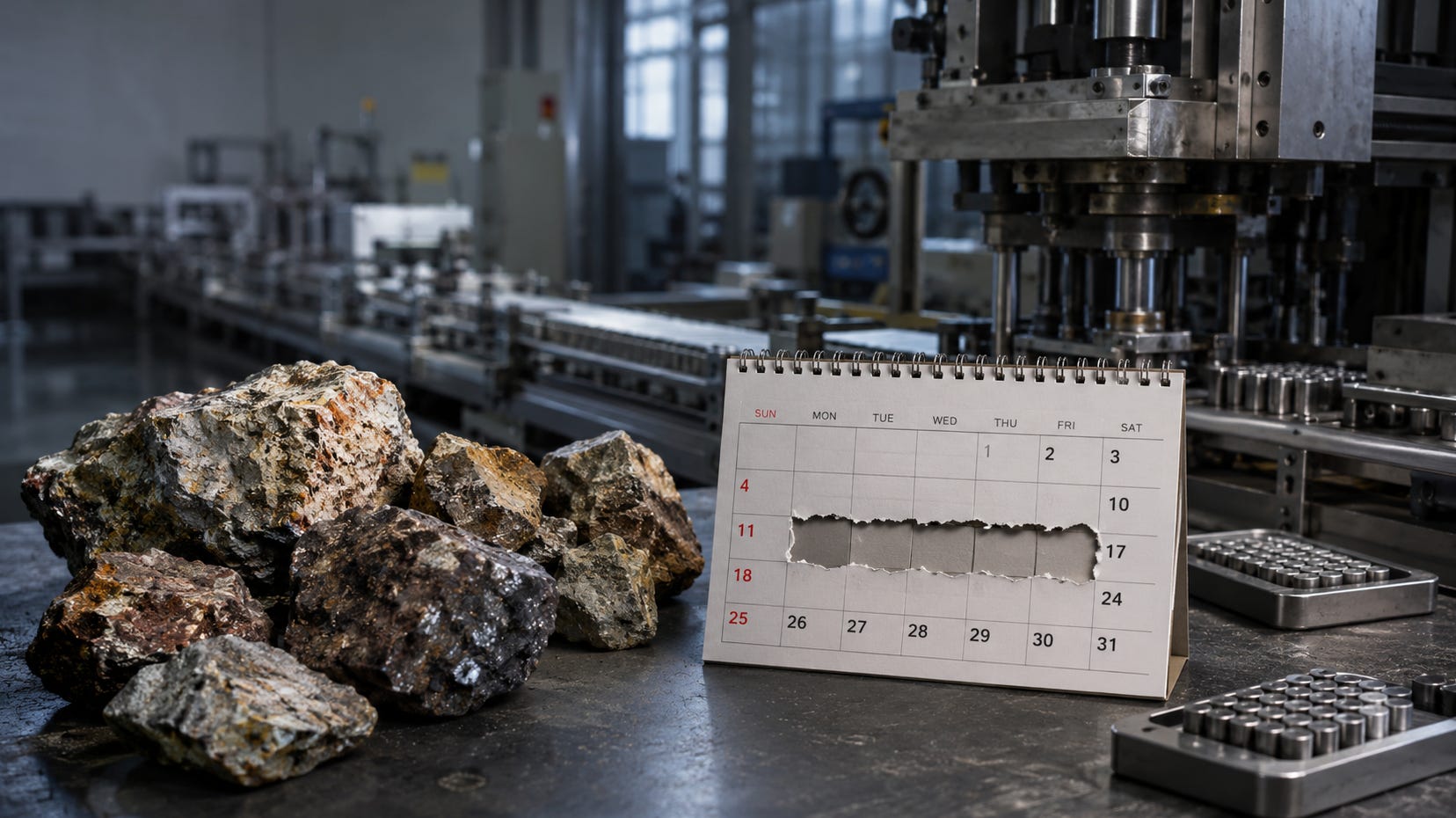
Forty-seven days later, on November 10, China’s suspension of its rare earth export controls expires.
That suspension is a specific legal instrument. On November 7, 2025, following the Busan meeting, China’s Ministry of Commerce and General Administration of Customs issued Announcement No. 70, suspending six announcements issued on October 9, 2025, until November 10, 2026. Those six had imposed controls on rare earth processing equipment, technology, and related materials, including extraterritorial provisions reaching products manufactured outside China that contain controlled Chinese material.
Analysts identify three possible outcomes at the deadline: extension of the suspension, selective reinstatement aimed at particular elements or end uses, and full reimposition of the October 2025 measures. Each of those is a distinct market event with a known date attached.
What is not suspended, and this matters.
The April 2025 controls, covering seven heavy rare earth elements including dysprosium, terbium, yttrium, and scandium, were never suspended and remain fully in force. Neither was the underlying licensing architecture. On January 1, 2026, Beijing added samarium, gadolinium, lutetium, and silver to its export licensing catalogue.
So the truce paused one wave and left the machinery intact. China retains the legal authority to intensify, delay, suspend, or redirect controls without amending anything, and demonstrated in early 2026 that it will do so selectively, when it prohibited exports to Japanese military users.
The underlying dependence has barely moved. China holds roughly ninety percent of global rare earth processing. The United States accounted for about thirteen percent of global output in 2025 and has one operational mine. Analysts describe diversification as gradual and capital intensive, with China expected to retain its dominant position in processing and magnet manufacturing through the decade.
The volatility is not hypothetical.
This is where Tony’s question gets answered without anyone guessing at motive.
Announcements on this specific commodity have repeatedly produced enormous single-session moves. When China imposed the October 9 controls, markets fell sharply on the news and the American response. When the Busan de-escalation followed three weeks later, they recovered. When the Department of Defense took an equity position in MP Materials in July 2025, the company’s shares moved dramatically in a single day.
And on April 9, 2025, the president posted publicly that it was a great time to buy. Hours later he announced the ninety-day tariff pause, and the market recorded one of its largest single-day gains in decades. Members of Congress called for an insider trading inquiry. No finding was ever made public.
That sequence is not an allegation. It is a matter of record, and it establishes the only thing that needs establishing: that the timing of American trade announcements moves these prices violently, and that the person controlling the timing has previously told the public to buy shortly before making one.
The honest answer.
Tony asked whether Trump could generate volatility that allows connected people to profit.
The volatility will happen regardless of anyone’s intent. It is now a structural feature of this sector, produced by the fact that a handful of people know the content and timing of announcements that reprice billions of dollars of equity, and by a policy calendar with two hard dates on it.
Whether anyone positions ahead of it is a question the American disclosure regime is not built to answer. Executive branch officials file periodic financial disclosures with long lag times and broad valuation ranges. Congressional trade reporting under the STOCK Act runs on a forty-five day window and enforcement has been close to nonexistent. Private parties who are told something in a meeting are subject to insider trading law only if a prosecutor decides to look, and the Justice Department currently answers to the man whose announcements are the market-moving event.
So the structure exists. The detection apparatus is thin. And the enforcement apparatus reports to the person whose conduct would be at issue.
None of that establishes that anything improper has happened or will happen around September 24. What it establishes is that if it did, the public would probably never learn of it, and the fact that a citizen cannot get an answer to Tony’s question is itself the finding.
What to actually watch.
Three things, none requiring a theory.
The first is whether anything at the September 24 meeting produces a public statement about the November 10 deadline. An announced extension, a threatened reimposition, or deliberate ambiguity are three different market events, and ambiguity has been the most profitable of the three for anyone holding volatility.
The second is the periodic transaction reports filed by members of Congress covering late September and early November. They are public, searchable, and forty-five days late, which means the September window becomes visible in early November and the November window in late December.
The third is whether the administration announces any further federal equity positions or offtake agreements in domestic producers in the weeks around the visit. The MP Materials arrangement demonstrated that a single procurement decision can reprice a company by half in an afternoon, and there is no rule requiring advance notice of one.
I would add a fourth thing, which is not about money. If the November 10 suspension lapses without an agreement, the extraterritorial provisions return, and they reach products manufactured outside China containing Chinese material. That touches automotive, defense, and energy manufacturing directly, three weeks after a national election.
The stock question is the visible one. The supply question is the one that will still matter in March.
Great article 👏🏼👏🏼👏🏼 🙏🏼
China seems to have a iron grip on rare earths. What’s to keep them using this dominance as leverage to get what it wants?