


The comparison gets made constantly, and almost always as an insult, which is why it accomplishes nothing. A reader who already dislikes the president nods. A reader who does not hears a person reaching for the largest available word. Nobody’s understanding moves.
So run it properly instead. The Declaration of Independence contains an enumerated list, twenty-seven specific charges laid against George III, drafted by people who were describing conditions they were living in rather than composing an abstraction. It is the most detailed catalogue of executive abuse in the American founding documents, and it was written to be checkable.
Check it.
The seven that land.
He has affected to render the Military independent of and superior to the Civil power. In February 2025 the Defense Secretary removed the judge advocates general of the Army and the Air Force, the officers who administer the Uniform Code of Military Justice and advise commanders on the law of armed conflict, and sought nominations for all three service positions. His stated reason was that they had obstructed lawful orders. Five former secretaries of defense called for hearings.
He has kept among us, in times of peace, Standing Armies without the Consent of our legislatures. Since June 2025 the administration has deployed National Guard troops to American cities over the objections of the governors who normally command them. More than 5,000 Guard soldiers and Marines went to Los Angeles. In the first forty days they performed one temporary detainment, of a veteran who crossed a tape line on his way to a VA office, at a cost of roughly $120 million.
On September 2, 2025, Judge Charles Breyer found the deployment violated the Posse Comitatus Act, writing that there had been protests and some violence but no rebellion, and that civilian law enforcement had remained able to enforce the law. He noted that the administration had announced its intention to federalize the Guard in additional cities, and described what that would produce as a national police force with the president as its chief.
On December 23, 2025, the Supreme Court blocked the Chicago deployment 6 to 3, holding that the president had not invoked any statute providing an exception to the Posse Comitatus Act. Justice Kavanaugh concurred and observed that one consequence might be a president reaching for the regular armed forces instead.
He has obstructed the Administration of Justice. A federal court ordered the Justice Department to produce unredacted documents under a statute Congress passed for that purpose. The Attorney General conceded a violation of the Act. The department has spent two months submitting justifications the court has repeatedly found insufficient, and on the final day of the window filed a notice of appeal that advances no argument and concedes the department may lack standing to bring it.
He has made Judges dependent on his Will alone. Executive Order 14300 placed Nuclear Regulatory Commission rulemaking under White House budget review and assigned the agency a DOGE lead. In June 2025 the president fired Commissioner Chris Hanson after Hanson criticized federal workforce cuts. A Republican commissioner resigned afterward.
He has erected a multitude of New Offices, and sent hither swarms of Officers to harrass our people. This one requires no elaboration and every reader will supply their own example.
For depriving us in many cases, of the benefits of Trial by Jury, and for transporting us beyond Seas to be tried. Removals conducted without hearings, to foreign custody, are a matter of extensive public litigation.
Seven of twenty-seven is a striking number. It is also the end of the honest part.
The twenty that do not.
The remaining grievances describe a different situation, and the differences are not cosmetic.
The Declaration charges the king with plundering seas, ravaging coasts, burning towns, and destroying lives. With transporting armies of foreign mercenaries to complete works of death and desolation. With dissolving representative houses repeatedly and refusing for a long time to permit others to be elected. With rendering elections impossible and returning legislative powers to the people at large. With cutting off trade, imposing taxes without consent, and abolishing the free system of English laws in a neighboring province.
Some of these have surface analogues that dissolve on contact. Tariffs are imposed by executive action under delegated authority, which is a real constitutional question and a live one, and it is a different thing from a Parliament in which the colonies had no seats at all. Congress sits. It has not been dissolved. Elections are scheduled for November 3.
Anyone who elides that distinction is doing what the makers of the comparison always do, which is to borrow the moral weight of 1776 without paying for it.
And now the part that should trouble you.
George III did not do most of what the Declaration accuses him of.
He was a constitutional monarch. Taxation, trade restriction, the quartering of troops, and the punitive acts against Massachusetts were the work of Parliament and of ministers. Jefferson knew this. Attributing everything to the person of the king was a deliberate rhetorical decision, made because a revolution needs an antagonist with a face and because the colonists had spent a decade petitioning the king as their protector against Parliament. The list is a bill of particulars against a system, addressed to a man.
That matters for the comparison, because the man himself turns out to have a record on the only question that finally counts.
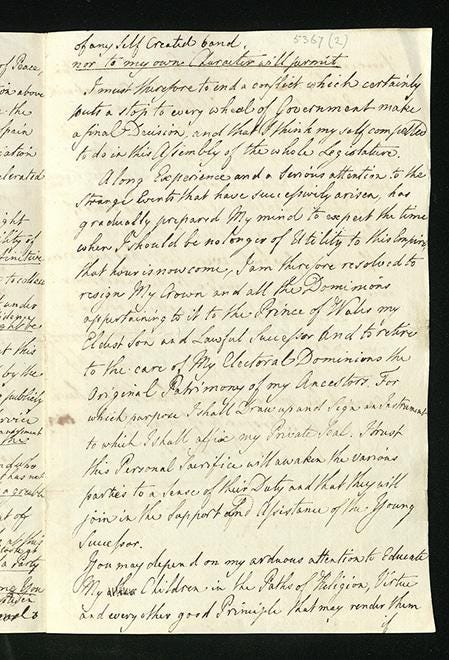
In March 1783, after Yorktown and the fall of North’s ministry, George III wrote a draft of an abdication speech. The Library of Congress holds it. It was never delivered. He stayed, accepted a government he had not wanted, and accepted a peace he detested.
The court painter Benjamin West told a story about him afterward, recorded years later in Joseph Farington’s diary, so treat it as the secondhand thing it is. The king asked West what Washington would do if America were declared independent. West said he thought Washington would retire to private life. The king said that if he did, he would be the greatest man in the world.
On June 1, 1785, George III received John Adams at St. James’s Palace as the first minister of the United States. He told Adams that he had been the last to consent to the separation, and that having been made, he would be the first to meet the friendship of the United States as an independent power. He later gave Adams free use of his personal library.
That is the record of a man who lost, and knew he had lost, and transferred what he had to transfer.
What the founders actually assumed.
They did not design the presidency to withstand a person who would not accept a result. They designed it against a specific catalogue of abuses, with separated powers and enumerated limits and an assumption running underneath all of it that officeholders would concede when the mechanisms produced an answer they disliked. Every constraint in the document is a constraint of that kind. It works on someone who accepts constraint.
The seven grievances that land are not the story. Individually, each is a legal dispute with a court attached, and the courts have in fact ruled, twice, against the deployments. The system has been producing answers.
The story is what happens to the answers. The Los Angeles deployment was found unlawful and hundreds of troops stayed. The Supreme Court blocked Chicago and a justice noted aloud that the regular military remained available. The Epstein order was entered and the documents have not been produced, and the department’s response to a judge who told them plainly that he has held Justice Department lawyers in contempt before was a filing that declines to state what it thinks the law is.
The relevant comparison was never about grievances. Both men have a list. The difference is that one of them, on the day the mechanism finally said no, wrote out his surrender in his own hand, put it in a drawer, and then stood in a room and shook hands with the ambassador of the country that had beaten him.
We do not know what the other one will do. Ten weeks from now, we may find out.
"They did not design the presidency to withstand a person who would not accept a result." Our constitutional loopchasm.
Oh, based on the recent past,I think I have a pretty good idea.