


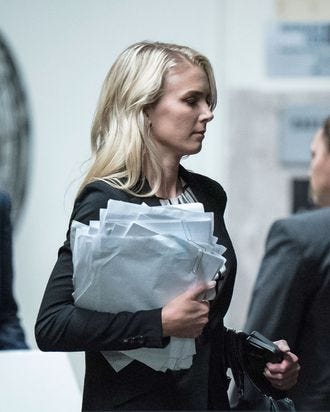
If you have watched the president closely over the last two years, you have seen her, even if you did not know to look. A blonde woman, mid-thirties, seated just behind him at the wrestling championship, in the courtroom during the criminal trial, feet away at the NATO summit in Ankara as he met with Zelensky. She rarely speaks in the footage. She is usually holding paper.
Her name is Natalie Harp, she is thirty-four, and her official title is executive assistant, which does not begin to describe what she does or why the internet has become fixated on her. In the last month alone she has been the subject of a viral and false rumor that she is Trump’s secret hospice nurse, a second rumor that she is his mistress, and a steady drip of book excerpts portraying her as the most devoted and unsettling figure in the president’s inner circle. People want to know who she is. The real answer is more interesting than any of the rumors, and considerably sadder, and it says more about the man she serves than about the woman herself.
The Printer
Start with the nickname, because the nickname is the clearest window into the job.
They call her the human printer. Trump does not like reading on screens, so Harp follows him with a portable printer and a battery pack, generating paper copies of emails, news articles, and social media posts for him to hold. When he wants to see how a story is playing, she prints it. When he golfs, she has been photographed trailing him with the laptop and the printer, ready to produce the day’s coverage on demand.
The paper is curated. By multiple accounts, what Harp prints and hands him skews relentlessly positive, the flattering story, the favorable poll, the post that praises him, assembled into stacks and, according to reporting on her habits, sometimes held together with gold paper clips. She is, in the most literal sense available, a filter. The president’s sense of what the world is saying about him passes, in significant part, through the choices of one devoted aide about which pages are worth printing.
She has also posted to his Truth Social account on his behalf, including, on at least one occasion, a post announcing he had received a target letter in a federal investigation, which reportedly surprised other aides who did not know it was coming. She is credited, or blamed, with enabling the late-night posting sprees, printing out drafts for his approval and then logging in to publish them into the small hours.
Consider what that means, mechanically, about the flow of information to the most powerful person on earth. A single individual, chosen for devotion rather than judgment, stands at the intake valve, deciding which version of reality reaches him on paper and helping push his own words back out into the world. That is not gossip. That is an actual feature of how this presidency processes information, and it should unsettle you regardless of what you think of her.
How She Got There
Harp’s path to that printer runs through a genuine catastrophe, and this is the part that has to be handled with care, because it is real and it is the key to everything else.
She grew up homeschooled, the daughter of parents who, by her estranged brother’s account, raised their children on a curriculum of American exceptionalism and what he described as a whitewashed version of history. She earned a degree from a Nazarene university and an MBA from Liberty. And somewhere in there she was diagnosed with stage two bone cancer, and in 2015 a nurse made a catastrophic error, reportedly mixing up her IV, an accident that left her in excruciating pain and, by her account, wheelchair-bound. She has said she failed two rounds of chemotherapy, was rejected from clinical trials, and was presented with end-of-life options, including the choice to stop eating and drinking, at an age when most people are starting careers.
Then, she says, the Right to Try law, which Trump signed in 2018, allowing terminally ill patients to access experimental treatments not yet fully approved, gave her a path to a therapy that worked. In 2019 she went on Fox News and told that story, and she framed it in language she has used ever since. Trump, she said, was her Good Samaritan. “I was that victim on the side of the road,” she told a faith conference, with Trump listening. “He didn’t walk by, he stopped.”
I want to be careful here, because experts who reviewed her account later cast doubt on whether Right to Try was actually responsible for her recovery, given the timeline and the nature of the drugs involved. But whether or not the law saved her is almost beside the point psychologically. She believes it did. She believes, in the most total way a person can believe anything, that this man reached down and saved her life when she was dying and everyone else had walked past. And once you understand that she experiences her devotion as gratitude to a savior, the rest of it stops looking like ambition and starts looking like something closer to faith.
The Letters
Because the devotion did not stay at the level of a grateful supporter, and this is where the story turns genuinely strange.
According to Michael Wolff’s reporting and, separately, a book by the New York Times journalists Maggie Haberman and Jonathan Swan, Harp took to leaving letters where Trump would find them, sometimes reportedly slipping them into the very stacks of paper she handed him. The letters, as published, do not read like the correspondence of a staffer. “You are all that matters to me,” one said. She described him as her “Guardian and Protector in this Life.” She wrote, “I want to bring you joy.” In another she reportedly cast herself as unworthy of his support while asking him to help make a “better version” of her.
During the criminal trial, when a gag order limited what Trump could say about witnesses, Harp reportedly proposed a solution that stopped a room full of lawyers cold. She would post his attacks under her own name. “I’ll go to prison,” she announced, and by Wolff’s account the legal team stared at her as though she had grown a third eye. She was offering, apparently sincerely, to be incarcerated in his place.
This is the material that has fed the mistress rumors, and I think the mistress framing is both unsupported and a way of avoiding what the evidence actually suggests, which is stranger than an affair. An affair is a comprehensible transaction between two people. What the letters describe is closer to worship, a person who has dissolved her own center entirely into another human being and experiences that dissolution as devotion. “You are all that matters to me” is not the language of romance. It is the language of a person who has stopped having a self separate from the object of her attention.
When the Guards Noticed
The most telling detail in the entire record is that the people whose job is to protect the president came to see his most devoted aide as a risk.
According to Wolff, the Secret Service grew concerned enough about Harp that they considered her a potential danger to herself and to the president. He describes the aggressiveness of her attention, and her fury when that attention was refused, as an escalating worry for the security team, one of whom reportedly called her a time bomb. When Trump’s own team tried, at Bedminster, to manage what was internally dubbed “the Natalie situation” by declining to give her housing, she reportedly showed up anyway. Even Eric Trump is said to have taken a turn at trying to address her closeness to his father.
And Trump waved all of it away. “Nonsense,” he reportedly said. “She just loves her president.”
That line is the hinge of the whole story, because it is simultaneously a dismissal and the most honest thing anyone has said about the arrangement. She does love her president, totally, without reservation or limit, and that is precisely what makes her useful to him and precisely what alarmed the professionals around him. The qualities that would disqualify her in a healthy operation, the absence of any independent judgment, the inability to say no, the willingness to go to prison on command, are, in Trump’s court, her entire value. He did not find her devotion concerning. He found it ideal.
What She Reveals
Here is why Natalie Harp is worth understanding, beyond the curiosity, and it is not really about Natalie Harp.
Every powerful man is surrounded by people, and the kind of people he surrounds himself with is one of the truest available measures of him. Some leaders build rooms full of advisers who will tell them hard things. Others assemble courts. Trump has assembled a court, and Harp is its purest product, the aide selected, elevated, and defended over the objections of his own security detail precisely because her devotion is absolute and her independence is nonexistent. She is what the incentive structure of that court produces when it runs to completion. She prints the good news and withholds the bad. She posts what he wants posted. She offers to be imprisoned in his place. She has no center he does not supply.
And the reason this should trouble you is that she is not an anomaly in that world. She is its logical endpoint, the model of what proximity to him rewards. The senators trade their principles for his approval and get to keep some outward dignity. Harp traded her entire self, and got the desk closest to the door. The difference between them is one of degree, not of kind, and everyone in that building can see which one the president prefers.
I do not think Natalie Harp is a villain. I think she is a person who suffered enormously, decided a powerful man had saved her, and gave him everything she had left in gratitude, and I think a decent person around Trump would have seen the vulnerability in that and protected her from herself. Instead the vulnerability was recognized as an asset and put to work, the printer strapped on, the letters quietly enjoyed, the security warnings ignored, because a woman with nothing left of her own but devotion is exactly the kind of instrument this president finds most comfortable to hold.
People want to know who she is. She is the answer to a question about him.
Good article. My belief is that Yodd Blanche is the male equivalent of Ms.Harp.
It’s very sad cause she’s not normal. This situation might not end well. I see real trouble. Glad they found each other. No one else wants them