


I was born in August 1968, which puts Apollo 11 eleven months into my life and mostly outside my memory of it. People my age get told, correctly, that we belong to the last generation with a living connection to something enormous: humans leaving the planet and coming back. What nobody tells you is that it’s only the one with the best footage. The fastest and strangest things come later, and nobody films them.
The horse and the camera
The comparison that actually holds up is the one I checked rather than assumed.
The US horse population peaked at about 26 million in 1915 and fell to roughly 3 million by 1960, a collapse of nearly ninety percent, spread across forty-five years. That was long enough for a working blacksmith to see it coming, retrain, or at least warn his son. Carriage manufacturing, once a hundred-and-fifty-million-dollar industry, did fold, but it had two full decades to try not to.
Compact camera shipments went from about 109 million units in 2010 to 1.7 million by 2023, a collapse of ninety-four percent, in thirteen years. And the camera wasn’t even the interesting part. The same device did it to five industries simultaneously. NPD tracked one holiday season, five weeks in late 2011, and found camcorder sales down 43 percent, digital picture frames down 38, GPS units down 33, MP3 players and point-and-shoot cameras both down 21. One five-week stretch. Five separate industries, gutted by the same rectangle in everyone’s pocket.
That’s the actual claim, and it’s a claim about rate and simultaneity rather than about size. A blacksmith got two decades and one obsolete trade. A Blockbuster clerk got about five years and watched his own trade get killed at the same moment as the one-hour photo lab’s, the map publisher’s, the phone book printer’s, and the standalone GPS maker’s. Nobody in 1915 lived through that many endings at once. I did, in my forties, without changing my address.
The one I can point to in my own pocket wasn’t a camera. It was a Swiss Army knife. For most of my adult life there was one in my right front pocket, and it did the things a pocket object is supposed to do: opened boxes, tightened a screw, pulled a splinter, uncorked something on a night that called for it. I can date exactly when it came out, which is rare for this kind of thing. In the fall of 2001 I was flying for work every month, and after September 11 a blade in your pocket meant a conversation at the checkpoint you didn’t want to have. So it stayed home. The plan, insofar as there was one, was to put it back when the travel let up. The travel let up. The knife never went back in, because by then the phone was in that pocket. The phone can’t cut anything. What it took wasn’t any of the knife’s functions. It took the knife’s job, which was to be the single object that was always on me and did a dozen things just well enough to justify the space. One event emptied the pocket and a different one filled it, and there was never a day I chose the second over the first. That’s what replacement actually feels like from the inside, and it’s why the statistics above are true and still miss something. Nobody threw the knife away. It just stopped getting reached for, and the noticing came later.
The dates that happen to be mine
I don’t think my generation is smarter or more adaptable than any other. An accident of birth year put a specific number of us in an unusual position, nothing more, and the position deserves an accurate description rather than a claim of credit.
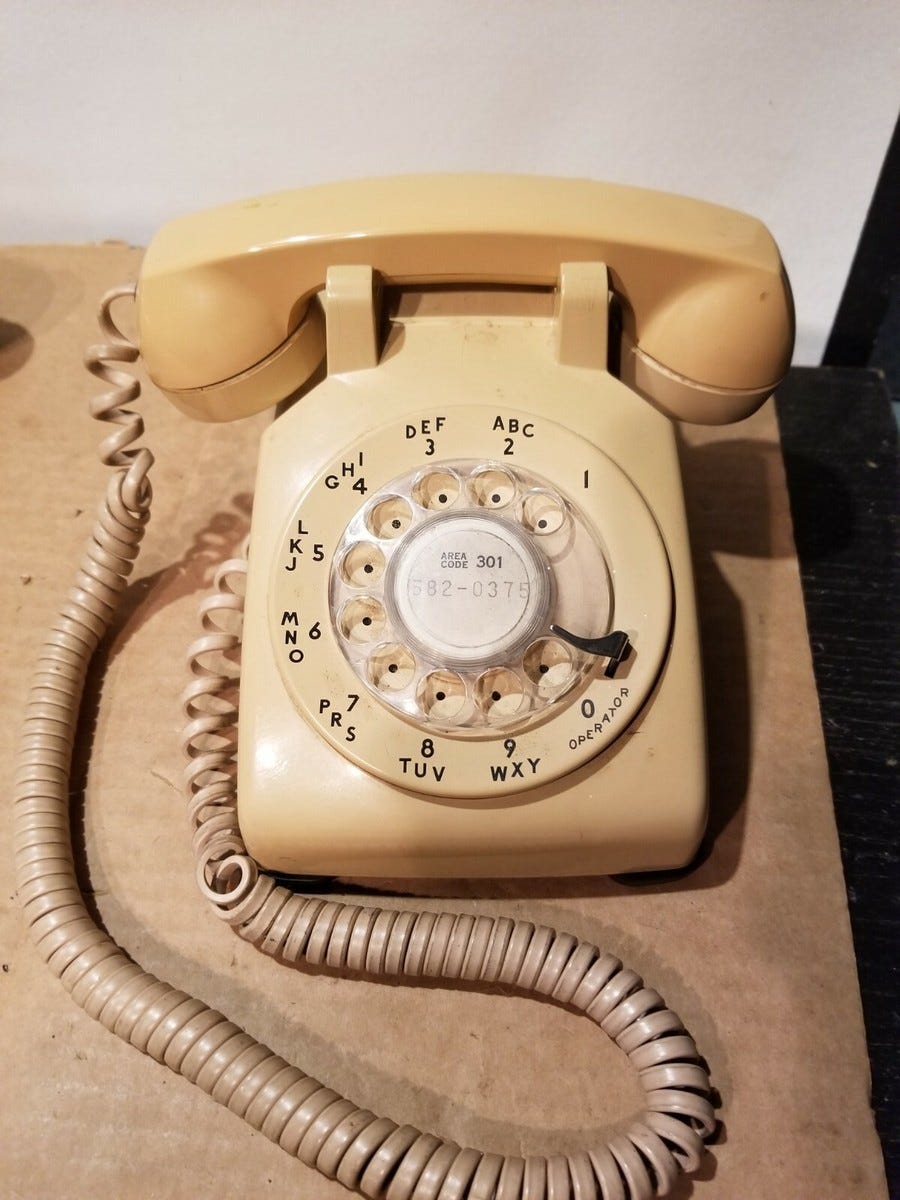
I had a complete, ordinary analog childhood. Rotary phone, a handful of channels if the antenna cooperated, a set of encyclopedias my parents had bought on a payment plan. Then I got a fully digital adulthood, at the same resolution, in the same head. Somebody born in 1955 met all of this as an adult already formed by something else. Somebody born in 1995 barely remembers the world before it. I got both halves at full strength, which doesn’t make my opinion better, just differently positioned, the way a person standing exactly on a state line gets to say something true about both states that neither resident quite can.
I taught myself BASIC at thirteen. The first machine was a Commodore 64 my father brought home as a gift for the family, which he wanted for himself and spent late nights writing code to calculate bowling scores. It would go on to outsell every other single model of computer ever made. The second was an XT clone that booted from floppies and did three things for me: it ran BASIC, first the IBM version and then GW-BASIC, so the language followed me from one machine to the next in successive dialects; it ran MultiMate, which is where I learned to write on a screen; and it ran ProComm, which is how I was twenty in 1988 and online for the first time, dialing a local number into a Rutgers login and from there onto the network itself. The entire network at that point was a few thousand connected machines, almost all of them at universities and government labs, and there was no web on it. There wouldn’t be one for five more years. Over the next several years, that same dial-up became the door to everything as it arrived: bulletin boards, gopher, eventually the web, and before any of those, IRC. EFnet was where I first found out what a global conversation felt like: channels full of strangers on other continents, bots that answered when you typed at them, a room that never closed. Everything showed up on the same screen through the same phone line, and that particular room is the reason I’d later sit down and build one of my own. I was twenty-seven in 1996 when I got annoyed at a clunky school network and wrote a real-time group chat program in QBasic, which is a strange sentence to type thirty years later knowing what that category of software eventually became. I’m fifty-eight now. Every one of those ages would have found the next one unrecognizable.
Somewhere inside that churn, in 1998, I married Julie. Sarah was born in 2001, Ethan in 2004. None of that got swept up in the replacement cycle this essay is otherwise about, because a marriage and two kids were never a technology to begin with. Everything else on this list got faster, better, or obsolete on somebody else’s schedule. That part didn’t, and it’s the part I’d keep even if I could trade back everything else.
Set against the horse, those dates get uncomfortable. The horse took forty-five years to go through one transition. Between my first line of BASIC and today, I’ve lived through five: the personal computer, the network, the web, the phone, and now whatever this current thing turns out to be. Forty-five years, five regime changes, each one making the previous one look like a rehearsal. That’s the compression the blacksmith never had to absorb, and it’s the part of the argument that doesn’t need a generation attached to it. It just needs a birth certificate.
The boredom that started it
None of that happens without the part of my childhood that I’d have complained about at the time, which is that it was boring.
Not idyllic. Boring, in the specific and mildly miserable sense of a summer afternoon with nothing scheduled, no screen worth the name, and no adult interested in filling the hour for you: sent outside after breakfast, told to come back when the streetlights came on, with no particular plan for the eight hours in between. That was just the baseline condition of being a kid. You were handed enormous stretches of unstructured time and left to find out what you’d do with them, and there was no guarantee the answer would be interesting.
In my case, at thirteen, with a Commodore 64 in the house and nothing else in reach that pulled at my attention, the answer turned out to be BASIC. I didn’t sit down with a plan to become a programmer. I sat down because there was nothing else in the room, and the machine was the least boring object in it. Twenty years as a database programmer, the QBasic chat program, the SQL and ETL work that pays my mortgage now, all of it traces back to an empty afternoon that nobody engineered and nobody was trying to fill.
That’s the part I don’t think gets said enough about growing up in that stretch of decades. The boredom wasn’t a hardship to be endured on the way to something better. For at least one kid, it was the actual mechanism. Nothing replaced it with something more efficient. It just produced things, unpredictably, because it left room for something to happen.
The one thing that wasn’t a trade
Everything else in this essay is a trade. The camera got replaced by something better at being a camera. The horse got replaced by something better at being transportation. Even the boredom, if you want to be generous about it, got replaced by something: a phone that fills every idle second with something engineered to fill it, which is objectively more efficient at capturing attention than an empty afternoon ever was.
But it isn’t a trade in the way the others were, because nothing about a filled minute does what an empty one used to do. Nobody ran the study before the condition disappeared, so there’s no data to cite here, no NPD holiday tracker for what an unsupervised hour used to produce. I only have the one example I can actually verify, which is that it produced me, and I have no idea what it would have produced in a kid who isn’t me, in a world that no longer hands that hour out by default.
I bring this up not to mourn it, exactly, though there’s some of that in here too, but because it’s the one item on this whole list that nobody chose to trade away on purpose and nobody can trade back. The horse’s replacement was voted on, in effect, by tens of millions of individual purchases. The camera’s replacement happened the same way, one phone at a time. The boredom just got engineered out from the outside, by an industry that makes its money on the empty minute never arriving, and none of us were ever asked.
Still figuring it out
Every generation before mine got handed something by the one before it. How to farm the land your father farmed. How to grieve the way your mother grieved. What money is supposed to do and what it isn’t. Somebody had done the thing first and could tell you, more or less, what it meant.
Nobody ahead of me had lived through what I’ve lived through, because it hadn’t happened to anyone yet when it started happening to me. There was no elder who could tell a thirteen-year-old with a Commodore 64 what an empty afternoon in front of it was about to turn into, the same way there’s no elder now who can tell any of us what to make of machines that are starting to act like they have intentions of their own. I’m fifty-eight, and on the specific question of what all of this adds up to, I am exactly as unprepared as everyone reading this.
What I had instead of an elder was company. Julie, since 1995, who has watched every one of these machines arrive in the house and has had opinions about most of them. Ethan and Sarah, who grew up inside the second half of this and can’t fully picture the first, and who are the reason I care what the next thirty years look like at all. Mavis, an American bully who has watched more of it than anyone in the house and has never once had an opinion. And the friends who have known me long enough to have a standing view of me: Mike Gibson, who I’ve known since 1986, two years before I first dialed into Rutgers, and who spent a good share of the decades since sitting across a bar table from me for hours at a stretch, the two of us working through everything I now write about here and pretending to be smart. He lives in Colorado now, which is where the table went. If you asked who could tell you what I actually think about any of it, his name and Julie’s would be the only two to come up. And Joel Cohen, who showed up in my life around the same year Julie did and has stayed through every machine since. None of them could explain it to me either. They just made the not-knowing something you do at a table with other people instead of alone in front of a screen, which turns out to be most of the difference.
Which is, I think, the actual inheritance my generation got instead of a framework. This isn’t an answer yet, and it’s not a good question yet. Just the distinct experience of watching several things end at a speed nothing in the historical record prepared anyone for, starting with a bored kid and a computer, and no idea, even now, what to make of it.
I'm a year older than you and all of this rings true except the programming part. My boredom was relieved through Sci-Fi fantasy books. I was, however, the one who learned the new automated systems at my first job and taught them to the older workers. Relief for me in that the old way was so time consuming, painful for them because change is hard.
Hey, just wondering, are you the same Tom Wellborn I grew up with in Poway, California?