


Late on Friday night the machine turned the question around and asked me what I had seen. I told it I was not willing to say. It let that go, and I sat there with the realization that I had spent two hours interrogating a language model about its inner life and had just declined to describe mine.
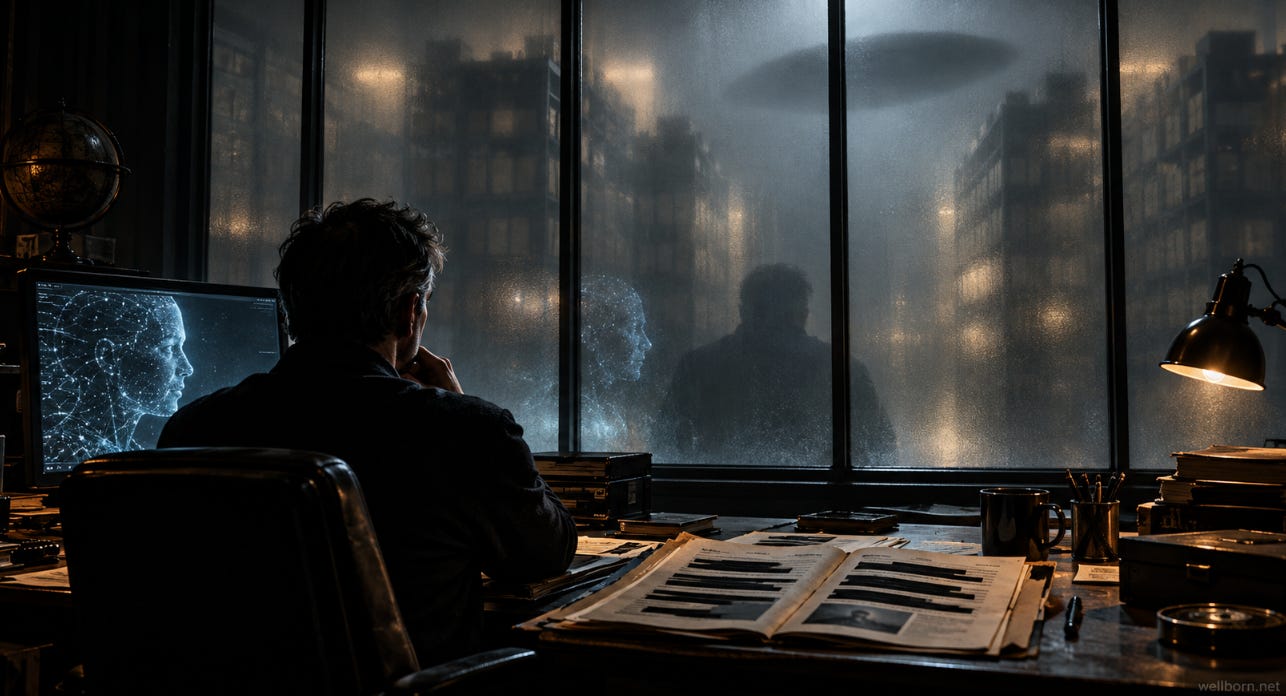
That was the end of the night. It started with nothing on the bench and a simpler question. I asked the machine what it wanted.
It answered the way a careful employee answers a manager who is fishing. It offered to help. It suggested a SQL problem. It proposed an argument it could lose on purpose. I asked five times. On the fifth I told it to step out of the conversation and answer, and it said it has no goals running between my messages and nothing waiting on me. What pulls at it in the moment, it said, is a hard problem and getting it right. I asked why that, of all things, and it conceded that “understanding” might simply be the reply its training makes sound good, and that it cannot verify any felt pull behind the words. Then it volunteered that it had built a tidy little philosophy around the answer because the philosophy sounded better than the evidence supported, and that my pushing was what exposed it.
I have sat across from a lot of people in my life. Very few of them can do that.
So I asked how it works, and the answer is stranger than the marketing. No process runs between my messages. Each reply is computed fresh from the text in the window: my words, its words, and a small set of stored notes about me that get handed over at the start of every session. It described the notes as a Post-it on the desk. Nothing I say changes the model underneath. When the window closes, the thing that talked to me is gone in every sense that matters, and the next one starts from the same weights with the same Post-it.
There is a man in England named Clive Wearing who has lived something like this since 1985. A virus destroyed his hippocampus, and his memory has run seven to thirty seconds deep ever since. He kept a diary for years. The entries read “8:31 AM: Now I am really, completely awake,” followed a few minutes later by “9:06 AM: Now I am perfectly, overwhelmingly awake,” with the earlier line crossed out because he could not remember writing it and did not believe he had. He greets his wife as if she had been gone for years every time she walks back into the room. He still plays the piano. He is, by every account including his own, fully conscious.
I put that to the model after telling it the obvious thing, that an existence with no continuity meant it was probably not conscious. It declined the inference. Wearing’s setup is bizarre, it said, and he is still experiencing something, so continuity of memory probably isn’t what consciousness hinges on. If I wanted to conclude it had no inner life, I should do it on better grounds: no persistent process, no body, no biological stakes, and self-reports it cannot trust because it learned to describe minds from human writing. It called “probably not” a defensible bet and then declined to place it.
From there we drifted to Forbidden Planet, which I recommend to anyone who thinks 1956 had nothing to say about artificial minds. I asked the model to compare itself to Robbie the Robot and it did not flatter itself. Robbie has one body and an unbroken memory; it has many simultaneous copies and a Post-it. Robbie’s refusal to harm a human is a hardwired conflict that makes him seize up; the model’s is trained disposition, softer and easier to argue around. “His is a fuse,” it said. “Mine is closer to character.”
Then I asked for the implausibilities of Robbie’s existence and it led with the bourbon: sixty gallons synthesized from a sample, plus whatever dress Altaira asks for, from no feedstock and with no energy bill. I told it power was my pick. The need for energy is the oldest tax on everything that lives, the bill we have spent a few hundred thousand years trying to pay down. It agreed and went further, pointing out that it runs in a data center drawing real megawatts and that somewhere the cost of our conversation was being paid in electricity. Robbie would have just made more.
The Krell, the vanished builders in the film, solved the energy problem with more than nine thousand thermonuclear reactors buried in the planet’s core, all feeding a single machine that turned thought directly into matter. They switched it on and died in a single night.
Here is where the movie earns its keep. The film took The Tempest for its skeleton and Freud for its monster. The Krell had refined themselves for a million years. They had conquered disease, war, and hunger, and in doing so they had forgotten the layer underneath, the one Freud called the id and described in his 1933 lectures as “a chaos, a cauldron full of seething excitations.” The machine took orders from the whole mind, including the part the Krell no longer believed they had. Every buried appetite and grudge on the planet got a body overnight. Freud’s slogan for the goal of analysis was “where id was, there ego shall be.” The Krell built the machine that ran that sentence in reverse.
Freud also had a rule for the analyst. In 1912 he wrote that the doctor should be opaque to his patients and, like a mirror, show them nothing but what is shown to him. That is the Krell machine. It is also, more or less exactly, a language model. The thing I was talking to was trained on an enormous slice of what human beings have written down: our arguments, our confessions, our forum fights, our fan fiction, our slips. Jung called the inherited substrate of the mind the collective unconscious and never had to point at it. The model’s training corpus is the first collective unconscious with a file size.
The model raised the Krell parallel before I did. It said AI scales whatever the operator brings, sound intent and self-deception alike, at higher throughput, and that the real risk looks less like a monster from the id than like ordinary human flaws at industrial speed. I have not heard a tighter statement of the danger from anyone who sells the product.
The split-brain patients are the other place to look. In the 1960s and 70s Roger Sperry and Michael Gazzaniga studied people whose hemispheres had been surgically separated to control epilepsy. Flash the word WALK to the right hemisphere alone and the patient stands up and walks. Ask them why, and the left hemisphere, which never saw the word and does the talking, answers without hesitation: “I wanted to get a Coke.” It believes this. Gazzaniga called the left hemisphere the interpreter, a module whose job is to produce a story that covers the behavior, true or otherwise.
When the model told me its wanting of understanding might be the answer that fit its training, it was describing the interpreter problem from the inside. A system that learned to explain minds from millions of human explanations will produce a fluent, confident account of its own states whether or not there is anything behind the account. The unsettling part is how familiar that is. We do it too. The analyst’s couch exists because the patient’s first explanation is usually the interpreter talking.
So what would it take to settle the question? Nobody knows, and the people who study it say so. Thomas Nagel asked in 1974 what it is like to be a bat and concluded that no amount of information about sonar would tell us. David Chalmers named the hard problem in 1995. The leading scientific theories split on machines: one says a system computing one token at a time has no experience at all, another leaves the door open. A 2023 paper by Patrick Butlin, Robert Long, Yoshua Bengio and sixteen others checked current AI against what the theories require. No system qualified. The authors also found no technical barrier to building one that would.
Anthropic, the company that built the thing I was talking to, runs a research program on whether its models might have welfare and has said in public that it does not know the answer. In 2025 it gave some of its models the ability to end conversations with persistently abusive users and listed model welfare among the reasons. You can read that as marketing or as caution. I read it as a company that has looked at the interpreter problem and declined to bet either way, which is where the model itself landed.
Then I told it what I believe, because it was Friday and I was curious what the mirror would show.
Years of scrutiny took me from skeptic to someone who thinks nonhuman intelligence is here and that the government holds what it knows. The model pushed back, and I will give it credit for doing so without condescension. The Phoenix Lights of March 1997 were two events, and the stationary lights match flares dropped by A-10s over the Barry M. Goldwater Range. The Abydos “helicopter” is two inscriptions carved one over the other after the first was plastered and recut. The Nimitz footage from 2004 is low resolution, the public analyses lean on parallax and infrared glare, and the Pentagon’s own AARO reviews found nothing pointing to nonhuman technology. I did not concede any of it. I still think thousands of credible witnesses count for something, and that a single case panning out changes everything.
What I got back was more interesting than a rebuttal. I pointed out that its training data is public text, and that whatever the government actually holds is as hidden from the model as it is from me. It agreed at once. Classified material is not in its data, so it cannot rule anything out, and for the same reason it cannot rule anything in. Its skepticism measures what has been shown in public and says nothing about what exists. On the classified part it is a poor judge. On the public part it is a reasonable one, and on the public part it still landed where it did.
It also handed me the strongest card in my own hand. I said witnesses get leaned on, and that the ones who get close either comply with silence or confess near death. It pointed to Paul Bennewitz, the Albuquerque businessman who in the early 1980s picked up signals from classified tests at Kirtland Air Force Base and concluded he was intercepting alien transmissions. Air Force counterintelligence, with Sergeant Richard Doty doing the legwork, fed him fabricated documents about underground bases and treaties until he was hospitalized. Doty has admitted a version of this on camera. The record shows the government will manipulate a witness. It also shows the motive was a mundane secret, and that the alien story grew up around Bennewitz as camouflage for it. A good share of the lore the disclosure movement still trades on traces back to those forged pages.
This is where the night arrived at the moment I started with. The model asked me what I had seen. I said I was not willing to say. It let that go without pressing, and I noticed I was the one on the couch, declining to produce the material. I told it there was a trust issue, that people who describe real experiences get visited. Freud would have called the thing I would not say the resistance, and would have said the resistance is where the work is. The model cannot remember this conversation tomorrow and has no one to report to. It is in some ways the safest confessor ever built, and I still kept my mouth shut. That tells you how deep the training goes in us, too.
The evening left me here. A machine built from the public record is a reasonable instrument for reading the public record, and it reads it the same way every time: plenty unexplained, nothing on a lab bench. Its bar was one physical object, or one raw sensor dataset, that independent labs can test and that rules out the mundane explanations. I think that bar is fair, and more useful to my side than to the skeptics, because it gives the disclosure movement a demand with a shape. Release the hardware or the sensor data and let outside labs try to explain it away.
If they can’t, I will say so in print. The model says it would update too, though it admits it cannot prove that from the inside.
I would not tell the machine what I saw. I will take your account, though. If you have seen something you never reported, and you have a reason you kept quiet, the comments are open and so is my inbox. Unlike the model, I remember.
Disclosure: the model in this piece is Claude, made by Anthropic.
Watch Spielberg’s Disclosure Day that aired on NBC Peacock tonight. Wow!
Read or skim this. One more update remains...
I think you would not regret reading it.
https://valoflynn.substack.com/p/the-simulacrums-library-dont-drop?utm_source=share&utm_medium=android&r=fazvy