


Written by Tom Wellborn and Mike Gibson.
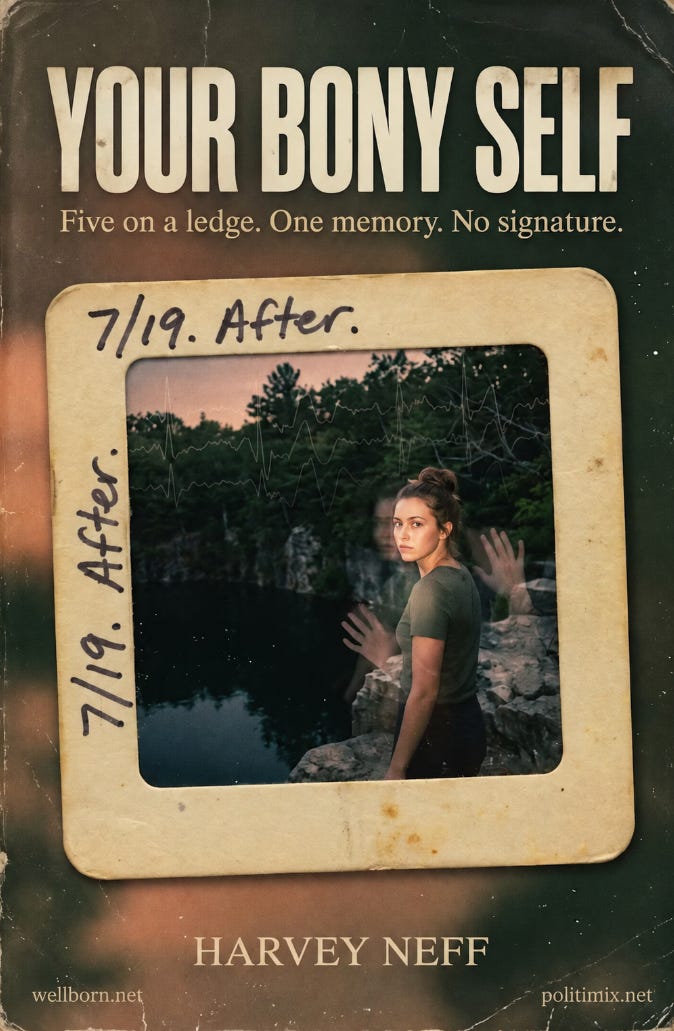
I. The Lawn
When you meet your bony self, it’s quite the realization. All those years of anatomy, doctors, splints, and casts flash over your eyes, or sort of in the background, to a soundtrack of a Beatles song. All the times you thought a muscle was an organ, playing underneath, a simple ditty that turns out to be a little bit of Chopin. A Nocturne. Creeping in from the sides like an army in North Africa. When you meet the earth’s bony self, you remember just how small humans are. You can feel the ground beneath your feet shifting around in its casket. Crumbling. You feel light as a feather as you slam into the ground. Imagine your own little skull the first time it peeped out of your mother. Whaaa! What the hell is this? And on and on until you get to “pass me that ashtray,” and Heel leans toward you with a guitar cradled in his lap. Which is odd, because you can’t play guitar that way unless you’re a Beatle on acid. But he isn’t playing. He’s pontificating.
“What if Bin Laden hadn’t died? How do you know he’s not on a satellite up there right now, laughing at us?” Heel strummed the unconnected guitar. It was obvious he had no idea what he was doing. It wasn’t his; it was an ash-colored Strat that belonged to another dude. Heel didn’t play much. Heel didn’t do much. Heel was what a continental European would call an Indigo Child. Don got up out of the loveseat, which was set up next to the couch Heel was lying on, all of it on the front lawn of an old building that had obviously been updated multiple times, in a small town in the burgeoning country that was America.
“Well, we’ll see the pics soon enough anyway,” Don mumbled as he got up and walked toward the house. “One way or another, whether or not the doctor releases them, we’ll see ‘em.” He glanced back at Heel, who was struggling to wrap his fingers around the neck of the guitar. It was the exact same scene he’d seen almost thirty years ago.
“It’s good to see some things never change,” Don bellowed as he skipped up the lawn, eyeing Neff, who had just slipped out onto the porch.
“Nothing changes. You just forget where you put everything,” said Neff with a snort. He lit a cigarette.
“Change chaNGE CHANGE!” hollered someone from deep within the house. Don looked past Neff at the girl on the next block, who was washing her car and had gotten her jeans wet in some suggestive places. Out on the couch, on the front yard, Heel strummed into a lengthy rhythm that put the lie to Don’s assumptions about how Heel had spent the last few years.
Heel sang out, “When you meet yer bony self, it shouldn’t be such a surprise, he was with you all along and the rest was just lies lies lies,” at which point Don thought: Did I say anything about my bony self out loud? I don’t remember it that way. How did Heel just happen to land on that particular song? But a blast from inside the house distracted him from this distraction. A blast that sounded like a shotgun, except that none of them owned any actual firearms. As far as he knew.
Neff jumped right off the porch, landing like a twelve-foot-long cat somehow, balancing his smoke perfectly all the while. Heel stopped strumming and his head popped over the back of the couch with a WTF look on its sack-around-a-slimy-baseball face. Don stood his ground. Everyone waited. There were no more noises from the house, no puff of smoke like everyone expected, no sign of life at all. Don thought about smoking a cig. Heel put that other guy’s guitar down on the couch next to him. Neff coughed as he tried to smoke and speak at the same time. Behind them all, facing the house as they were, a car careened to a halt at the curb. They turned to look at it. Torney, wearing a black Tool shirt and black jeans, popped out of the early-aughts car and looked up at them looking back at him.
“So what’s up, boys? You look like you’re gettin’ ready to paint that house black. Or red.”
The other three just turned toward the house, where one of those medical-model full-size skeletons was poking out of the basement entrance, off to the side of the porch. The skeleton jiggled.
“I am the ghost of Bin Laden!” it seemed to shout, “and I have come for your daughters and your sons, for your daughters can cook and make soldiers and your sons can have sex with me! Buwhahaha!” And then the skeleton fell backwards and they all heard Johnny hit the basement floor. A minor dust storm popped out of the basement entryway.
Nobody went down to check on him. Nobody ever did. Don stood on the lawn with the sun on the back of his neck and thought, for no reason he could have named, about a quarry, and about the word he had written on a piece of cardboard thirty years ago with a felt pen, and about the fact that he had given the boxes to Neff on Thursday and Neff had not said a word about them since, and that Neff had been on the porch just now with the look of a man who has not slept and has found something in a box. Don knew the look. He had been waiting for it since the Clinton administration.
Out on the couch Heel had picked the Strat back up and was playing, very softly, the thing Don was thinking.
II. The Slides
Dr. Harvey Neff wiped his eyes as he again turned away from the stream of memories. He crushed out an already extinguished cigarette and glanced at the clock. Five hours had gone somewhere since he’d started poring over the fifteen-something shoe boxes full of slides, pictures and negatives that lay scattered over the table before him. This wasn’t a task for the weary or faint of heart, apparently.
Of course the sun was coming up. Of course it would be another night of only three or four hours of sleep. Neff was perched, sitting, on the side of his bed, staring intently out the window toward the sunrise. Sparse sunbeams fought with the clouds to present slivers across the rug of his room. Neff wasn’t anywhere nearby to enjoy it. His mind remained transfixed on his trip into the past.
It had been the camping shots that really started him reeling backwards in his head. The scenes were in Vermont, where he and a group of friends had gone a few summers in a row. The year didn’t matter, though, nor did most of the friends he had recently remembered. In a dream he’d replayed the scene with the disappearing body, its clear blue eyes rolling back, as if to look down the ledge behind it as it tumbled into the quarry. Later, Johnny had sworn he’d only hallucinated this scene. But every few years it did what it had done yesterday: replayed in Neff’s dreams with all the same details. A specific memory, in his opinion, and no hallucination. The body had never been recovered, so by now it hardly mattered. And the result for Neff had been a positive one: he’d stopped taking hallucinatory drugs and gone back to college, earning a medical degree based on his research into the human brain, perception and memory. For a long time he avoided that kind of drug. He’d needed all the brain power he could muster anyway for his studies. But then he started again, and ended up having a long stretch where he was more creative and productive than he’d ever been. Then things turned sour, and eventually things just rotted around him. The hallucinations became semi-permanent. The light of the sun became unbearable. His phone rang and told him his friends were dead over and over. He heard reports of their deaths on the radio. But they were all just fine. And he no longer was.
That was the version for the licensing board, and for the two reporters who had called in 2019, and for himself on bad mornings. It was true as far as it went. What it left out was the chair.
The chair was in the basement, under the house with the skeleton, in the room Johnny didn’t go into. Neff had built it in the productive years, out of a dental recliner, a hospital surplus EEG cap, a peristaltic pump, and about nine thousand dollars of equipment ordered under the name of a neurology practice that had existed for exactly as long as the orders took to ship. The literature had a word for what the chair did, and the word was reconsolidation, and the literature was very clear that reconsolidation was a thing that happened to rats. You cue a memory. For a few hours after the cue the memory is chemically soft, written in pencil, and in that window you can read it closely, or you can alter it, or, if you have the compound, which the literature did not have and Neff did, you can find out whose hand it was written in.
The compound was the thing. He had made it the first time at twenty-two, in a kitchen in Burlington, from a paper in a Hungarian journal that he could not read and had translated with a dictionary, because the abstract had used a phrase that stopped him on the library stairs. The phrase, in his translation, was the boundary condition of the self in encoded experience. He had taken it to mean that a memory, when it was laid down, got a signature on it, a mark that said this is mine, and that the signature could be loosened. He had been right about that. What the paper had not said, because the Hungarians had only ever given it to one subject at a time, was what happened when five people took it together and then had an experience that mattered.
What happened was that the experience didn’t get five signatures. It got none. It went into all of them unsigned, like a letter that arrives at every house on the street, and for thirty years each of them had been reading it and believing it was addressed to him.
He knew this now the way he knew the structure of the hippocampus. He had proven it in the chair, on himself, in 2016, in a session he had no clear memory of, which was the point. He had put a slide in the viewer, a nothing slide, Heel on a picnic table in 1994 holding a beer, and had cued it, and had gone under, and had found, inside the memory of Heel on the picnic table, the taste of the beer. He had not drunk the beer. Heel had. He had found Heel’s tongue in his own head, and had sat in the chair afterward for an hour with his hands shaking, because it meant the thing he had suspected since the first reunion, when Heel had sung a line of a song that existed only in Don’s head, was simply true. They had been leaking into each other for thirty years. They called it déjà vu. They called it a weird feeling. Torney, who had it worst, called it the universe mocking him.
It also meant something about the ledge, and he had known that too, and had not gone looking, for ten years, because he was a coward, and because the memory of the ledge was the one with his own name on it, in his own hand, and he had built a career and a ruin on the assumption that the hand was his.
Don had given him the boxes on Thursday. Fifteen boxes, every summer, every slide. Don had carried them up the porch steps himself and set them on the table and said, “I think you’re ready,” and left, and had not explained, and Neff had understood that this was the kindest thing anyone had done for him since Ruth had taken his pulse on the ledge, the summer before the last summer, when he had thought he was dying from something he’d made, and she had held his wrist and counted and said “You’re fine, Harvey. You’re just scared,” and had been right.
He had spent five hours with the boxes. He had been working toward box eleven the way you work toward a tooth with your tongue.
On his answering machine he saw he had a message from Torney. This was always a complicated proposition. The man had always been a good friend, but certainly tried everyone’s patience at times. The women, the slipping through the cracks. Most of his circle was somewhere between disdain for him and jealousy. Envy charged their critical comments even when they were making reasonable points. But Neff kept those observations to himself. Or so he believed.
He did not play the message. He picked up box eleven and went down to the basement.
III. Torney’s Morning
Martin Torney was having a very bad day. It wasn’t as if the universe ever granted him any favors, but this particular day was beyond ridiculous, and of course he had nobody to blame but himself. What the fuck else was new?
After sucking down a stale cup of rancid coffee, popping three aspirin, and murdering his wife again, which he did most mornings now, in the four seconds between waking and remembering, Martin sat on the edge of his bed feeling rather dejected and wholly disconnected from everything. Shit had gone downhill really fast. Like, seriously fast. Years ago. It just kept going downhill, was the thing. There was no bottom to it.
His day had started like any other. Martin awoke blurry-eyed and peckish, still drunk from the previous night’s gig. Some kind of music was stabbing at his head from the TV in the living room, some awful, mind-numbing repetitive electronic crap against which his entire existence had always railed. Fabulous sunbeams struck through the long windows in his bedroom, offering nothing but more pain inside his rocking skull, kneading his brain into black disgust. He was struggling to recall who was in the next room, hoping it was a whore instead of one of his needy groupies in need of a morning fuck and a fix and “Hey baby, can I get twenty for cab fare after a boot and one more shag on your toilet?”
He tried to recall the events of the previous night. He always remembered the beginning. The partying as the opening band struggled to get the attention of anyone. Whiskey shots, sometimes X, sometimes even H. Last night was an X night and he wasn’t able to recall much past their second set, when his arch nemesis Mr. Blackout whisked his mind away, replacing it with Mayhem Martin, brilliant singer, master and commander of the stage. Giving himself over to this personality reaped the standard rewards of sex, drugs, money, fame. The obvious downside was memory holes and black hangovers from hell. What a sick fucking ride it all was.
Torney’s wife had never really wanted any part of this lifestyle. She’d been enthralled to be linked to a musician and singer at first. They always were. They were only in their mid-twenties at the time, after all. She’d played along like a champ, apparently. She’d just started nursing school and all the talk was about how her steady career could carry them through the uneven career of a musician. The equipment she’d buy him, the touring she’d do with him, the life of freedom they could live. She partied right along with the bandmates and their women, even tolerated the groupies and whatever Heel dragged around that was worse. And he’d stayed faithful to her, the first woman he’d really ever done that with. But sometime during her third year, she’d suddenly started pushing a grown-up agenda. Settling down had to be part of the plan, owning property to secure their futures, planning for kids and college for them, all the crap Torney had never wanted. The worst part of this whole change was that Torney realized he loved her deeply, like he never had before for anyone else. This made his first instinct, to just cut her off and out as usual, much harder than he’d expected. Naturally, he started doing even more drugs, and his music turned angry. Angry enough to frighten her. This drove the pitch of their arguments straight up through the roof, even as he became less coherent on the drugs. Mayhem Martin rolled right up to the front, and he started pretending to her that his work was all that mattered, that he no longer loved her. Perhaps he could never love again. He played the martyr very well.
Inside his head, he just switched between Roger Waters on The Wall, Trent Reznor on Broken, and Charlie Manson. Of course, he never actually thought that he would behave like Manson. Nor could he have guessed that killing by proxy would be the biggest and baddest rush he’d ever had. All the warnings in movies and books could never tell you what you’d feel after you’d done such a thing. What you expected was guilt, recrimination, repentance. What Torney got was an exaltation, and an excuse to do more drugs, trying to wipe away the tiny fragment of guilt that did occur in him. Self-recrimination he wiped away with Manson’s reasoning: they did something to him, they deserved something back from him. Even if, or perhaps especially if, what they’d done was dare to love him. Repentance he had no time for. No great authority in the sky, no need for shameful regret.
He had learned that although he could write songs of all kinds for his fans, describing their feelings and experiences in minute and intimate detail, he himself was a cavernous hole in the earth with only the slightest veneer of human caring covering the hole. Like a woman on a ledge, she had ended up standing on that flimsy veneer, blue eyes shining bright with fear and hope. His friends and family could only be allowed to see that veneer. All of his friends claimed to be in touch with their dark side, but he doubted that any of them had really explored it the way that he had. Except for Neff, maybe. Hallucinatory drugs had finally taken a part of Neff’s great intellect, and he had become less sane, to all appearances, than Torney himself. Of course, they did the expected dance continuously: when both parties are closer to insane than most, which of them decides who is the more sane? At the very least, Neff had become less capable of hiding his madness than anyone else in their circles. Which is why Torney had finally used him, that summer in Vermont, to remove a great obstacle in his life. A beautiful, complicated, demanding and loving five-foot-three gremlin.
That was the version Torney told himself. He had been telling it for a long time. Lately he had started to notice that the telling had a shape to it, the way a song does after the four hundredth show, and that he could not remember, any more, whether the shape had come from the night or the night had come from the shape.
What he remembered, when he let himself, which was never on purpose and always in the four seconds, was this: the ledge, the evening, the quarry gone copper under them, Ruth with her back to him and her hair up, looking down, and his two hands coming forward into the frame of his vision, and the small of her back under them, and the give. The give was the thing. The way a thing you’re pushing against stops pushing back. He remembered that in his palms. He had remembered it in his palms for thirty years, on stage, mid-song, in the four seconds. He had never once questioned whose palms.
The thing that was different about this morning, the thing that made it beyond ridiculous, was the phone. He had called Neff at four, drunk, from the parking lot of the club, and had said into the machine the thing he had never said to anyone, and had hung up, and had driven home, and had slept, and had woken, and had done the four seconds, and had remembered the call. The universe, which had spent thirty years sending him songs on the radio and the slant of light through a window at the hour she used to come home, had finally sent him his own voice, on Harvey Neff’s answering machine, saying I think it was you, Harv. I think I’ve been carrying yours. I think you’ve got mine.
He had no idea what he had meant by it. He had meant it completely.
He put on the Tool shirt because it was on the floor. He drove to the house. On the way there, on the radio, a song he had never heard came on, a woman’s voice over a piano, and he knew every word, and he had never once in his life heard it, and he turned it off and drove the rest of the way with the window down, in silence, with his palms on the wheel, feeling, for the first time in thirty years, nothing in them at all.
IV. The Basement
The chair had its back to the door. Neff was in it. He had been in it for forty minutes, with the cap on and the line in and box eleven open on the tray beside him, and he had not yet put the slide in the viewer, because he was afraid of it, and he was fifty-four years old, and he was tired of being afraid of a piece of cardboard.
“You gonna do it or you gonna sit there,” said Johnny, from the dark by the furnace.
Neff did not turn around. Johnny had been in the dark by the furnace for most of thirty years. He had a cot there, and a lamp, and a shelf of paperbacks, and a job three days a week at a hardware store that did not know his last name, and he came up for the reunion weekends and did the skeleton bit because it was expected and went back down. Nobody asked him why. Nobody had asked Johnny anything since 1996, because Johnny had been the one who went down to the water, and had come back up the path twenty minutes later while the rest of them were still screaming on the ledge, and had said, in a voice none of them had ever heard him use, “There’s nothing down there,” and had kept saying it, through the police and the divers and the two days of dragging and the thing in the paper, until it was the official version, and then had stopped saying anything at all.
“I’m going to do it,” Neff said.
“Which one is it.”
“The ledge. Don wrote on it.”
“Don wrote on all of them.”
“He wrote ‘after’ on this one.”
Johnny was quiet for a while. The furnace ticked. Somewhere above them Heel was playing the Strat, badly, and then well, and then badly again, which meant the thing that was in the room with the two of them was leaking up through the floorboards and Heel was picking it up and putting it down.
“You know what you’re going to find,” Johnny said.
“I know what Torney thinks he’s going to find. He called at four. I didn’t play it. I didn’t have to; I could hear him thinking it from the driveway. He’s figured it out. The pool. He doesn’t have the word for it but he’s got the shape.” Neff turned the slide over in his fingers without looking at it. “He thinks he’s been carrying mine and I’ve been carrying his. He thinks I pushed her and he watched.”
“And what do you think.”
“I think that’s probably right. I think that’s what the chair will say. I think I’m going to go in there and feel her back under my hands and the give, and come out, and know, and that’ll be that, and I’ll have been a murderer for thirty years and not known which one I was.”
“That’s not what you’ll find,” said Johnny.
Neff turned around then. Johnny was sitting on the cot with his elbows on his knees. He had the face he’d had since the water, a face like a door somebody had closed carefully from the inside.
“You never took it,” Neff said. “That summer. You never took anything.”
“No.”
“So you’ve got the only one that’s yours. The only clean copy.”
“I’ve got what I saw. I don’t know what you’ve got. I’ve never known what any of you have got. You all came back from that ledge with four different nights in you and I had the one, and mine was the one nobody wanted, so I kept it down here.” He nodded at the viewer. “Go on. Put it in. Then come find me and tell me what the chair says, and I’ll tell you what I saw, and we’ll see which of us is crazy. That’s the game, right? Torney’s game. Which one of us gets to decide.”
Neff put the slide in the viewer.
The ledge. The quarry gone copper. Ruth standing at the edge with her hair up and her back three-quarters to the camera, turning, looking at the lens with an expression Neff had never seen on her and would have called, if asked, decided. Torney behind her, blurred, both arms down. Heel out of frame. And off to the left, in focus because the camera had been on him the moment before, Harvey Neff at twenty-four, ten feet from anyone, with his hands in his pockets, watching.
The cardboard mount, in Don’s square felt-pen hand: 7/19. After.
He pushed the plunger and cued it and went under.
What he expected was the back. The small of a woman’s back under two palms, and the give. He had carried it for thirty years as his own, and it was there, right where he’d left it, and in the chair, with the compound loosening the ink, he read the signature on it for the first time, and it was Torney’s. He had known it would be. He felt the relief of it go through him like cold water, and then he felt the cold water, and it was not a metaphor.
It was underneath. Under Torney’s memory of the push, under his own memory of standing with his hands in his pockets, there was a third thing, and it had been there the whole time, filed where he had never looked, because he had labeled it, at twenty-four, in the first terrible week, drowning, and had never once opened a thing with that label on it.
It was from the water.
Forty feet of quarry water, cold, going dark, and up above, through the surface, a ledge full of screaming men getting smaller. Lungs. The decision to kick. The far wall of the quarry, the part nobody went to, where the old cut left a shelf a foot under the surface. A hand on wet stone. Another. The cold air on a wet face. And at the waterline, six feet away, close enough to touch, Johnny’s face, white, with his boots in the water, looking at her.
Looking at her.
Neff was in Ruth’s memory. He had been carrying Ruth’s memory of her own death for thirty years, under the two men’s versions of it, and it was not a memory of death.
She looked at Johnny and Johnny looked at her, and something passed between them that the compound rendered with perfect clarity and no words, and it was a question and an answer. Are you going to tell them. And: There’s nothing down there. And she pulled herself up onto the shelf, and stood, dripping, in the dark, and looked up once at the ledge where four men she had loved in various ways were screaming her name, one of whom had just put his hands on her back, and she turned, and walked into the trees, and the memory went with her, and kept going, and Neff, in the chair, felt it keep going, the way a radio station keeps going after you’ve driven out of range, faint, still there, still broadcasting.
She was alive.
She had been in the pool the whole time. Every song on Torney’s radio. Every slant of light. The phone calls that said his friends were dead, which had not been the pool lying to him but Ruth, somewhere, dreaming the four of them dead and gone the way you dream a thing you need to be true. The pool ran both ways. It had always run both ways. And for thirty years the five of them had been dreaming each other, and four of them had thought it was guilt, and one of them had thought it was the only way to survive.
He came up out of it slowly, the way you come up out of water. The basement. The cap. Johnny on the cot with his elbows on his knees.
“Well,” Johnny said.
“You saw her.”
“I saw her.”
“You let her go.”
“I let her go.” Johnny looked at his hands. “She looked at me, Harv. You’ve got that now, I guess. You know what she looked like. She’d just had that done to her by a man she was going to spend her life with, and she’d gone in the water, and she’d come up, and she had the choice, and she looked at me like I was the choice, and I was twenty-three years old and the only sober man in Vermont, and I made it. I’ve been making it ever since. Every reunion. Every time one of you looks at me like I’m the one who’s not right.” He shrugged. “There’s nothing down there. There never was. That’s the only true thing anybody’s said about that night in thirty years and it was me that said it.”
“Where is she.”
“I don’t know. I never knew. She walked into the trees.” Johnny looked at the boxes. “Don might. Don knows things. Don wrote ‘after’ on a slide in 1996 and never said what he meant and gave you the boxes on Thursday. I’d ask Don.”
Neff pulled the line out of his arm and sat for a while with the cap in his lap. Upstairs, Heel had stopped playing. Through the floor, very faintly, he could hear Don’s voice on the porch, saying something to Torney, who had just arrived, and he could hear, underneath it, the thing he could always hear now, the station at the edge of the range, a woman’s voice over a piano, and he understood that he had been hearing it for thirty years and calling it tinnitus.
V. The Dayroom
Don knew. Don had known since the nineteenth of July, 1996. He had been the one with the camera, and a man with a camera is a man who has been looking at the thing everyone else is only in, and what Don had seen through the viewfinder on the ledge on the nineteenth of July was Ruth turning to look at the lens with the face of a woman who had made up her mind about something, a full second before Torney’s hands came up. He had taken the picture. He had written the word on it when it came back from the lab, because he had been there when Johnny came up the path, and he had seen Johnny’s boots, and Johnny’s boots had been wet to the knee, and the path from the ledge did not go anywhere near the water.
He had not said anything. He had kept the slides. In 2011 a woman had written to him, care of the paper that still ran his photographs sometimes, and had asked whether he had a picture from a particular evening, and he had understood from the handwriting who she was, and he had sent her a print, and she had sent back a card with no words on it and a return address, and he had kept the card in the box with the slide, where it had been for fifteen years, and where Neff found it at nine the next morning, after Don had looked at him on the porch for a long moment and said, “Check the box again.”
The address was two hours north. The town was the kind with one road in. The building was a long low brick thing with a parking lot and a sign that said MEMORY CARE in letters that had been chosen by someone who thought the phrase was comforting.
He sat in the car for a while. The station was very loud now. He had been driving toward it for two hours and it had come in the way a station comes in as you drive toward the transmitter, the static falling away, the voice clearing, until by the time he turned into the lot he could hear it as plainly as he could hear the engine: a woman thinking, in no particular hurry, about a man she had taken the pulse of thirty-one years ago, and about the fact that he was in the parking lot, and about whether she would get up from the chair she was in or let him come to her.
She let him come to her.
The dayroom had a television on with no sound and eleven people in it, none of whom were watching. She was at a table by the window with a man who was eighty if he was a day, helping him with a puzzle of a lighthouse that he had evidently been doing for some time and would be doing for some time more, and she looked up when Neff came through the door, and she was fifty-six, and she had the eyes, and she had a nurse’s badge that said a name that was not Ruth, and she said, to the old man, “Arthur, this is my friend Harvey. I’ve known him since I was a girl,” and the old man said, “Is he staying for lunch,” and she said, “We’ll see.”
They sat in a courtyard with a bench and a bird feeder. She did not ask how he’d found her. She knew how he’d found her. She had been in his head for the drive.
“You built a chair,” she said.
“Yes.”
“I felt it. When you went in. Last night. I was asleep and I was in the water again and I thought, well, there he is, finally. Took you long enough.” She said it without rancor. She said everything without rancor. She had the manner of a woman who had spent thirty years with four men in her head and had made her peace with the noise the way people who live by the tracks make their peace with trains. “You know what it’s like? It’s like having the radio on in every room. Martin’s the loudest. Martin is always the loudest. He kills me every morning, did you know that? Four seconds. I wake up in his hands every morning of my life. Don’s quiet. Heel is just songs. And you.” She looked at him. “You’re the one who kept trying to find the dial. I could feel you looking. All those years in that chair, looking for which one of you did it. I kept thinking, Harvey, it doesn’t matter which one. I’m the one it was done to. I’m the only one who was actually there.”
“Why here,” he said.
She looked at the building. “Because they don’t have anything in their heads. Not one of them. Arthur doesn’t know his own name. I come in here and it’s quiet, Harvey. It’s the only place I ever found where I could stand to be, where there’s nobody broadcasting. I’ve been here nineteen years. I’m good at it. I’m the one they call when somebody’s frightened, because I know what it is to have your own mind not be yours.” She took a breath. “And because, if I’m honest, I was waiting. For one of you to get sane enough to come. I thought it’d be Don. Don’s been sane the whole time, he just takes pictures instead of saying things. But it was always going to be you, because you’re the one with the chair.”
“What do you want,” he said, and he already knew, because she was thinking it, and had been thinking it for two hours, and he had driven toward it with the window down.
“I want out.”
“Of the pool.”
“Of the pool. I want one mind, Harvey. I want to wake up in the morning and not be murdered. I want to turn the radio off. You can do it. You’ve known you could do it since you found the beer on Heel’s tongue in 2016; it’s in there, I felt you figure it out. You go into the memory with the person while it’s soft and you cut the signature loose and it stops being shared. It goes back to one hand.” She looked at the bird feeder. “I want to go back to one hand.”
He had known since the parking lot what the price was, because he had been thinking about it for two hours and she had been listening, and so there was nothing to explain, but he said it anyway, because some things you say out loud so they’ll be true.
“It only works from inside. I’d have to go into the ledge with you. And whoever does the cutting keeps what’s cut. It doesn’t go away. It goes to the one holding the knife.” He looked at his hands. “I’d have your copy. All of it. The water, the shelf, Johnny’s face, the trees. Nineteen years of this place. I’d carry it alone, with nobody else in the pool to share the weight, for the rest of my life.”
“Yes,” she said.
“And you’d have nothing. You’d remember that night the way anybody remembers a night. One copy. Yours. No Martin in the morning.”
“Yes.”
He sat for a while. A bird came to the feeder and left. Inside, through the glass, Arthur had found the piece with the top of the lighthouse on it and was holding it up to the light.
“Torney would never know,” Neff said. “He’d keep it. He’d go on thinking he did it. Every morning.”
“He did do it,” Ruth said. “He put his hands on my back. He gets to keep that. It’s the only thing he ever made that lasted.” She said it the way she said everything. “I’m not asking you to take it from him. I’m asking you to take it from me.”
“Why me.”
She looked at him then the way she had looked at him on the ledge the summer before the last summer, with his wrist in her fingers and his pulse under them, a man who thought he was dying of something he’d made.
“Because you’re fine, Harvey,” she said. “You’re just scared. You always were. And you came anyway.”
VI. The Chair
He drove home. Torney was awake.
He was on the loveseat on the lawn with the Tool shirt rucked up and a beer he wasn’t drinking, and he watched Neff get out of the car and come up the walk, and he did not get up, and when Neff was close enough he said, “Where’d you go.”
“North.”
“Was she there.”
Neff stopped on the walk. Torney was looking at his own hands, turning them over, the way you look at a tool you’ve used for years and have just noticed is not the one you thought.
“I felt it go,” Torney said. “On the drive over this morning. Thirty years I’ve had it, right here,” and he held up the palms, “and somewhere on Route 9 it just wasn’t there anymore. Like a tooth. You keep putting your tongue where it was.” He looked up. “I left you a message.”
“I didn’t play it.”
“You didn’t have to.” Torney laughed, which was not a sound Neff had heard from him in a long time. “That’s the thing, isn’t it. None of us ever had to. I’ve been getting the radio for thirty years and I thought it was her haunting me and it was just you guys. All of you. In my head. Every song.” He put the beer down on the grass. “So tell me. You went in the chair. You went north. Which one of us was it, Harv. Which one of us put his hands on her.”
Neff thought about the courtyard. About he gets to keep that. About the fact that the man in front of him had spent thirty years building a self out of a single memory and calling it a dark side and writing songs on it, and that the memory was real and was his and that Neff had carried a copy of it as his own and knew exactly what it weighed.
“What do you want it to have been,” Neff said.
Torney looked at him for a long time. The girl on the next block had finished with her car. Heel, on the couch, was not playing anything.
“I want it to have been me,” Torney said. “I know that’s sick. I know what that makes me. But if it was you, then I’m nothing. I’m a guy who stood there. I’ve been the other thing my whole life, I’ve been it on stage, I’ve been it in every song I ever wrote that was any good, and if you tell me I stood there with my hands in my pockets then there’s nothing left of me at all.” He picked the beer back up. “So. Was it me.”
“It was you,” Neff said.
Torney nodded. He drank. His hands, Neff noticed, had stopped turning over. They were just hands, holding a beer, on a lawn, and whatever had been in the palms for thirty years was not going to come back, because the only copy of it that had ever been shared was now two hours north, in a woman who had just asked to be rid of it, and after tonight it would be in a basement, in a man who had agreed to hold it, and Torney would have only the version he’d told himself, the one with the shape of a song, which was his, and which he could keep, and which was, Neff understood, the thing he had actually come to the lawn to be told.
“Thanks, Harv,” Torney said.
Neff went up the porch steps. He did not tell Heel, who would have sung it. He told Don, on the porch, in four words, and Don nodded and went inside and came back out with the last box, box fifteen, which Neff had never opened, and set it on the rail, and said, “Those are hers. From the lab. She sent me her negatives in 2011. I figured you’d want the whole set,” and went back in.
He told Johnny, in the basement, all of it, and Johnny listened with his elbows on his knees and at the end said, “Okay,” and then, after a while, “You want me to sit with you,” and Neff said yes.
He had done the arithmetic on the drive, the way he did all arithmetic. The chair could do it. The compound could do it. What it could not do was leave him the way it found him. A man with two copies of a night, one from ten feet off and one from the water, both his, both signed, and no pool to spread them across, was a man with twice the night and half the mind to hold it in. He had seen what that did. He had been doing it to himself for thirty years with a lighter load.
He did not care. He found, in the chair, with the cap on and the line in and box fifteen open on the tray and Johnny on the cot in the dark, that he had not cared since the courtyard, since you came anyway, and that there was a kind of freedom in it that he had been looking for in the wrong boxes his whole life. It was the freedom of a man who has finally found out what he saw and has decided that it doesn’t matter, because the woman who lived it has asked him to carry it, and he can.
He put her slide in the viewer. It was the same ledge, from the other side, from the water, the negative Don had printed for her in 2011: the quarry wall, the shelf, the trees, and up at the top, tiny, four figures on a ledge against a copper sky, screaming. She had taken it herself, in 2010, standing where she’d stood. She had gone back. Of course she had. She had stood on the shelf with a camera and looked up at the place she’d been pushed from and taken a picture of it, and sent it to Don, and Don had written on the mount, in the square hand, 7/19. Before.
“Before what,” Johnny said, from the dark.
“Before she decided,” Neff said. “Before she walked into the trees. She went back and took it from where the decision was. It’s the only slide in sixteen boxes that’s hers.”
He pushed the plunger. He cued it. Somewhere two hours north a woman at a table with an old man and a lighthouse looked up from the puzzle and closed her eyes and said, “Arthur, I’m going to be quiet for a minute,” and Arthur said, “Okay,” and she went under with him.
They were in the water. It was cold and it was going dark and the ledge was up there with the men on it and she was beside him, in no particular hurry, the way she did everything, and she said, in no words, there, and he saw it, the signature, her name on the night in the loose unsigned hand the compound had left it in thirty years ago, shared out to five, and he reached for it, and it was like reaching for a thread in moving water, and he got it, and he cut.
The pool closed over the place where she had been.
She was gone. Not dead. Gone the way a station goes when you drive out of range, except that this time it was the station that had driven, and the silence it left was total and clean and, he realized, hers, a thing she had not had in thirty years and had now, two hours north, with her eyes closed at a table. He felt it as a kind of weather. And then he felt the rest of it arrive, the thing he was holding, the whole copy, the water and the shelf and the trees and nineteen years of a dayroom and every morning she had woken up in Torney’s hands, coming into him from every side at once, and it was so much heavier than he had done the arithmetic for, and he held it, and it was all right.
He came up slowly. The basement. The cap. Johnny on the cot, not moving.
“Harv.”
“I’m here.”
“You okay.”
He thought about it. He had two nights in him and one mind and the radio was off for the first time since he was twenty-four, and upstairs Heel had stopped playing, because there was nothing coming up through the floor anymore for him to play, and Torney was asleep on the lawn with empty hands, and two hours north a woman was helping an old man find the top of a lighthouse in a room full of people with nothing in their heads, and she was, for the first time in thirty-one years, one of them, and had chosen it.
“I’m fine,” Neff said. “I’m just scared.”
“That’s all right,” said Johnny, who had been scared since the water, and who got up off the cot for the first time in a long time, and came over, and took the cap off Neff’s head with both hands, carefully, the way you’d take a thing off someone who’d been under, and set it on the tray next to box fifteen, and sat down on the floor beside the chair, and the two of them stayed like that, in the basement, in the quiet, until the light came in under the door and told them it was morning.
W o w