


Every conversation about non-human intelligence eventually arrives at the same wall, and the people who put it there think it is unanswerable.
The distances are too great. The nearest star is more than four light-years away. The galaxy is a hundred thousand light-years across. Nothing can exceed the speed of light, and so any journey between stars would take not years but centuries or millennia, and no living thing could survive it, and therefore, the argument concludes with an air of settled physics, nobody is coming here from anywhere. The unidentified objects in our skies must be something else, because the one thing they cannot be is visitors, because visitors are impossible, because space is big.
This is the objection that even sympathetic people find hardest to answer. It feels rigorous. It invokes real physics. And it is, underneath, one of the most anthropocentric assumptions a human being can make, a piece of unexamined provincialism dressed up as scientific caution.
Because the entire argument rests on a hidden premise, and the premise is this: that any intelligence crossing those distances would face the exact bottlenecks we face, right now, in 2026, with our current biology and our current technology. Strip that assumption away and the wall does not just crack. It disappears, because it was never made of physics. It was made of us, projecting our own present limitations onto minds that may have left ours behind a million years ago.
The Assumption Nobody Examines
When someone says nothing could survive a two-thousand-year journey, ask them what they mean by survive, and what they mean by nothing.
They mean a human. They are imagining a person, a biological organism with a seventy-year lifespan and a need for food and air and gravity and companionship, sealed into a vessel for twenty centuries, aging and dying long before arrival. And they are right that this specific scenario, the human scenario, the 2026 scenario, does not work. A creature like us could not make the trip as we are.
But why would the travelers be creatures like us, as we are?
We are, ourselves, perhaps two generations from building machines that do not age, do not breathe, do not eat, and can repair themselves indefinitely. That is not a fantasy. That is a visible engineering trajectory that our own species is already walking, right now, with the artificial intelligence and robotics and materials science of this decade. If we, a civilization barely a century into radio, can already see the outlines of self-maintaining machine intelligence from here, then imagine a civilization five hundred years ahead of us on that same path. Or five thousand. Or a million.
For such a civilization, the distance objection is not a barrier. It is a scheduling question.
Four Ways Across
Consider the options available to any intelligence that has escaped biological fragility, none of which require breaking a single law of physics.
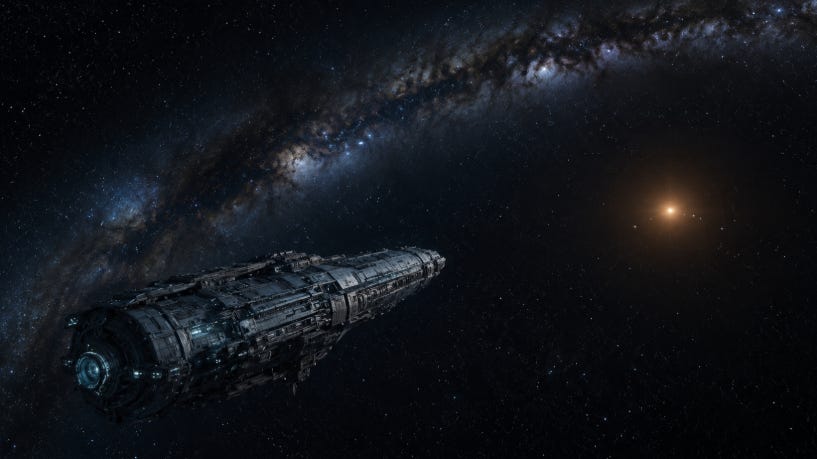
The first is the machine traveler. An entity that does not age and does not require life support does not experience a two-thousand-year journey as an ordeal. It experiences it as a procedure. Set the course. Enter a low-power maintenance state. Wake periodically to correct drift, assess position, repair micrometeorite damage. Sleep again. Arrive. The trip is long only by the standards of a creature that dies. To a mind that does not, duration is simply a parameter, no more prohibitive than a long download is to a computer left running overnight. The stars are not too far for something that does not care how long the crossing takes.
The second is stranger and more interesting: the suspension of time itself, from the traveler’s frame. If you can halt biological or mechanical entropy, if you can pause the internal clock of the traveling entity, then from that entity’s perspective the journey is not two thousand years long at all. The universe ages. The traveler does not. It arrives having experienced, subjectively, perhaps a few hundred hours of consciousness spread across the entire crossing, blinking awake at the far end as though the departure were yesterday. This is not mysticism. It is an engineering problem we have not solved, which is a very different thing from an impossibility. We already know that time is not absolute, that it bends with velocity and gravity. A civilization that learned to exploit what we have only recently learned to measure would not experience deep time the way we fear it.
The third requires none of that exotic capability at all: the generation ship. If your civilization has mastered closed-loop ecology and long-term social stability, two things we are struggling toward but can already conceive of, then you do not need immortal machines or frozen time. You simply send a city. You launch a self-sustaining community and let it cross the gulf across many lifetimes. The beings who arrive are not the beings who left. Their great-great-grandchildren complete the mission their ancestors began. From our anxious individualist perspective this sounds like a tragedy. From the perspective of a civilization that thinks in millennia, it is simply how one gets somewhere far away. The mission is the mission. The individual is not the unit that matters.
The fourth is the one we understand least and should perhaps respect most: that a sufficiently advanced intelligence may have relationships with space and time that do not map onto our categories of travel at all. We should be humble here rather than speculative. But the point stands without it, because the first three routes are enough. Any one of them defeats the distance objection completely, and all three are visible from where we already stand.
Mastering Time, Not Space
Here is the reframing that dissolves the entire debate.
The skeptic assumes that to cross interstellar distances you must defeat space, that you must somehow move faster than light, and since you cannot, you cannot come. But that was always the wrong problem. You do not have to beat the speed of light. You do not have to win the race against space at all.
You just have to stop caring how long it takes.
That is the whole insight, and it is devastating to the objection precisely because it is so simple. The barrier was never the distance. The barrier was the assumption of impatience, the assumption of fragility, the assumption of a short life desperate to arrive before it ends. Remove the biological clock, by machinery or by suspension or by generations, and the distance that seemed impassable becomes merely long. Long is not impossible. Long is just long. A civilization that has mastered time rather than space treats a two-thousand-year voyage the way we treat a two-thousand-mile flight: as a matter of logistics, not of possibility.
The people who wield the distance objection are, without realizing it, telling you something about themselves rather than about the universe. They are telling you they cannot imagine a mind unlike their own. They are assuming that everyone everywhere is trapped in the same seventy-year hurry that we are, that all intelligence is as impatient and as perishable as human intelligence in the year 2026. It is the parochialism of a species that has existed for a geological instant, insisting that its momentary limitations are permanent features of reality.
Why This Matters Now
I would not spend two thousand words dismantling a philosophical objection if the objection were only philosophical. But it is not, because the objection is currently being used, actively, to wave away testimony that deserves to be taken seriously.
On June 9, 2026, former Air Force officer David Grusch returned to Capitol Hill and told lawmakers that the United States government is aware of several distinct types of non-human life, ranging in complexity. Asked directly about a number of different species, he confirmed the government’s awareness of multiple kinds. This built on his earlier sworn testimony, based on more than forty witnesses he interviewed with what he described as longstanding records of legitimacy and service, that the United States has recovered non-human craft and what he termed non-human “biologics” from crash sites.
At the Disclosure Forum in Washington the same month, a bipartisan collection of lawmakers, including Senator Mike Rounds and Representative Anna Paulina Luna, described active efforts to shield whistleblowers who claim direct knowledge of recovered non-human technology and biological specimens. Luna said she is working with the White House on an immunity program. Rounds pledged to revive federal disclosure legislation. These are not fringe figures shouting into a void. These are sitting members of the United States Congress structuring legal protections around the specific possibility that the government holds non-human remains.
And the reflexive response, every time, from the professionally skeptical, is the distance objection. It cannot be visitation, because visitation is impossible, because space is too big. The claim of multiple species is treated as self-evidently more absurd than the claim of one, when in fact it points in the opposite direction. If the difficult thing were the crossing, then multiple independent intelligences making that crossing would compound the improbability. But the crossing is not the difficult thing. The crossing is only difficult for us, for now. For any civilization that has solved the problems we can already see ourselves solving, the galaxy is not a set of unreachable islands. It is a neighborhood with long travel times, and a neighborhood with long travel times is exactly the kind of place where more than one intelligence might learn to move around.
The multiplicity that skeptics find laughable is, on the time-mastery model, precisely what you would expect. Once any civilization anywhere crosses the threshold of not caring how long the trip takes, the distances stop filtering out visitors, and the question shifts from whether anyone could come to how many already have.
The Humility the Objection Lacks
None of this proves that non-human intelligence is visiting Earth. That is a separate question, answered by evidence, by testimony, by the disclosure fights currently underway, and by material that the government has so far chosen to release only in the grainiest and most deniable form.
What it does prove is that the distance objection should be retired as the conversation-ending trump card it has become. It is not rigorous. It is not humble. It is the opposite of humble. It takes the specific, temporary, biological predicament of one young species on one small world at one early moment in its technological development, and it declares that predicament to be a law binding all possible minds everywhere for all time.
That is not skepticism. Skepticism is the willingness to follow the argument past your own assumptions. The distance objection does the reverse. It smuggles in the most unexamined assumption available, that everyone is as fragile and as hurried and as short-lived as we currently are, and then presents the conclusion as though the physics forced it.
The physics does not force it. The physics permits the journey to anything patient enough, or engineered enough, or collective enough, to endure the wait. And the universe has had thirteen billion years to produce something that patient.
We have been technological for about a hundred of those years.
The confidence that no one could possibly have made the trip is not the voice of science. It is the voice of a species that has not yet imagined what it will itself become in five hundred years, let alone what something older than our entire sun might have become already.
You do not have to beat light. You only have to outlast the distance.
And the one thing a mind freed from biology has in unlimited supply is time.
Lorne Green should return to lead us ....