


I watched 9 to 5 again the other night, for what I think is only the second time in my life, and I got every joke. Not most of them. All of them, including the ones that are just a piece of office equipment sitting in a frame.
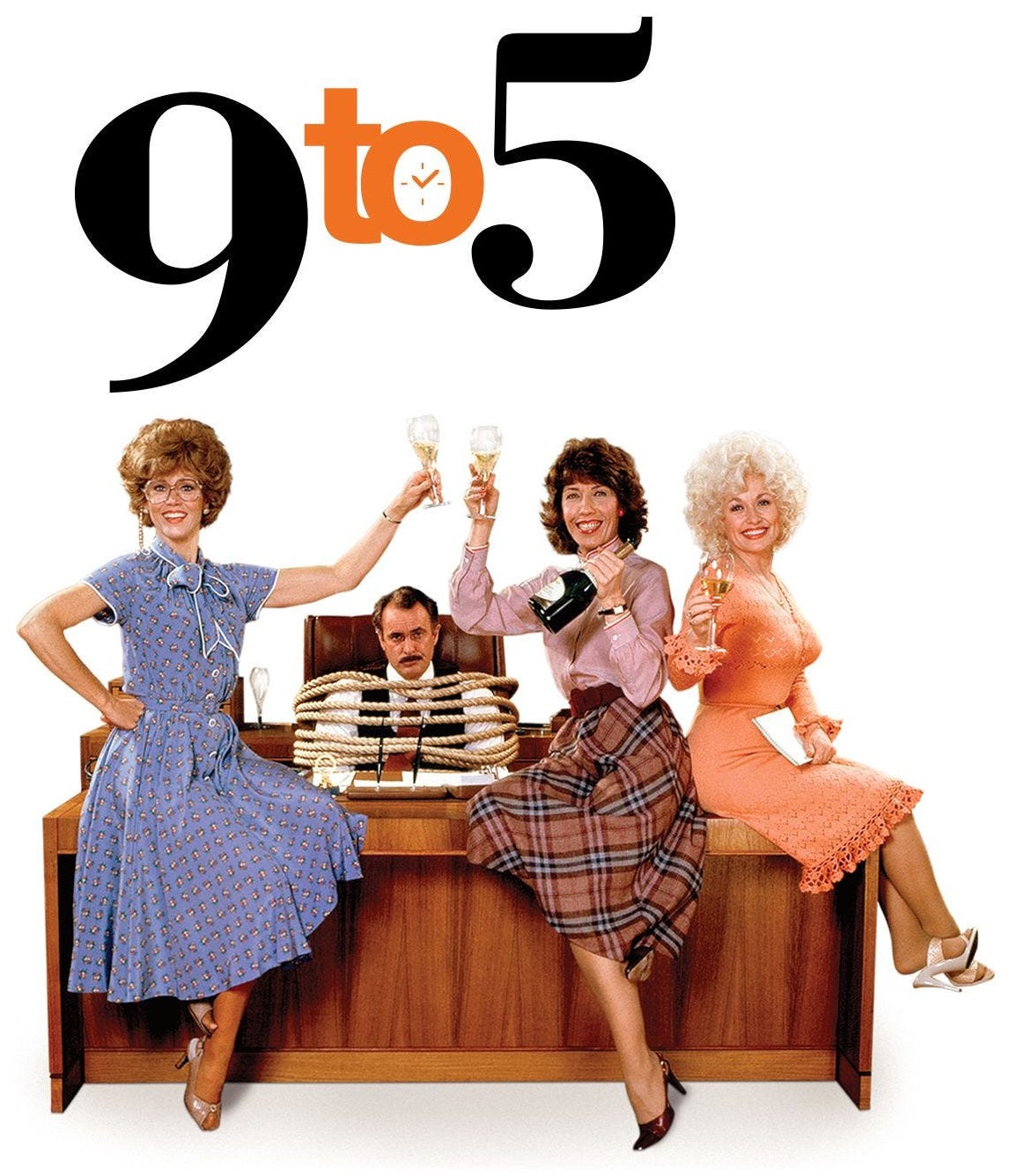
I got them because I was there. The film came out in 1980, directed by Colin Higgins, written by Higgins and Patricia Resnick, and the workplace it shows is a hair before my own but close enough that nothing in it needed explaining. It is also, and this is the part worth holding onto, extremely funny. Laugh out loud funny, forty-six years later.
Here is what I have been thinking about since.
If a twenty-five-year-old watched it tonight with a phone in their hand, they could look up every single thing in it. Every reference, every object, every piece of law. And I do not believe they would understand it.
The archaeology
Start with the machines, because the machines are the easy part.
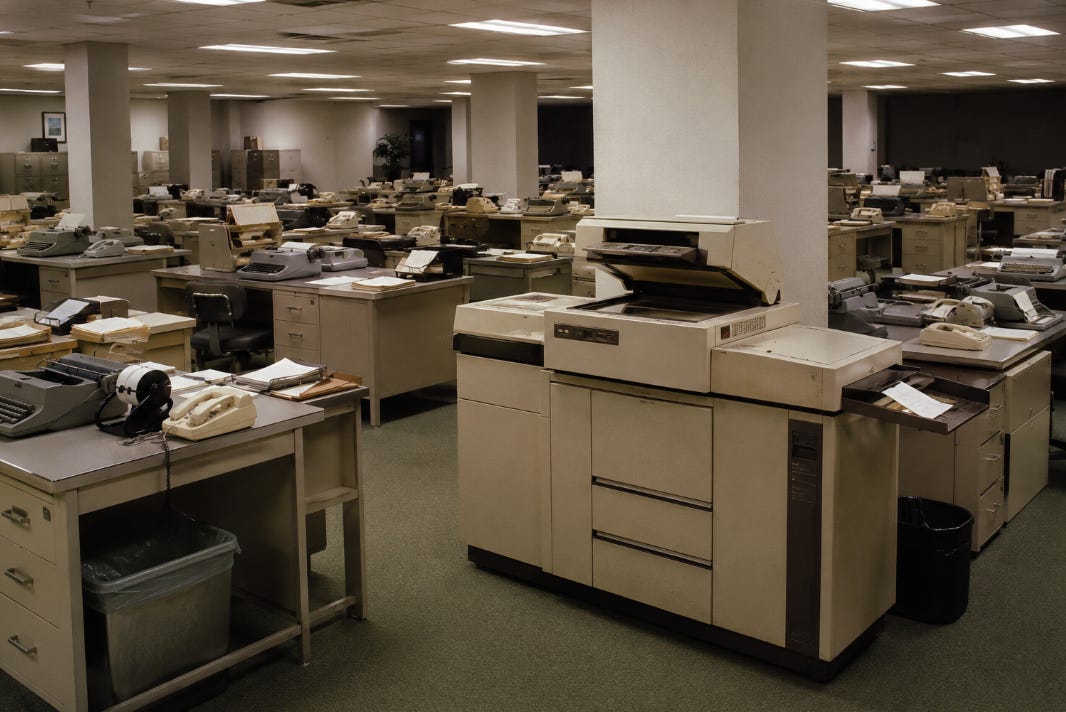
Judy Bernly arrives for her first day and is destroyed by a copier. The scene works as slapstick and it also works as documentation: the copier was a single point of failure, physically located in one room, and a jam meant the work stopped and everyone knew whose work it was. Documents lived in one place. A typo meant retyping the page, not the letter, the page. Nobody could see your output except the person you handed it to, which is why being physically present was the whole proof that you had a job, which is why the film is named after a range of hours rather than a kind of work.
Now the part that is harder to convey.
Violet Newstead has trained the man who gets promoted over her. Her efficiency proposals are presented to the company president as Hart’s own, and she watches it happen in the room. Hart asks her to buy a scarf for his wife, and when she declines he tells her she is not being a team player.
A secretary named Maria is fired for discussing salaries. Roz overhears it in the ladies’ room. That was normal. Pay was not published, not shared, and in many offices formally forbidden as a topic, which meant a person could work for twenty years without ever learning she was underpaid.
Hart tells Doralee Rhodes he is in love with her and puts his hands on her. She refuses him. He responds by spreading a rumor that they are sleeping together, and the rumor works, and the other women in the office turn on her. She is wearing a scarf he gave her, which he had asked Violet to buy for his wife, and that scarf is the evidence against her. She has no way to correct the story. There is no channel through which a correction would travel.
Eventually she tells him she keeps a gun in her purse.
The door that was not there
A modern viewer watching those scenes has an obvious question, and the question is why nobody reports him.
The answer is that there was no one to report him to, and this is a matter of record rather than interpretation. The Supreme Court did not recognize a hostile work environment as sex discrimination under Title VII until Meritor Savings Bank v. Vinson in 1986, six years after the film. The term “sexual harassment” was about five years old when the movie was shot. The EEOC had issued guidelines only in 1980, the same year. There was no human resources apparatus for this, no complaint process, no legal category, no precedent.
Every fact in that paragraph is available in ninety seconds on any phone.
And having those facts does not do it. A viewer who looks all of it up will still watch Doralee absorb the rumor and think, at some level below argument, that she had options. Because the viewer has lived their entire life in a world with doors, and the presence of doors is not a fact they possess. It is the shape of the room they grew up in.
Two kinds of not knowing
This is the thing I actually want to put down.
There is a kind of ignorance that consists of a missing fact. You do not know what a Rolodex is, or when Meritor was decided, or what a scarf cost in 1980. That kind closes in ten seconds and has closed for practically everyone. It is arguably the largest change in the human condition in my lifetime, larger than any of the ones we usually name.
There is another kind that consists of not having been formed by a condition. No quantity of retrieval touches it. You cannot look up what it is to work somewhere with no door, any more than you can look up what it is to be the person who grew up assuming every photograph of you is permanent.
And here is the trap. The first kind used to be constant. It was the texture of daily life, the sensation of reaching for something and finding it absent. Now it is nearly extinct, and its extinction is what hides the second kind, because every gap you actually run into during an ordinary day is one you can close immediately. If all the gaps you meet are closable, you conclude there are no others.
Which brings me to myself
I am well read for my age. When a word I do not know goes past me, I look it up, and I am usually square in about ten seconds. Not much throws me.
I have been treating that as evidence that I keep up. Working through this, I think it is closer to the opposite.
The apparatus I built, reading widely, staying current, running down what I do not recognize, was the correct adaptation to a world where facts were scarce and getting them was a skill. It was a good apparatus and it is now roughly obsolete as a distinguishing capacity, because a phone does it. More to the point, it was never any use at all against the second kind of gap, and I did not notice, because the first kind kept me busy.
I also do not observe younger people much. I said that out loud recently and heard it land wrong. If I am not looking closely, then nothing throwing me is not evidence of understanding. It is what a closed system feels like from the inside.
So I cannot tell you what I am missing. That is the actual condition rather than modesty or a rhetorical move. If I could name it, it would be the other kind of gap, and I could close it before dinner.
What I can tell you is that I watched a comedy from 1980, understood every frame of it because I was there, and became certain that no amount of looking things up would put a younger person in that room with me.
The reverse is also true, and I have no way to check it.
I remember the first anxious months of Covid, when no one knew what it was, how it transmitted, or had any means to stop it, while every night we heard reports of morgue trucks piling up and hospitals overrun. My mom grew up during WWII. She recently told me about the high school assembly at the end of the day on 12/8/41, where they were told that FDR had declared war while they were in class that day. What Covid taught me to appreciate was the uncertainty they felt. I grew up knowing how WWII ended. That colored my feeling about all the events, without even realizing it. When Covid came and we had no idea for months if we were facing a Black Death type extinction, whether our family was safe, I looked back at my mom's experience and FELT how stressful just living through that had been. Some things you have to experience.
Spot on...and I laughed out loud watching the movie. I can remember the pleasure at seeing the horrible boss getting done in when the movie first came out.