The number that should stop you
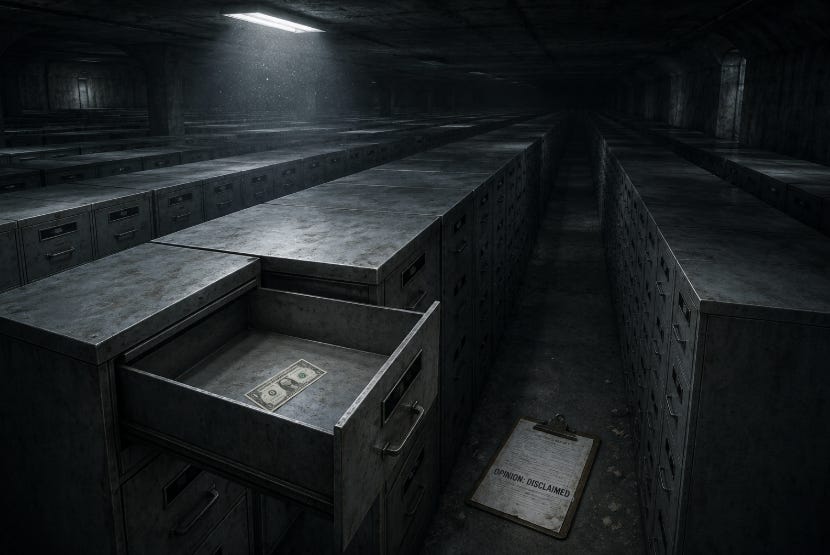
The Department of Defense has never once, in its entire history, passed a financial audit. Not once. It is the only one of the twenty-four major federal agencies subject to the Chief Financial Officers Act that has never achieved a clean opinion, a distinction it has now held since audits became mandatory for federal agencies in the 1990s.
In December 2025, the Pentagon failed its eighth consecutive annual audit. The department reported $4.65 trillion in assets and $4.7 trillion in liabilities, spread across all fifty states and more than forty countries. Auditors identified 26 material weaknesses and two significant deficiencies in financial reporting, the most serious categories of internal control failure that exist in federal accounting. The year before, the department could not properly account for 63 percent of a reported $3.8 trillion in assets. The year before that, 61 percent of $3.5 trillion. The trend line is not toward resolution. It is toward a larger number of dollars the department cannot verify, growing every year, indefinitely.
To generate even the appearance of coherent books, the Pentagon’s own financial managers made close to $7 trillion in unsupported adjustments to their ledgers in a single recent year, an amount larger than the entire annual federal budget, entered as corrections to make numbers reconcile. The Pentagon’s Inspector General found the department could not produce receipts for $2.3 trillion of those adjustments. Half a trillion dollars of the changes were themselves corrections of earlier mistakes, meaning the department was correcting its corrections, in trillions, without documentation, and calling the result an audit.
The 2024 National Defense Authorization Act requires the Pentagon to achieve a clean audit by 2028. Its own Chief Financial Officer, Jules Hurst, has said this goal is achievable with sustained investment and leadership commitment, the same sentence financial officers have used every year since the requirement was first imposed. Nothing has happened to the department as a consequence of eight consecutive failures. No budget has been cut. No official has been fired. The failures generate press coverage and congressional statements and then the following year’s identical failure.