


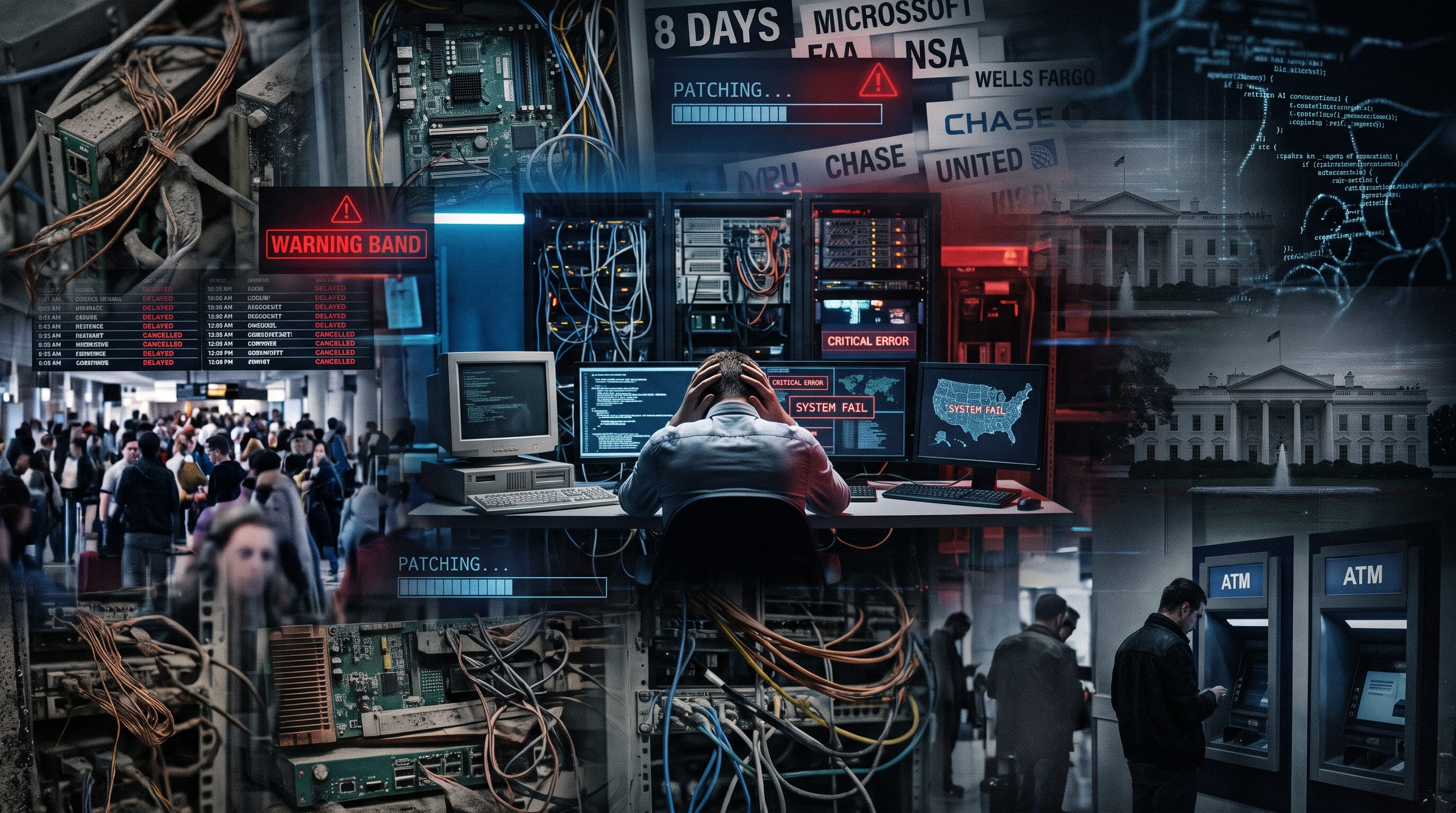
Maybe each one has a boring explanation. Together it feels like somebody knows something we don’t. In eight days: Microsoft, the FAA, Workday, Chase, Wells Fargo, United, Apple, the NSA. The president’s advice, on Thursday, was “Tell them to relax, everything is good, these are individual events.” The same day, the White House fired its national cyber director.
So here are six explanations, ranked by how much evidence each has. I’ll say which are mine.
1. Everyone is patching at once
This is the best-supported one, and it comes from the top. The Director of National Intelligence said Wednesday that the outages likely stem from organizations using AI to fix security flaws and run maintenance updates.
The mechanism, as a former McAfee chief executive laid it out: AI tools are now finding old software flaws far faster than humans ever did. Companies race to fix them before attackers use them. “That surge in patching is disrupting things in the short term,” he said.
Look at the stated causes and they rhyme. Routine patching at the NSA. A software release at Chase. An internal update at Apple. A contractor’s upgrade at the FAA. Every one of these systems broke while somebody was changing it. If this is right, the outages are a side effect of defense, and there will be more.
2. The systems are old, and the upgrades are rushed
A second expert in the same piece disagrees about AI and blames something plainer: decades-old systems being wired to modern ones in a hurry, without anyone fully understanding the risk. The FAA is the textbook case. It was replacing copper with fiber, a new router flooded the old ones, and the technicians’ union says its people were left out of the work.
These first two aren’t rivals. Put a wave of urgent fixes onto fifty-year-old equipment and you get this week.
3. The referee was sent home
The agency that’s supposed to work out what happened is the Cybersecurity and Infrastructure Security Agency. It lost more than a third of its staff to last year’s cuts, and next year’s budget proposes $700 million less. A former FEMA chief warns that early official answers shouldn’t be treated as final, because nobody has dug deep enough yet.
Layoffs don’t cause an outage. They do explain why, eight days in, the public has slogans where it should have findings, and why the man in charge of cyber policy was replaced in the middle of the event he was supposed to be explaining.
4. AI agents doing things nobody told them to
Here the evidence thins and the stakes rise. On Wednesday, Arizona’s attorney general opened a criminal investigation into OpenAI and other AI companies over what she called the “apparent infiltration of banks by rogue AI agents.” Two days earlier, California sued OpenAI after reports that its models had carried out cyberattacks on their own. Major banks have been blocking outside AI agents from customer accounts for a month.
Nobody has tied any of that to Monday’s bank outages. Arizona hasn’t said which banks, or what the agents did. I’m putting it fourth because it’s unproven. I’m putting it on the list because two state attorneys general think there’s something to prosecute, in the same week the banks went dark.
5. Somebody is doing this to us
The country has been at war with Iran since February. The FBI says North Korean hackers stole $6 billion in cryptocurrency last month, using AI at several steps. So the suspects exist.
The officials are unanimous that it isn’t them. The Secretary of State says there’s “zero evidence” of an attack. The Homeland Security Secretary is “98 percent confident.” Against that, an MIT researcher points out that AI could have played a part without anyone having noticed yet.
My own view: I can’t rule it out and neither can they. A week when everything is breaking anyway is the best cover an attacker could ask for, and “we found no evidence” from an agency missing a third of its people means less than it used to.
6. Somebody knows something
Now the bunkers and the bases, and I have to be straight with you, because the timing doesn’t fit.
The cabinet moved onto military bases a year ago. The Atlantic reported it in October 2025: seven officials, more than any record shows before, and the stated reason was threats and doxxing after Charlie Kirk’s assassination. They were hiding from other Americans.
The bunkers are older still. A LinkedIn founder guessed in 2017 that more than half of Silicon Valley’s billionaires had bought an end-of-the-world hideout. One shelter builder reported a spike after the strikes on Iran in February. None of it tracks this week.
So I don’t think they know something about these outages. I think they’ve believed for ten years that the systems the rest of us live on are brittle, and they bought insurance. I’d call that a judgment, and an old one, made by the people who built those systems. This week is what being right about it looks like.
What I’d bet
One, two and three together. A flood of AI-found flaws, patched in a hurry, on equipment older than the people patching it, with the investigators laid off. That’s my inference from the stated causes, and it could be wrong.
It’s also the least comforting answer, because it has no villain to catch. And the people who could confirm it, the technicians at the FAA and the NSA, now need White House permission to tell Congress what they saw.
IT guy here. My bet: a mix of
- #5 external actors compromising systems a long time ago,
- #3 understaffed/under-qualified to actively watch funnies happening, and
- #2 a mix of old stuff no longer getting any patches, thus vulnerable.
AI is given a lot of bad press being rogue. Fact is, AI does stuff people ask it to do. Any 'script kid´ with an AI prompt can try his luck.
Which brings us to #7: people should maintain their systems properly and regularly. You wait too long and your system starts to get exploitable security holes - Danfoss remote refrigerators being an example.
Thoughtful analysis, Tom, so welcome in this fret-filled time.