


There is a popular sentiment, and it sounds profound at two in the morning, that most humans no longer live on the actual planet. We live inside constructs. The names of the days, the tracking of time, the houses, the clothes, the routes we travel, the food, the rituals: all of it, the sentiment goes, is foreign to the Earth that produced us. We are tenants in a building of our own design, and we have lost the address of the ground.
It is a satisfying thing to believe. It is also, on inspection, not quite true.
Start with the materials. The clock on the wall is quartz and copper and a sliver of lithium, all of which the planet made and the planet still owns. The house is timber, stone, and fired clay, and the fired clay is just dirt that met a temperature. The clothes were wool and cotton and flax long before they were polyester, and the polyester is petroleum, which is to say it is very old dead things under pressure. Nothing in the catalog of human construction escaped the Earth. It got dug up, heated, pressed, woven, and stacked. The arrangement is novel. The substance is entirely local. There is no exit. There has never been an exit.
So if the materials are all native, what exactly feels foreign?
Consider the termite. The termite builds a mound that can stand two stories, ventilated, climate stable, oriented to the sun. No one calls the mound unnatural. No one says the termite has lost touch with the savanna. The mound is simply the thing that animal does, the way the reef is the thing the coral does and the dam is the thing the beaver does. Building is not a departure from biology. It is biology continued by other means. A city is a primate behavior. It is as natural as a nest, only larger and worse at drainage.
By that measure, the construct is not the problem. We are an animal that builds, and we have built. The claim that we abandoned nature collapses the moment you notice that nature includes us, and includes the things we cannot help making.
But the sentiment is not entirely wrong, and the part it gets right is worth isolating.
The termite does not think of the mound as Tuesday’s work. It does not carry a mortgage on it. It does not feel that its identity depends on the mound being a particular style, or worry that a neighboring colony built something more impressive. We made the mound, and then we built a second structure on top of it, an invisible one, made of agreement. Schedules. Money. Status. Names for stretches of time. We live mostly inside that second structure, and the second structure is the one with no physical referent at all.
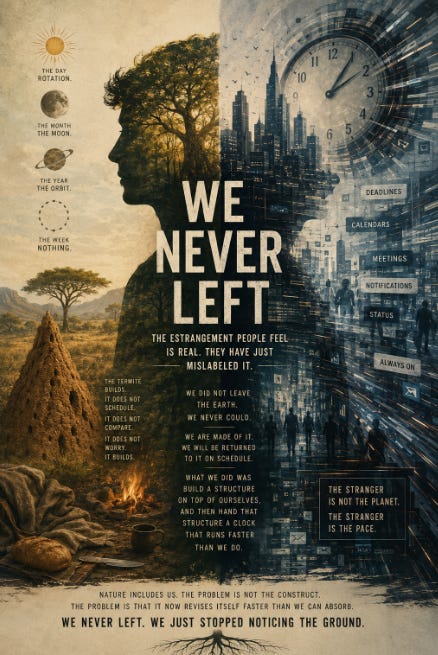
Look at the week. The day has the rotation of the planet behind it. The month has, loosely, the moon. The year has the orbit. These are real. You can point a telescope at them. The week has nothing. Seven days corresponds to no astronomical event whatsoever. It is a number that several old civilizations happened to like, and it has propagated for millennia on momentum alone. And yet a missed Monday deadline produces genuine fear. We obey a pure abstraction as if it were gravity, and we manage not to notice that we are doing it.
That is the real estrangement. Not distance from the planet. Distance from the knowledge that most of what governs us was invented, and could have been invented differently.
Here is the part worth sitting with.
The estrangement is not species deep. It is only a few centuries deep. Hand a person from the year 1200 a wool cloak, a fire, a loaf of bread, a knife, and a clear night sky, and none of it would surprise them. They would be at home in the overwhelming majority of human history, because the overwhelming majority of human history was paced to the human body. What would baffle them is recent. The elevator. The phone. The forty-hour work week sliced into meetings. The assumption that a person can be reached at any hour by anyone who wants something. The estranging layer is thin. It sits on top of a very long stretch of life that any of our ancestors would recognize on sight.
This is either comforting or unsettling, depending on how the day is going. It is comforting because a thing that is only centuries old is still young enough to look arbitrary, and arbitrary things can be renegotiated. The week is not load-bearing. We could, in principle, put it down.
But there is one feature of the construct that is genuinely new, and it is not the construct’s existence. It is the construct’s speed.
For most of the human record, the symbolic structure changed slowly enough that a person could finish adapting to it inside a single life. You learned the tools, the customs, the rhythm of the place, and they mostly held until you died. That is no longer the arrangement. The construct now revises itself faster than a human being can absorb the revision. The software updates. The platform rewrites its rules. The job you trained for reorganizes around a technology that did not exist when you trained for it. A person now spends an entire life adapting to a structure that never holds still long enough to be learned.
That is the actual condition, and it deserves a clearer name than alienation from nature. We did not leave the Earth. We never could. We are made of it, and we will be returned to it on schedule. What we did was build a structure on top of ourselves, and then hand that structure a clock that runs faster than we do.
The planet is not the stranger. The stranger is the pace.
Thank you for putting words to the way I feel. I saw ducks or geese this morning on my way to my soul-less, corporate job that I thought I'd never have to resort to. There was a mom with 5-6 ducklings following. 3 other adults and 2 "teenagers". waddling along the grass strip beside the road I take in to work. There is a pond nearby and plenty of trees and grass in the relatively rural office park. I was delighted to see them and thought how fortunate they are to have everything they need provided by the earth around them. None has to call an accountant, do laundry, have a quarterly review. I envied them so strongly. So many humans think we are a superior species. How could they possibly think that?
We are star stuff.
-CS.