


Updated 8/5/26
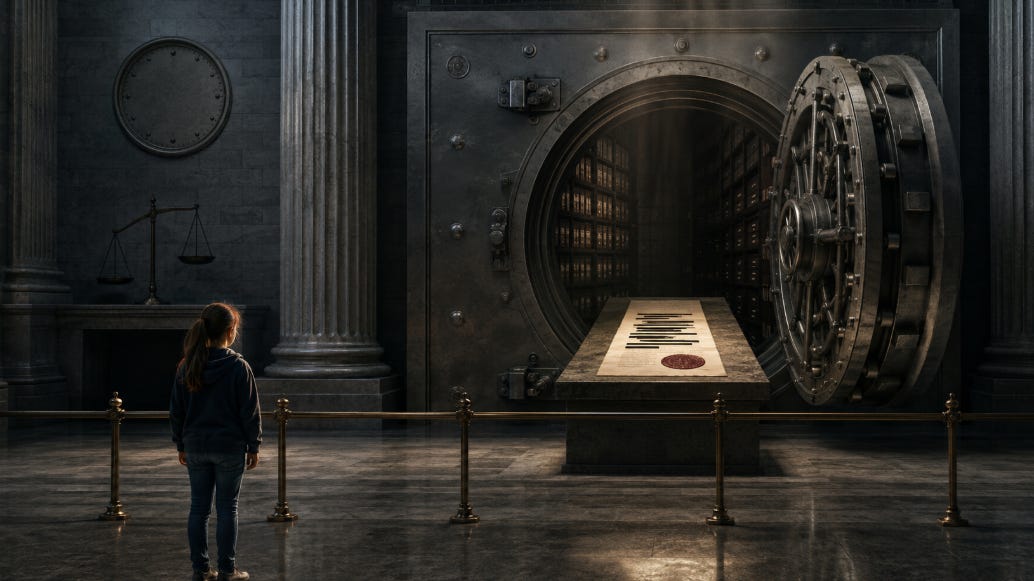
In 2001, a fourteen-year-old girl in Palm Beach was told by a friend that she could make two hundred dollars giving a massage to an older man. She was told he was a doctor of some kind, a brain surgeon maybe. Her name is Courtney Wild. She went to the house on El Brillo Way. The federal courts have since described her as one of more than thirty minor girls abused there, some as young as fourteen. Wild was eventually paid to recruit others. She has said publicly that she brought somewhere between fifty and seventy underage girls into that house, a child recruiting children into the place she had herself been recruited into.
On September 24, 2007, federal prosecutors in the Southern District of Florida signed an agreement resolving the investigation into the man in that house. Jeffrey Epstein would plead guilty in state court to two prostitution charges, one involving a minor. He served thirteen months of an eighteen-month sentence in a private wing of a county jail, most of it on work release, leaving six days a week for twelve hours at a stretch to work in an office. In exchange, the United States agreed not to prosecute him federally. It agreed not to prosecute four named women who had worked for him. And then it agreed not to prosecute any other potential co-conspirators, unnamed, uncounted, undescribed, permanently.
Wild was not told. None of them were told. The agreement contained a provision requiring that it be concealed from the victims, and the prosecutors honored that provision, and the girls learned their case had ended when they read about it.
Wild sued the United States in July 2008 and spent the next thirteen years in federal court arguing that the government had broken the law by hiding the agreement from her. In 2019 a district judge agreed that her rights under the Crime Victims' Rights Act had been violated. By then Epstein was dead in a cell and the judge ruled he could grant her no remedy. In 2021 the Eleventh Circuit rejected her petition outright, holding that the statute's protections do not attach until federal charges are filed, which meant that the very secrecy she was complaining about was what placed her outside the law's reach. The opinion opens by acknowledging sympathy for her. The Supreme Court declined to hear it.
She was right about everything and she lost, and the mechanism by which she lost was a rule about timing.
That is the vault. Not a rumor, not a basement. A signed federal document with a docket number, and a girl who read the law correctly and was told the law had not started yet.
What was stolen
Before going further I have to deal with the thing that has made this subject nearly unwriteable.
Between 2017 and 2021 a movement assembled itself around the claim that a cabal of Democratic politicians and celebrities was running a child trafficking network and harvesting compounds from the victims, and that a figure inside the government was days away from arresting all of them. None of it was true. Not a distorted version of something true. The names were invented, the mechanism was invented, the timeline was invented and reinvented every time it failed. A man walked into a pizzeria with a rifle. Families were destroyed from the inside. People believed it hard enough to die for it.
What that movement accomplished, beyond wrecking the lives of the people who fell into it, was to render the documented record radioactive. After Pizzagate, any sentence beginning with a concern about how institutions shield powerful men who abuse children arrives pre-labeled. Serious people apply the label in good faith, because they have been burned. The effect is that a federal agreement, signed and filed and public for years, is harder to discuss now than it was in 2008.
They were wrong about everything except that something was being hidden. Being that wrong that loudly is the largest single favor anyone has ever done for the people who draft these agreements, and it was performed for free, by volunteers.
So, to be clear: no cabal. No coordinated ring of leaders agreeing in a room to protect one another. What exists is worse in one specific respect. It does not require anyone to agree to anything.
The instruments
Take the machinery apart one component at a time. Every piece was built for a defensible reason. That is the entire problem.
The sealed settlement. A civil suit resolves, the parties jointly move to seal, a judge signs off because judges sign off on nearly all of them, and the record of what an institution knew and when it knew it vanishes while the institution keeps operating. The stated reason is that litigants have privacy interests and that settlements would be harder to reach without confidentiality. The effect is that a serial abuser generates a dozen settlements across twenty years and remains, in the public record, a man against whom nothing has ever been proven. Each seal is individually reasonable. The twelfth one is a career.
The nondisclosure agreement as a condition of payment. A survivor is offered money she frequently needs to live, in exchange for a permanent contractual bar on ever describing what was done to her. The stated reason is freedom of contract. The effect is a market in which the wealthiest abusers purchase the largest silences and the price is set by how badly a twenty-three-year-old needs rent.
The non-prosecution agreement, negotiated in private. The stated reason is prosecutorial discretion, which is real, necessary, and exercised thousands of times a day. The effect, when the target can hire the best defense lawyers in the country and the prosecutor is contemplating a trial whose witnesses are teenage girls with juvenile records, is that the arithmetic quietly bends toward the deal. The 2007 agreement was not a scandal in the sense of a rule being broken. It was discretion functioning precisely as designed, pointed at a man who could afford to make a trial look expensive.
The civil statute of limitations. Until recently most states gave a survivor a few years past their eighteenth birthday to sue. The research on disclosure is not ambiguous and has not been for decades: most survivors of childhood sexual abuse do not tell anyone for years, many not for decades, and a substantial share never tell anyone at all. A limitations period premised on a violated nine-year-old filing a lawsuit at nineteen is not a neutral procedural rule. It is a rule calibrated, whether or not anyone intended it, to expire before the plaintiff becomes capable of using it.
Defamation exposure. In the United States a public figure must show actual malice, which gives reporting room to breathe. In England and Wales the burden ran the other way for most of the relevant period, and the cost of losing was ruinous, and this made London the venue of choice for wealthy men who wanted allegations killed before publication rather than answered after.
And underneath all of it, the credibility discount, which is the load the whole structure rests on.
Read the Jay report on Rotherham. Alexis Jay concluded in August 2014 that roughly fourteen hundred children had been sexually exploited in one English town between 1997 and 2013. Girls as young as eleven, raped by groups of men, trafficked to other cities, beaten, threatened with guns, doused in petrol and told they would be set alight if they talked. Three earlier reports, in 2002, 2003, and 2006, had put the evidence in front of the council and the police. The first was suppressed. The other two were ignored.
The police, Jay found, regarded many of the children with contempt. The later police watchdog review put it in the language the officers themselves had used: they saw children as consenting to their own exploitation. One father of a fifteen-year-old girl was told by an officer that what was happening to her would teach her a lesson.
Understand what that officer was doing. He was not covering for anyone. He had no relationship with the men abusing that child. He simply looked at a fifteen-year-old girl from a rough estate who had been in trouble before, and he applied the categorization that every institution she had ever touched had already applied to her, and he decided she was the author of her own situation.
That is the selection criterion. Predators of this kind choose children who are already in care, already truant, already using, already known to police, precisely because those children have been pre-discredited by the state. Then the same discrediting, produced in court by a defense attorney, becomes the acquittal.
Nobody had to conspire. Assemble these components with the best intentions available and you arrive at a system in which a man with sufficient money is functionally unprosecutable for crimes against children, and every person who built a piece of it can go home believing they upheld a principle. Many of them did. That is not a mitigation. It is the finding.
Where it broke, and what it cost
Anyone making this argument has to confront the strongest objection, which is that it has worked. Not often. But it has.
The Boston Globe published in January 2002 and the American Catholic Church has been in continuous legal and financial crisis ever since. A Pennsylvania grand jury in 2018 produced an 884-page report naming 301 priests and more than a thousand identified children across six dioceses, and concluded that the real number was likely in the thousands. Almost every allegation in it was too old to charge. Two priests were prosecuted. Australia ran a five-year Royal Commission and published all of it. Ghislaine Maxwell was convicted in 2021 and is serving twenty years. New York opened a revival window in 2019, eventually two years long, for claims its own limitations rule had extinguished, and roughly ten thousand eight hundred suits were filed through it, many with multiple plaintiffs apiece.
Now look at what each one cost, and who paid.
In the summer of 2015, an eighteen-year-old gymnast named Maggie Nichols and her coach reported Larry Nassar to USA Gymnastics leadership. She was the first. The report reached the FBI's Indianapolis field office in September. McKayla Maroney spent nearly three hours on the phone with an agent describing things she had not told her own mother.
The Bureau opened no investigation. It issued no search warrants. It made no arrests. It notified no state or local police that a doctor with unsupervised access to children was under credible allegation. For 421 days, nothing happened, and Nassar continued seeing patients, and the majority of the women who later filed claims against the FBI were abused during that window. The Justice Department's Inspector General later found that agents failed to document what Maroney told them for a year and a half and then misrepresented it, that senior officials lied to his investigators, and that the special agent in charge had been pursuing a job with the Olympic committee, an opportunity raised by the head of the organization he was supposed to be investigating.
One agent was fired. One retired before he could be disciplined. The Department of Justice declined to prosecute any of them, including the ones the Inspector General found had lied under oath.
Nassar was sentenced in January 2018, forty to one hundred seventy-five years on top of a sixty-year federal sentence, after 156 people read statements in open court across seven days. He will die in prison. That is the win. The win required hundreds of women to identify themselves publicly as having been molested by their doctor. It required Nichols to report at eighteen and be ignored, and to watch the ignoring produce hundreds more victims, and then to sit in a Senate hearing room six years later and explain it to the men who ran the agency that did nothing.
And Virginia Giuffre. In the summer of 2000 she was sixteen, working as a locker room attendant at the Mar-a-Lago spa, hoping to train as a massage therapist. Maxwell's driver testified under oath that Maxwell saw the girl walking to work from the back seat of a car and ordered him to stop. Giuffre spent the next twenty-five years telling the story in court filings, depositions, press conferences, and finally a memoir she completed in October 2024 and instructed her collaborator to publish if she died. She died in April 2025, by suicide, at forty-one. The book came out six months later. King Charles began stripping his brother of his titles as it was published. The machinery finally moved for Virginia Giuffre after she was dead.
That is the pattern, and it is not a pattern of accountability never arriving. It arrives. It arrives for the institution and almost never for the individual. It arrives when the individual is retired or elderly or dead. It arrives decades after the fact, and it arrives only because a specific set of people paid for it personally: a fourteen-year-old who spent thirteen years in federal court and lost, an eighteen-year-old who reported and was filed in a drawer, a sixteen-year-old who told the truth for a quarter of a century and did not live to see the title stripped.
And every single one of those arrivals came through the same four instruments, none of which belongs to the institution being examined. A free press with a legal budget. An independent judiciary. A legislature willing to act against its own donors. And survivors willing to say it out loud at a cost most people cannot imagine paying.
There is no fifth instrument. Watch those four.
The live test
Which brings us to a courtroom in Washington, this week, and a set of documents.
In late 2025 Congress did the thing that ordinarily does not happen. The Epstein Files Transparency Act, sponsored by a libertarian Republican from Kentucky and a progressive Democrat from California, passed and was signed by the president. It required the Justice Department to release its unclassified Epstein records by December 19, 2025, and it specified that nothing could be withheld on grounds of embarrassment, reputational harm, or political sensitivity.
The Department missed the deadline. It then produced files in tranches, roughly three and a half million pages by the end of January, and its deputy attorney general described that release as the final word on what existed.
It was not. An independent journalist named Katie Phang sued the Acting Attorney General in April. In June, Judge Emmet Sullivan granted a preliminary injunction and gave the government until July 2 to unredact a deliberately narrow set of records or explain itself: eight email chains, a draft indictment with the names of potential co-conspirators blacked out, FBI interview notes, and a complete log of every redaction made under the Act.
The Department refused. It appealed. Its spokesman called the ruling perverse.
On July 25 the judge stopped accepting the Department's characterizations and demanded proof. Produce the unredacted originals to my chambers, he ordered, with documentation establishing that each blacked-out name belongs to the category you claim. The Department asked for sixty days. It got five. On July 30, at 2:28 in the afternoon, thirty-two minutes before the deadline, the Acting Attorney General of the United States hand-delivered hard copies to a judge's chambers.
Strip away the personalities and look at the shape. A bipartisan statute compelling disclosure, signed into law. A department that blew the statutory deadline, declared completion, was caught, defied a court order, and appealed. A private citizen with a lawyer forcing each increment. One judge with lifetime tenure who declined to take the government's word.
Press. Courts. Legislature. And the survivors who spent two decades demanding the files, most of whom are not in the room, one of whom did not live to see this week.
That is the entire mechanism, running in public, in real time.
[EPILOGUE SLOT: Sullivan's ruling on the in camera review. Insert on publication if issued. The piece stands without it.]
The boring answer
The question underneath all of this is how it changes, and the honest answer is unsatisfying enough that people reject it in favor of theories about basements.
It changes by statute, and every necessary statute already exists somewhere.
End sealed settlements in cases alleging the sexual abuse of minors. The public interest in knowing which institutions harbored which predators outweighs a defendant's interest in confidentiality, and it is not close. Void nondisclosure agreements covering sexual misconduct, which several states have already done. Abolish civil statutes of limitation for childhood sexual abuse and open retroactive windows, which New York did, producing some ten thousand eight hundred suits that the previous rule had defined out of existence. Strip the institutional exemptions from mandatory reporting laws. Fund the prosecutions, because a case built on the testimony of traumatized adolescents against a defendant with unlimited counsel is the most resource-intensive prosecution in the system, and underfunded district attorneys plead those cases out, and pleading them out is how September 24, 2007 happened.
None of that requires believing anything about a cabal. All of it is dull, legislative, achievable at the state level, and opposed in every jurisdiction by insurers and dioceses and school districts and universities, quietly, in committee, where nobody is watching.
That is where it gets defended. A subcommittee hearing at ten in the morning, four people in the gallery, a lobbyist at the table who has read the bill more carefully than the members have, and a vote nobody reports.
None of that repairs anything. Courtney Wild did not get a ruling. She got a holding about when a statute begins to apply. Virginia Giuffre did not live to see the title stripped. The women who testified against Larry Nassar had to say it out loud, in a room, with him sitting there, because that was the only mechanism available to them. In Rotherham, across 265 allegations of failure, not one officer was dismissed. Those children are adults now and the men who did it are mostly still in the town.
Passing every statute in the preceding paragraphs would not repair one hour of that. It would mean only that the next fourteen-year-old who reads the law correctly gets a different answer than Courtney Wild got. That is the whole prize. It is smaller than the injury and it is the only thing on offer, and it is being decided this year, in committee rooms, in every state, by people who are counting how many of us are watching.
Update, 8/5/26
Sullivan's ruling on the in camera review. Insert on publication if issued. The piece stands without it
The boring answer
The question underneath all of this is how it changes, and the honest answer is unsatisfying enough that people reject it in favor of theories about basements.
It changes by statute, and every necessary statute already exists somewhere.
End sealed settlements in cases alleging the sexual abuse of minors. The public interest in knowing which institutions harbored which predators outweighs a defendant’s interest in confidentiality, and it is not close. Void nondisclosure agreements covering sexual misconduct, which several states have already done. Abolish civil statutes of limitation for childhood sexual abuse and open retroactive windows, which New York did, producing some ten thousand eight hundred suits that the previous rule had defined out of existence. Strip the institutional exemptions from mandatory reporting laws. Fund the prosecutions, because a case built on the testimony of traumatized adolescents against a defendant with unlimited counsel is the most resource-intensive prosecution in the system, and underfunded district attorneys plead those cases out, and pleading them out is how September 24, 2007 happened.
None of that requires believing anything about a cabal. All of it is dull, legislative, achievable at the state level, and opposed in every jurisdiction by insurers and dioceses and school districts and universities, quietly, in committee, where nobody is watching.
That is where it gets defended. A subcommittee hearing at ten in the morning, four people in the gallery, a lobbyist at the table who has read the bill more carefully than the members have, and a vote nobody reports.
None of that repairs anything. Courtney Wild did not get a ruling. She got a holding about when a statute begins to apply. Virginia Giuffre did not live to see the title stripped. The women who testified against Larry Nassar had to say it out loud, in a room, with him sitting there, because that was the only mechanism available to them. In Rotherham, across 265 allegations of failure, not one officer was dismissed. Those children are adults now and the men who did it are mostly still in the town.
Passing every statute in the preceding paragraphs would not repair one hour of that. It would mean only that the next fourteen-year-old who reads the law correctly gets a different answer than Courtney Wild got. That is the whole prize. It is smaller than the injury and it is the only thing on offer, and it is being decided this year, in committee rooms, in every state, by people who are counting how many of us are watching.
It is obscene that rich men & women keep getting away with raping & ruining the lives of children who have already gotten the short end of the stick in so many instances. We should treasure those lives as well as the innocents. They should not have to wait for justice because the statutes, paid for by their rapists, allow them to shrug, pay some $ & walk away. Power should not ascertain who wins this fight.
Brilliant piece.
10 documents delivered at 2:30 yesterday; those will have already been reviewed by the judge, surely. How long until we'll hear the judgment about what will happen next....? We don't know which 10 files; that will be an important detail, if it's ever given to the public. God I hope Trumpy is in one of those files, fully incriminated.
@joni The entirety of human existence has been polluted by the distribution of money, and the power of those who have much. We, as a species, have to walk away from money-first mentality. We're the only species on the planet with that idiotic system.