


Here is what this means, and why it should frighten every American.
There is a word in the reporting that most outlets are stepping past as though it were decoration, and it is the most important word in the story.
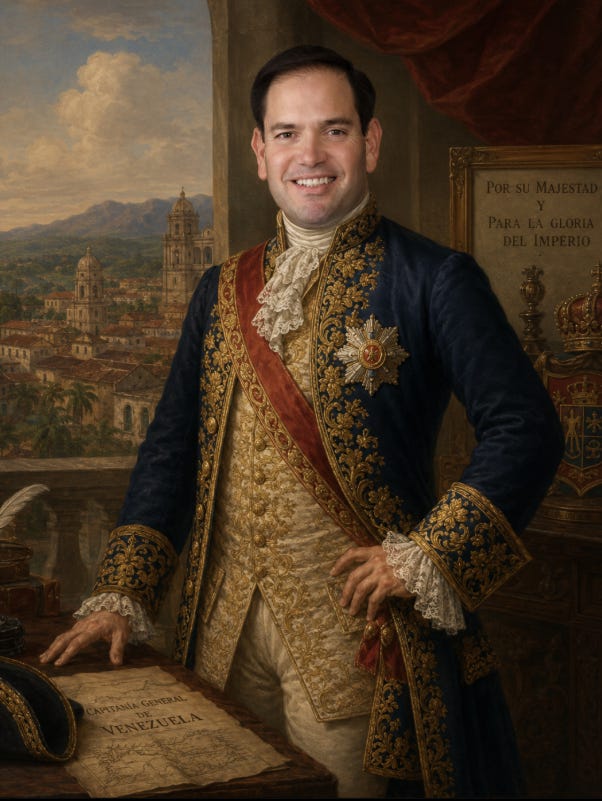
Viceroy.
The New York Times, in an investigation published Saturday and built on interviews with more than a dozen officials across both the American and Venezuelan governments, reported that Secretary of State Marco Rubio has become the de facto viceroy of Venezuela. He controls the country’s finances. He controls the distribution of its natural resources. He controls its government’s decisions, its personnel appointments, and, in a detail so absurd it would be funny if it were not terrifying, its social media posts. He does all of this without having set foot in the country since American special forces captured its president in the pre-dawn dark of January 3, 2026.
Officials in both governments are, according to the Times, actually using the word. Viceroy. They are not using it as an insult or a metaphor. They are using it as a job description, because it is the only word in the language that accurately describes what Marco Rubio is now doing.
This is the biggest story of the week, and you would barely know it happened, because it landed in a news cycle already saturated with a senator’s death, another senator’s month-long disappearance, and an expanding war with Iran. The saturation is not entirely accidental. A government doing something this extraordinary benefits enormously from doing it during a week when no one has the attention to spare. So let us spare it. Let us slow down and look directly at what is being reported, because it deserves far more than the single line most of the coverage has given it.
What a Viceroy Actually Is
Start with the word, because the word carries centuries of meaning that most Americans have never had reason to learn.
A viceroy is a person who governs a colony or a subordinate territory in the name of a sovereign. The term comes from the French, roughly “in place of the king.” Its defining feature is that the viceroy rules a land that is not his own, on behalf of a power that is not present, over a people who did not choose him. The Spanish crown ruled its American empire through viceroys for three hundred years, men in Mexico City and Lima who governed vast populations as the personal representatives of a king across an ocean. The British ruled India through a viceroy, a single appointed official who held near-absolute authority over hundreds of millions of people who had no vote, no consent, and no recourse. The viceroy is the human instrument of empire. He is what colonialism looks like when it needs a face and a signature.
To call someone the viceroy of a country is to say that the country is no longer sovereign. It is to say that its government is a facade, that its president is a figurehead, and that real power has been relocated to a foreign capital and vested in a foreign official who answers to a foreign ruler. There is no version of the word that is compatible with the independence of the nation it is applied to. A country with a viceroy is, by definition, a country that has been taken.
This is the word that officials in Washington and Caracas are using, on the record, to describe the relationship between the United States and Venezuela in the year 2026. Not annexation in name, but conquest in fact, administered by a Secretary of State who exchanges WhatsApp messages with his puppet in Spanish and signs off on which businesses may operate in a nation of nearly thirty million people.
The last time an American wielded this kind of control over another country, it had a name too. His name was L. Paul Bremer, and the country was Iraq, and the year was 2003, and the Times drew the comparison deliberately, because it is the only recent precedent that fits. Bremer ran occupied Iraq as the head of the Coalition Provisional Authority, and his tenure is remembered as a catastrophe whose consequences, the insurgency, the sectarian war, the rise of the Islamic State, killed hundreds of thousands and destabilized a region for a generation. That is the historical company Rubio’s role keeps. That is the scale of what is being described.
The Receipts
Now the specifics, because the specifics are what make this undeniable.
According to the Times reporting, the mechanism of control runs through money, and it is total. The United States Treasury collects all revenues from Venezuelan exports, including its enormous petroleum earnings. The money is then released back to Venezuela in controlled amounts, with tight restrictions on what it can and cannot be spent on. The Times described the arrangement, in a phrase that should be carved into the record, as being like parents handing out allowances to children. Rubio holds the allowance. Delcy Rodríguez, the acting president installed after Maduro’s capture, depends on that money to pay government workers and prop up the national currency, which means she depends on Rubio, which means she does what Rubio says.
And what she does is comprehensive in its submission. Rodríguez reportedly clears major government personnel decisions directly with Rubio, including the appointment of Venezuela’s minister of defense. Consider that. A foreign official is approving who runs another sovereign nation’s military. When Venezuela’s foreign minister published a statement condemning the American attack on Iran, the Trump administration ordered the statement removed, and the foreign minister deleted it within hours, an act the Times characterized as an open admission that Venezuela no longer controls its own foreign policy. Rodríguez reportedly submits her own draft social media posts to Rubio’s team for approval before she publishes them. When Fox News requested an interview with her, she responded that Trump would have to approve it first.
This is not influence. This is not a strong bilateral relationship or an alliance of unequal partners. This is one man in Washington operating the levers of another country’s entire government, down to its press appearances, and a growing number of officials describing it plainly as colonial rule.
Rubio has, of course, denied it.
The Denial, and the Culture That Manufactured It
“There is no war against Venezuela,” Rubio said, “and we did not occupy a country.”
This denial arrives in a specific context, and the context is everything, because Marco Rubio did not always lie like this. There was a version of this man, and it was not so long ago, who was regarded across the political spectrum as one of the more serious and substantive foreign policy voices in the Republican Party. He was a fierce critic of authoritarianism, a hawk on human rights, a man who spoke with genuine knowledge and apparent conviction about the evils of dictatorship in exactly the part of the world he is now helping to colonize. Whatever you thought of his politics, Rubio was, for years, a credible figure. He had a reputation. He had earned it.
That man is gone, and it is worth understanding exactly how he disappeared, because his disappearance is a case study in something larger.
Donald Trump has built, around himself, a culture of denial so pervasive and so total that it has become the defining characteristic of everyone who serves him. It is not ordinary political spin, the selective emphasis and favorable framing that every administration practices. It is something more corrosive: a wholesale rejection of observable reality as a condition of employment. In Trump’s orbit, you do not shade the truth. You deny the thing that is happening while it happens, in front of cameras, with the confidence of a man who knows that his base will believe him and his enemies cannot stop him. The lie is not meant to persuade. It is meant to demonstrate power, to show that the speaker can say the sky is green and suffer no consequence, because consequence itself has been dismantled.
Rubio has fully adopted this culture, and in adopting it he has spent down the entire reputation he took decades to build. The man who once spoke with moral clarity about tyranny now stands at podiums and denies occupying a country he administers by WhatsApp. The man who built a career on the credibility of his word now says there is no war while the Revolutionary Guard strikes American bases in retaliation for American attacks. He has become interchangeable with every other figure in the administration, the Secretaries and press officials and cabinet appointees who have learned that the price of proximity to Trump is the surrender of the ability to acknowledge what is true. He denies like the rest of them deny, reflexively, shamelessly, and without any apparent memory of having once been a person whose denials would have meant something.
This is what Trump does to people. He does not merely demand their loyalty. He demands their credibility, because a man who can still be embarrassed by a lie is a man who might, one day, refuse to tell one. So the culture requires that credibility be destroyed early and publicly, that each official be made to say the indefensible thing until the capacity for shame is gone. Rubio has paid that price in full. The viceroy of Venezuela telling you there is no occupation is not a man who expects to be believed. He is a man demonstrating that he no longer cares whether he is, which is exactly the state Trump requires of everyone around him.
The Job He Is Treating Like a Joke
Here is what compounds the danger, and it is the part that should trouble even people who feel no sympathy for Venezuela.
If Marco Rubio took the role he actually occupies seriously, he would be a man under almost unbearable weight. To be the effective ruler of a foreign nation of thirty million people is one of the most consequential and perilous positions a human being can hold. Every colonial administrator in history who understood his job understood that he was sitting on a volcano. You are governing people who did not choose you and have every reason to hate you. You are managing an economy, a military, a population’s daily survival, and a thousand competing factions, any of which can turn to violence. You are responsible, whether you accept it or not, for the lives and stability of an entire country. The viceroys who lasted knew the gravity of it. The ones who treated it lightly got their empires burned down around them.
Rubio is treating it lightly. The reporting paints a picture not of a man staggered by the enormity of an unprecedented responsibility, but of a man trading gossip and selfies and birthday greetings over a messaging app with his installed deputy, running a captured nation as a side project between NATO summits. He approaches the administration of a sovereign country the way the entire Trump operation approaches everything, as a performance, a transaction, a game whose consequences fall on other people. The seriousness that the role demands is precisely the seriousness that the MAGA culture has trained out of him. He is a viceroy playing the part of a Trump courtier, which means he is exercising colonial power without the sober terror that colonial power ought to induce in anyone honest enough to feel it.
A man in an unprecedented and daunting position, approaching it like a clown, is not a comedy. It is a hazard, because the position does not become less dangerous just because the man holding it refuses to take it seriously. The volcano does not care whether the administrator is paying attention.
The Unseriousness Starts at the Top
Rubio’s flippancy is not his own invention. It is inherited, and it is inherited from a man who is fundamentally, provably unequipped to run a government and has never once pretended otherwise except when a camera demanded it.
We have documented, at length, the condition of the man at the top of this operation. This is a president who cannot reliably identify which country he is bombing, who called Iran the Islamic Republic of Japan at a NATO summit and named the president of Ukraine as Putin twice in a single press conference. This is a man who has suggested nuking hurricanes, injecting disinfectant, and raking forests to stop wildfires, whose grasp of policy detail is so thin that his own advisers manage him like a hazard to be contained rather than a principal to be briefed. The capture and colonial administration of Venezuela is not the product of a serious strategic mind weighing the profound consequences of empire. It is the product of a man who wanted a thing, took it, and has the attention span of a cable news segment, delegating the actual governance of a conquered nation to a Secretary of State because the details bore him.
This matters enormously, and here is why. Empire is the most consequential undertaking a nation can attempt, and it demands, at minimum, seriousness. It demands leaders who understand history, who have read what happened to every previous power that thought it could administer foreign peoples from a distant capital, who feel the weight of the lives they are gambling. What Venezuela has instead is a president who does not read, does not learn, does not retain, and does not care, presiding over a colonial project he almost certainly could not describe in accurate detail if asked. The stupidity is not incidental to the danger. The stupidity is the danger, because a serious empire is merely evil, while a stupid one is evil and uncontrolled, careening from seizure to seizure with no strategy, no exit, and no comprehension of the forces it is unleashing.
Trump has taken a country the way a child takes a toy off a shelf, because he could reach it and no one stopped him. And he has handed it to a courtier who denies the toy exists. That is not statecraft. It is not even competent villainy. It is the reckless improvisation of a fundamentally unserious man who has confused the powers of the presidency with the impulses of a spoiled appetite, and the entire architecture of the American government has been remade to indulge him. The viceroy in Caracas is downstream of the vacancy in the Oval Office. Rubio treats the conquest of a nation like a game because the man he answers to treats the government of the United States like one.
Why This Endangers You
And now the part that matters most to the readers of this piece, who are, overwhelmingly, Americans wondering what a Venezuelan occupation two thousand miles away has to do with them.
It has everything to do with you, for several concrete reasons.
The first is precedent. The Venezuela model is a template, and it is already being copied. The Times reporting notes that Trump wanted to create a similar arrangement in Iran, and Rubio spent this week warning the International Criminal Court not to challenge American sovereign power, which is the language of a government that intends to keep doing this and does not want to be prosecuted for it. What has been built in Caracas, the capture of a head of state, the installation of a compliant deputy, the seizure of the national revenue through the Treasury, the administration of a conquered country by a cabinet secretary, is now a proven system. Systems that work get reused. The question is not whether this will happen again. The question is where, and how soon, and what it will cost.
The second is the erosion of the constitutional order that is supposed to protect you. A Secretary of State running a foreign country as a personal colonial fiefdom is not something the American system of government contemplates or permits. There is no congressional authorization for this. There is no treaty, no declaration, no legal architecture. It is executive power operating entirely outside the structures meant to constrain it, and every time executive power discovers that it can operate outside those structures without consequence, the structures weaken for everyone. The same lawlessness that lets Rubio rule Venezuela by decree is the lawlessness that lets ICE shoot bystanders, that lets the DOJ target the president’s enemies, that lets the whole apparatus operate as though the law is a suggestion. Venezuela is not a foreign problem. It is a demonstration of what this government believes it is allowed to do, and a government that believes it can conquer a country by WhatsApp is a government that does not believe in limits at all.
The third is war. This entire arrangement was born in a military operation that killed people and abducted a head of state, and it is being maintained in the middle of an expanding war with Iran in which American bases are now under fire. The viceroy model is not peaceful. It is conquest, and conquest generates resistance, retaliation, and escalation. Venezuelan officials reportedly provided the intelligence that enabled an American strike. The foreign policy of a captured nation is being weaponized. Americans in uniform are the ones who carry out these operations and the ones who die when they go wrong, and the family members of those Americans are the ones who receive the folded flags. An administration this willing to seize and administer foreign nations is an administration that will keep putting American lives in the machinery of empire, and empire, historically, is not a thing that ends well for the ordinary people of the nation that pursues it.
The fourth is the simplest and the hardest. A government that will lie to you about occupying a country will lie to you about anything. The denial Rubio issued, flat and shameless, is the same denial you will receive about every other thing this administration does to you and in your name. The culture of denial is not aimed only at Venezuela. It is aimed at you, the American public, who are meant to be kept confused, exhausted, and uncertain about what is real, so that extraordinary things can happen in your name while you are told, to your face, that they are not happening at all.
The Word Stands
The New York Times used the word viceroy because it was the accurate word, and the officials in two governments used it because it was the true word, and no denial from the man it describes changes what it means.
The United States has taken a country. It administers that country through a Secretary of State who governs it from Washington like a colonial proconsul, controls its money, appoints its ministers, and edits its social media, and who then stands before the public and says none of it is happening. This is the most significant thing that has occurred in American foreign policy in years, and it is being allowed to slide beneath the surface of a busy news week, which is precisely what the people responsible for it are counting on.
Do not let it slide. A viceroy in Caracas today is a precedent for a viceroy anywhere tomorrow, and the man holding the title has already shown you, by his denials, exactly how little the truth will be permitted to matter.
They took a country, and they told you they didn’t.
Remember which part is the lie.