


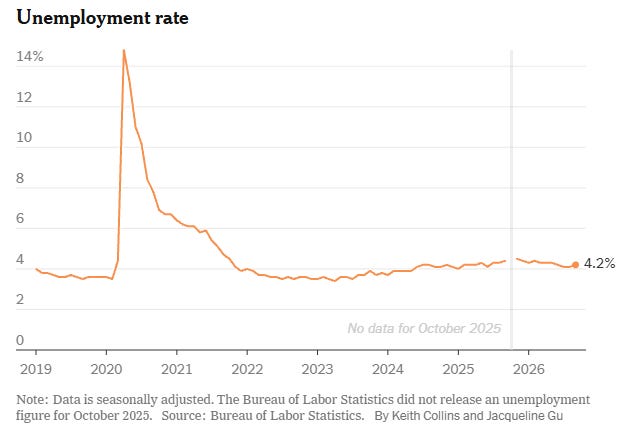
The Bureau of Labor Statistics reported Friday morning that the American economy added 29,000 jobs in September. Economists had expected somewhere between 84,000 and 90,000. The unemployment rate rose to 4.2 percent. July, which had been reported as a gain of 21,000, was revised to a loss of 10,000, the first negative month in years, and August was cut from 162,000 to 133,000, so that the two prior months together lost 60,000 jobs that had already been announced. Health care, which has carried the labor market for two years, added 17,000 against its twelve-month average of 33,000. Construction added 11,000 and manufacturing 9,000. Financial services lost 7,000 and has shed 129,000 since its peak in May 2025. Wages rose a tenth of a percent on the month and three percent on the year, which, with inflation at 3.4 percent, means the average worker’s paycheck bought less in September than it did in September of last year. Heather Long, the chief economist at Navy Federal, summarized it in a sentence: “Only healthcare and construction were hiring, and it was weak.”
That is one number, from one agency, on one morning. It would be a bad morning for any administration thirty-two days before an election. What makes it a story rather than a data point is that three other institutions, in the same two weeks, said the same thing from different directions, and only one of them is a pollster.
The Fed he picked
On September 17 the Federal Reserve raised its benchmark interest rate by a quarter point, to a range of 3.75 to 4 percent. It was the first increase since July 2023. The vote was 12 to 0. The chair who announced it, Kevin Warsh, was appointed by Donald Trump in May to replace Jerome Powell, after years of the president attacking Powell for refusing to cut. Warsh had been in the job, by his own count, “110 or 120 days.” He called the hike “a sober decision, serious decision, responsible decision,” and said the reason plainly: “inflation is too high and has been for too long.” Consumer prices rose 0.4 percent in August, the largest monthly gain in four months, and 3.4 percent over the year, up from 2.4 percent in February, before the war and the tariffs. The Fed’s own projection is 3.7 percent inflation for this year and no return to its 2 percent target until 2029. Sixteen of the eighteen officials on the committee expect at least one more hike before the end of the year; four expect two.
The president’s response is on the record. The day before the vote, at the airport in Charlotte, he said interest rates in the United States “should be 1%, or less.” He said he had spoken to Warsh and told him, “you might as well vote with the board because it’s not going to matter.” He called the board “hostile” and “political” and “a bunch of politicians.” He said he still had confidence in his chair.
Whether a president should be telling the chairman of the Federal Reserve how to vote the day before a meeting is a question with a settled answer, so the more useful question is what the hike means. The man Trump chose, after a years-long campaign to install someone who would cut, looked at the inflation his policies had produced and raised rates into a labor market that his own Labor Department would report, two weeks later, had nearly stopped hiring. A central bank raising rates while job growth collapses is the shape economists have a word for, and the word is stagflation, and the reason the Fed did it anyway is that it judged the inflation to be the larger danger. After Friday’s report, traders priced out an October hike. The next one is now expected in December, after the election, which is becoming the date on which this administration’s decisions tend to land.
The bond market
On Wednesday the yield on the ten-year Treasury note touched 5.34 percent, the highest since 2002. It closed Friday at 5.28, down on the weak jobs number, which is the bond market’s way of saying that bad news for workers is good news for lenders. The thirty-year sits near 5.6. These are the rates that set mortgages, car loans, and the cost of every business that borrows to make payroll. Reuters’ analysts named the drivers: central banks raising rates against inflation, enormous demand for capital from the AI buildout, and, in one analyst’s words, “large government deficits.” The deficit is the one the government controls. The budget law signed on July 4, 2025, adds more than three trillion dollars to the debt over ten years by the Congressional Budget Office’s count. The Pentagon’s request for $67.1 billion to cover a war that is costing $2 billion to $3 billion a month arrived on top of it. A bond market at a 24-year high is the price of borrowing all of that, and it is paid by anyone who takes out a loan in the next several years, which is most people.
The pump
Diesel set a national record of $6.53 a gallon on September 22. It stood at $6.37 on Friday, down from the peak and still nearly double the $3.70 of a year ago. Diesel is the price of everything that moves on a truck, which is nearly everything, and it moves into grocery prices with a lag of weeks. On Friday the G7 announced it would release up to 100 million barrels of oil and refined products from strategic reserves over four months, with a “frontloaded substantial release” of diesel in the first twenty days, after what the Washington Post described as pressure from the United States. Trump said the diesel would come “immediately,” and ruled out an export ban. Analysts noted that the International Energy Agency’s members had already committed to releasing 426 million barrels in March and asked whether the new 100 million was additional supply or the remainder of the old pledge, repackaged. Either way, the president who said in March that the Iran war would last four to five weeks spent the first week of October organizing the allied emergency reserves to get diesel down before November 3.
The voters
The AP-NORC poll conducted September 24 through 28, among 2,140 adults, found 26 percent of Americans approve of Trump’s handling of the economy. In March 2025 it was 40 percent. On the cost of living specifically, 17 percent approve. Sixty-five percent say his policies are to blame for high prices, and the two policies they name are tariffs and the war with Iran. About half say they are extremely or very concerned about affording fuel, up from 39 percent in July, and about half say the same about groceries. Among Republicans, roughly 60 percent now disapprove of his handling of the cost of living, up from about half in April, though two-thirds of them still say the causes are outside his control.
Axios put the number next to the record. Joe Biden’s worst economic approval, in the summer of 2022, at the peak of the inflation that cost his party the House, was 28 percent. At that time 44 percent of voters blamed his policies. Trump is at 26, with 65 percent blaming his. The inflation under Biden peaked above 9 percent; it is 3.4 percent now. The voters’ verdict is harsher at a third of the inflation, and the difference, by the poll’s own numbers, is that they have decided whose fault it is.
The case that it is fine
There is one, and it is worth stating plainly because the administration will. Unemployment at 4.2 percent is low by any historical standard. Growth has been solid. Inflation at 3.4 percent is nowhere near 2022. The Fed raising rates is the system working as designed: an independent central bank acting against inflation despite a president who wants the opposite, which is exactly what an independent central bank is for. The stock market rose on Friday. A single weak jobs report, especially one dragged down by revisions, is one data point, and the next one could reverse it.
All of that is true, and a reader is entitled to weigh it. What it does not answer is the direction. Every indicator in this piece moved the wrong way in the same month. Job growth fell. Unemployment rose. Prior months were revised down. Inflation rose to a level the Fed judged dangerous enough to hike into a weakening market. Borrowing costs hit a 24-year high. Fuel set a record. Economic approval set a record of the other kind. A president with solid growth and 4.2 percent unemployment does not ordinarily find 65 percent of the country blaming his policies for their grocery bill. That number requires the voters to have connected the tariffs and the war to the receipt, and the poll says they have.
What he did about it this week
On Thursday, in Durant, Oklahoma, Trump told a rally crowd, “Pretend I’m running, please. If we don’t win, they’ll end up impeaching me.” The same day he said Iran was “ready to fold up” and the war would end “right after the election, maybe before,” and that when it did, energy prices would come down “rapidly, rapidly.” On Friday the jobs number came out, and the G7 reserve release was announced, and the administration’s economic message for the weekend was that the war it chose and extended will end on a schedule it controls, after the vote, and that prices will follow.
Which is to say the administration’s answer to the economy is the war’s end, and the war’s end is scheduled for after the election, and the voters are being asked to grade the economy before the thing the president says will fix it. The Fed has already graded it; that was the hike. The bond market has graded it; that was 5.34. The Labor Department, whose previous commissioner Trump fired in August 2025 for publishing a jobs number he did not like, and whose replacement nominee is still unconfirmed, graded it Friday at 29,000, and that number came out of an agency run by an interim career economist with no reason to shade it in either direction.
The economy is the one election issue on which voters need no newspaper. They know what diesel costs because they bought it. They know what the mortgage quote was because they got one. They know whether their brother-in-law found work. The numbers this week are the official record catching up to what the AP-NORC respondents already knew when they answered the phone, and the record now says what they said. Thirty-one days remain. The president’s plan for them is a reserve release, a rally, and a war that ends in November.