


On Sunday, the President of the United States announced on Truth Social that his planned triumphal arch, the 250-foot granite monument he intends to build on Memorial Circle, where Arlington Memorial Bridge touches the Virginia shore, would no longer be only a monument. It would be converted, he wrote, into “a top grade Military Complex/Triumphal Arch,” equipped to house, store, and rapidly deploy “large numbers of drones, plus Snipers, on both the roof and plaza areas,” along with large quantities of sniper ammunition.
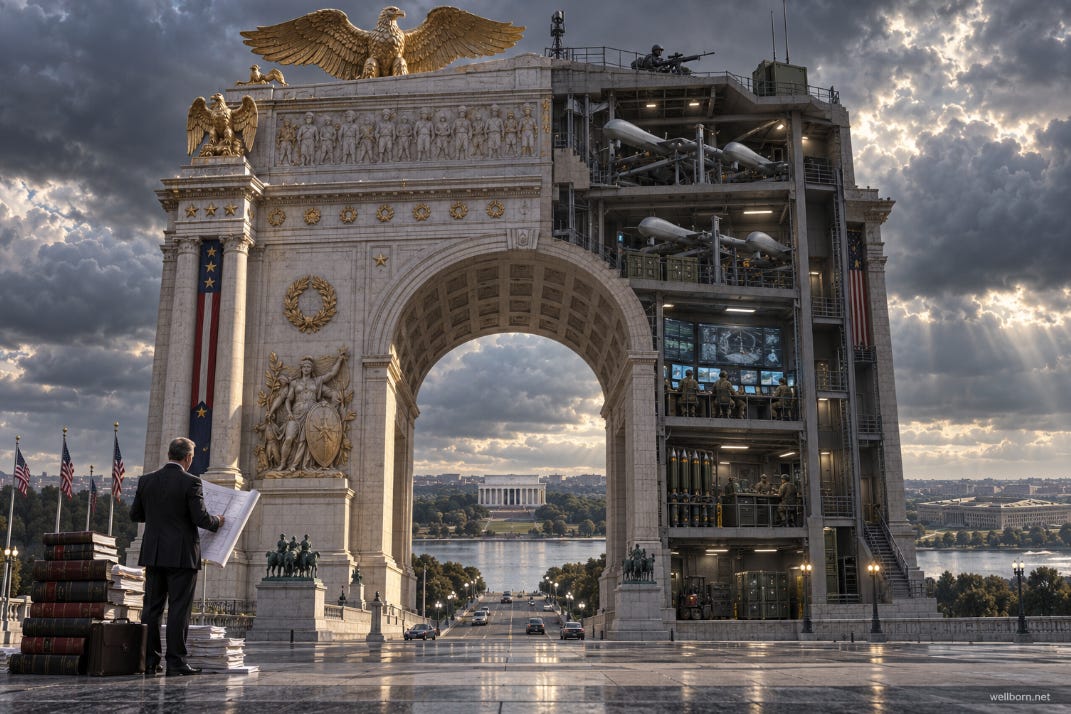
He said this was done “at the strong request of the United States Military.”
The United States Military, asked about its strong request, had nothing to add. The Pentagon told reporters it had no information beyond the President’s post. It did not say which command made the request, what threat the drones and snipers would answer, or why a military headquartered two miles away at the Pentagon needs a forward position inside a decorative arch.
Parts of Sunday’s announcement read like a joke, but the sequence of events behind it is serious, and the sequence is what matters here.
What the arch was
The arch began as a tribute. Trump pitched it as a monument to the nation’s 250th anniversary, modeled on the Arc de Triomphe, topped with three golden statues and an observation deck, and standing roughly twice the height of the Lincoln Memorial it would face across the river. He has argued that Washington “IS THE ONLY ONE IN THE WORLD THAT DOES NOT HAVE A TRIUMPHAL ARCH,” a claim that would come as news to Ottawa and Canberra.
The site he chose sits on the ceremonial axis that the city’s planners spent a century protecting: the straight line from the Lincoln Memorial, across Memorial Bridge, to Arlington House and the graves of the nation’s war dead. Congress approved a plan for that circle in 1925. It called for two 166-foot columns, which were never built. It did not call for a triumphal arch, and Congress has never authorized one.
The National Park Service’s own August review found that the arch would harm the nearby monuments and landmarks. More than 100,000 public comments came in, most of them opposed. Rep. Don Beyer, whose district includes the site, has pointed out that it sits in the approach path of Reagan National Airport. The Federal Aviation Administration cleared it anyway on Friday.
Then came the lawsuit. A group of Vietnam veterans and an architectural historian sued, arguing that the arch would desecrate the approach to Arlington and that the President has no authority to build a monument on that land without Congress. U.S. District Judge Tanya Chutkin ordered the administration to give 48 hours’ notice before any work begins on the circle. Groundbreaking had been scheduled for this month. The National Capital Planning Commission still has not given final approval.
That was the situation on Saturday: a monument with a legal problem.
By Sunday it was a military installation.
Why the word “military” matters
Monuments on federal land in and around the capital are governed by the Commemorative Works Act, which Congress passed in 1986 so that nobody, including a president, could put a memorial on the Mall or its approaches without Congress signing off. That is the statute at the center of the veterans’ argument that Congress has to approve this, and it is a strong argument. A commemorative arch built on National Park land at the foot of Memorial Bridge is exactly what the statute was written to govern.
A military facility is a different legal animal. Presidents have broad authority over defense installations and wide deference from courts when they invoke national security. Once the arch is described as a place to store drones and station snipers, the administration can argue that it is no longer a commemorative work at all, that the relevant law is the President’s power as commander in chief, and that a judge has no business second-guessing where the military chooses to position its assets.
The plaintiffs’ lawyer saw it immediately, calling the new rationale a “belated” effort to “manufacture a national security justification” that does nothing to cure the project’s “fundamental illegality.” Mark Cancian, a retired Marine colonel and defense analyst, described the military justification as something that appears to have been “tacked on” to answer the opposition, and noted that storing ammunition at a traffic circle next to a bridge is a logistical problem, not a solution.
We also know this move works, because it has already worked once.
The ballroom did it first
When Trump’s White House ballroom ran into legal trouble, the ballroom was reframed as well. The project that had been pitched for state dinners became, in his description, a “Military Complex/Ballroom,” with its underground security infrastructure moved to the front of the argument. In August, the Supreme Court allowed that project to continue.
So the pattern is established, and it is simple enough to state in one sentence. When a Trump building project meets a law that requires someone else’s permission, the project acquires a security function, and the security function becomes the reason no one else’s permission is needed.
That pattern should worry everyone, including people who have no feelings at all about arches or ballrooms, because the argument has no natural stopping point. If a monument becomes exempt from the Commemorative Works Act by having drones on the roof, any structure the President wants can be made exempt from any law by the same method. National security was written into the Constitution as a serious power for serious threats. It is being used here as a master key, and a master key opens every door.
What an armed arch at that spot means
There is also the thing itself, and it deserves to be described plainly.
Memorial Bridge is the ceremonial entrance to Washington from Arlington. It is the road funeral processions have taken to Arlington, and it connects the memorial to the president who held the Union together with the cemetery where the soldiers who died for it are buried. The President now proposes to put a sniper position and a drone launch site on the Virginia end of that bridge, overlooking the approach to the capital, in the same weekend that his administration confiscated the badges of reporters from three news organizations at the White House gate.
None of those facts, by itself, proves an intention. The arch has no approved plan, no confirmed military requirement, and no identified threat. It may never be built. But a republic is also made of symbols, and the symbol being proposed is a triumphal arch, a form invented by Rome to celebrate a general’s victories, fitted with sniper positions overlooking the road into the seat of government, and justified by a military that declines to confirm it asked for any of this.
The Arc de Triomphe, the model Trump keeps citing, stands over the tomb of France’s unknown soldier, with an eternal flame. The French did not put snipers on it.
What happens next
The arch still needs final approval from the National Capital Planning Commission, which is expected this fall. Half of its twelve seats are held by the President’s appointees and the heads of his own agencies. The Park Service has promised to expedite its review for a November decision. Judge Chutkin’s notice requirement stands, which means that any attempt to break ground will give the plaintiffs two days to run back to court, and they will.
Those are the formal checks. There are also ordinary ones.
Congress can end the argument outright. The Commemorative Works Act is Congress’s law, and Congress can clarify, in a single sentence of an appropriations bill, that no funds may be spent on a monument on Memorial Circle without its authorization, regardless of what the President calls it. Every member of the Virginia and Maryland delegations, and every member who sits on the committees that oversee the Park Service and the Pentagon, can be asked whether they support that sentence.
The armed services committees can ask the Pentagon, in writing and under oath, which office made the “strong request,” on what date, and in response to what threat assessment. If the request exists, it will have a paper trail. If it does not, the committees will have established that the President invoked the military to win a zoning dispute, which is worth establishing on the record before he does it again.
And the public can keep doing what more than 100,000 people already did, which is to object in writing through the official comment process when the Planning Commission opens its review. Those comments are part of the administrative record a court will read.
Trump wants an arch because every capital he admires has one. What he has now built, in one Sunday post, is a precedent: that a president who cannot get permission for a monument can get it for a gun emplacement. The arch may never go up. The precedent already has, and it will still be there after the arch argument ends.
"There's only one reason why you build a sniper stand for - quite frankly trying to bag a deer, to kill a deer. In this particular case, the president of the United States is trying to say, we need a sniper stand so we can kill Americans. It's absolutely shocking to me that he has said this in writing.
~ Ret Major Gen Manner
https://www.npr.org/2026/09/21/nx-s1-5975429/retired-major-general-questions-trumps-plan-for-a-militarized-monumental-arch