


There is a genre of writing in American public life that we tend not to recognize as a genre, and that failure of recognition is the joke. Call it the presidential physical bulletin. Five or six paragraphs of mildly Latinate, faintly liturgical prose, signed by a doctor in a uniform of some description, released on a Friday afternoon by the White House communications office, characterizing the health of the chief executive in a small permitted vocabulary of laudatory adjectives. Excellent. Exceptional. Robust. Strong cardiac, pulmonary, neurological, and overall physical function. The genre has house rules. You do not provide specific numbers unless they flatter. You do not name medications unless you have to. You do not characterize the patient’s actual conduct in the waiting room. You file the bulletin, collect the signature, retire to your office.
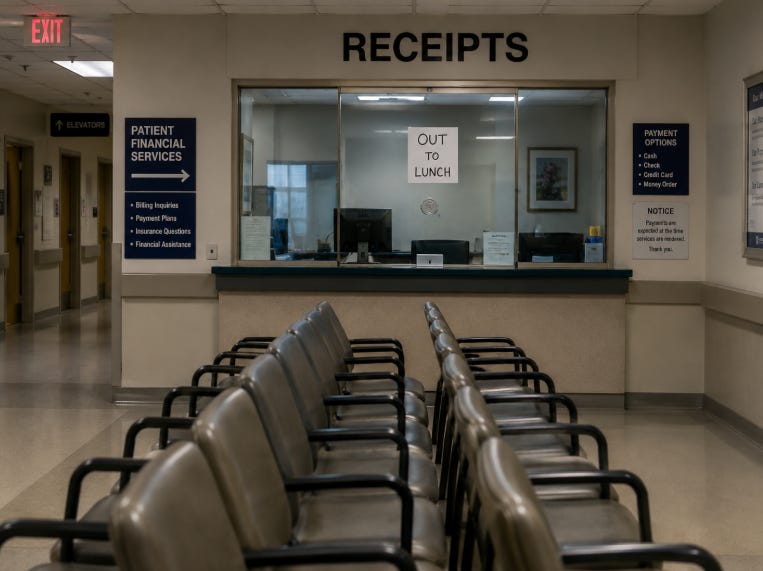
I have read every public Donald Trump health bulletin issued by every physician he has had between December 2015 and the one released last Friday afternoon, and after considerable study, I can report the single feature they all share. None of them brings a receipt. No itemized lab values. No clean imaging. No documented medication-adjustment timeline. No comparative weight chart taken on the same instrument across years. No mention of the procedure that explains the visit, in the visits where there clearly was one. Five doctors, eleven years, and not one of them has produced a document a working clinician could submit for peer review without first checking who was watching. The catalog runs as follows.

Doctor One. Harold Bornstein, gastroenterologist on the Upper East Side, the man with the shoulder-length hair and the round eyeglasses, family physician to the Trumps for three decades. In December 2015 his office released a four-paragraph letter declaring that the candidate’s recent medical examination had “shown only positive results,” that his blood pressure of 110/65 was “astonishingly excellent,” that his “physical strength and stamina are extraordinary,” and, most enduringly, that “if elected, Mr. Trump, I can state unequivocally, will be the healthiest individual ever elected to the presidency.” Two and a half years later, in 2018, Bornstein admitted to CNN that the patient had dictated the letter to him, dictated it through the car window while Bornstein and his wife drove across Central Park, and that the doctor had simply taken it down and signed it. “He dictated that whole letter. I didn’t write that letter. I just made it up as I went along.” Bornstein also disclosed that, the previous February, the President’s longtime bodyguard had arrived at his office with a Trump Organization lawyer and a third unnamed man and, over the course of twenty-five minutes, removed Trump’s medical records from the premises. The receipt for the records has never surfaced. Bornstein, who once described the indignity of the visit as feeling like a “raid,” is now dead. The records are wherever the records went.
Doctor Two. Ronny Jackson, then a Navy rear admiral, then the official Physician to the President, who delivered in January 2018 a White House podium briefing that survives as the high-water mark of the genre. Trump, Jackson reported, was in “excellent” health and possessed “incredibly good genes.” “I told the president,” Jackson confided to the assembled press corps, “that if he had a healthier diet over the last twenty years, he might live to be two hundred years old.” This of a McDonald ’s-fed seventy-one-year-old with elevated cholesterol and a BMI in the obese category once the inflated height was honestly recorded. The briefing went on for sixty-four minutes. The President nominated Jackson for Secretary of Veterans Affairs by way of thanks. The nomination collapsed amid allegations that the Pentagon Inspector General would later substantiate that Jackson had drunk alcohol on duty during a presidential trip, had taken prescription Ambien while operating as White House physician, and had made “sexual and denigrating” comments about a female subordinate. The Navy, accordingly, demoted him from rear admiral to captain in 2022. He continued to call himself Rear Admiral. The current Navy Secretary, this past June, restored the rank on review of unspecified additional materials. Jackson is now a Republican congressman from Texas, was briefly handcuffed at a Texas rodeo last year for interfering with deputies during a child’s medical emergency, and is the same doctor who would, in 2024, write the public letter about the Butler ear. We are not finished with him.
Doctor Three. Sean Conley, an osteopath and Navy commander, Physician to the President during the back half of the first term. Conley enters the historical record on November 16, 2019, when the President made an unannounced trip to Walter Reed for what the White House would describe, in retrospect and only in retrospect, as a “routine, planned interim checkup,” kept off the public schedule on account of “scheduling uncertainties.” A New York Times reporter later wrote in a book that the Vice President had been placed on standby to assume the powers of the presidency, an account the Vice President later said he did not specifically recall. Conley’s bulletin for the visit ran one page, omitted any specialized cardiac or neurological evaluation, and assured the public that the President had not experienced any “chest pain.” This was the first appearance of Conley’s signature device, which is to specify the catastrophic event that did not occur, leaving the curious reader to infer the catastrophic event that perhaps had. Conley’s masterpiece, however, was October 2020, when the President was hospitalized at Walter Reed with COVID-19. Across two consecutive podium briefings, Conley declined to confirm that the patient had been administered supplemental oxygen, which he had; declined to disclose that the patient had been given dexamethasone, a steroid generally reserved for severe and critical cases, which he had been; and declined to specify how low the patient’s blood oxygen had fallen, on the grounds, he said, that “we don’t have any recordings here of that.” Asked subsequently to account for these omissions, Conley explained on camera that he had been “trying to reflect the upbeat attitude of the team.” This is, in clinical terms, not what a physician is for. The bulletin survived the briefing. The receipt has never surfaced.
Doctor Four. Bruce Aronwald, a doctor of osteopathic medicine practicing in northern New Jersey, who in November 2023 released a single page on Trump Organization stationery summarizing a September 2023 checkup. The letter declared that the patient’s “overall health is excellent,” that “his physical exams were well within the normal range,” and that “his cognitive exams were exceptional.” It provided no vital signs. It listed no medications. It supplied no laboratory values. It did not state the patient’s weight. It made no reference to specific imaging or to any specific diagnostic procedure. Reading the document end to end, an experienced internist could determine that a doctor had been in a room with a patient, and almost nothing more. The letter contained, in its entirety, fewer measurable data points than a routine sports physical for a fourteen-year-old applying to summer camp. It satisfied the candidate’s filing obligations. It satisfied no one else’s.
Doctor Two, second appearance. Ronny Jackson returned to the dais in July 2024, a week after the assassination attempt in Butler, Pennsylvania, with a public letter describing a two-centimeter gunshot wound to the upper right ear, initial significant bleeding, marked swelling subsequently resolved, intermittent bleeding due to ear vascularity, no sutures required, a CT scan performed, and a patient who was “doing well, and recovering as expected.” The hospital where the patient was treated did not make doctors available for questions. The campaign did not release the underlying medical records. The FBI Director, testifying to Congress that same week, observed that there was “some question” whether the patient had been struck by a bullet or by shrapnel. The bandage on the patient’s ear grew steadily smaller across subsequent appearances and then quietly vanished, replaced by an ear that, in photographs taken in the months since, appears largely intact. Plastic surgeons have offered the reasonable observation that vascular ear wounds can heal with minimal visible scarring. The White House physician’s report a year later listed, among the patient’s “abnormalities,” scarring on the right ear from the Butler injury. The scar itself remains, to the public eye, largely invisible. The receipt for what struck him, what was removed, what was scanned, what was sutured, if anything was sutured, has not been produced.
Doctor Five. Sean Barbabella, U.S. Navy captain, current Physician to the President. Barbabella has filed three bulletins so far: a three-pager issued in April 2025, a single-page October 2025 follow-up, and the report issued last Friday from a Tuesday physical at Walter Reed that ran three and a half hours and produced no specific account of what was done during the additional one hundred and fifty minutes beyond the typical sixty. The April 2025 bulletin contained the document’s most lasting contribution to the genre, an unbroken sentence in which Barbabella cited, among the supporting evidence for the President’s “well-being,” his “frequent victories in golf events.” The October 2025 follow-up, described as routine despite the annual having occurred six months prior, was reported to have included an MRI of an unspecified anatomy and produced a one-paragraph summary declaring the President in “exceptional health” with no further detail. The May 2026 report restored the standard prose, declaring strong cardiac, pulmonary, neurological, and overall physical function, reporting a perfect 30-out-of-30 Montreal Cognitive Assessment for the third recorded time, noting “slight lower leg swelling” from the previously disclosed chronic venous insufficiency with improvement from last year, and attributing the visible bruising on the backs of both of the President’s hands to a daily aspirin regimen plus a vigorous handshake habit. The bulletin did not mention the patient’s height. It did not mention the patient’s weight. It did not specify the imaging. It did not address why the patient required a third Walter Reed visit in thirteen months. It declared him fit. It went home.
Five doctors. Eleven years. Six bulletins of any length. The bulletins, read in chronological sequence, would describe a man whose health has been steadily improving from his late sixties into his early eighties, a man whose cognitive scores have remained at ceiling on a screening instrument designed to detect impairment in nursing-home residents, a man whose only documented abnormalities are a healed ear and a polyp, a man for whom the relevant adjective has not varied from excellent in eleven years across two presidencies and a private interregnum.
The patient described by the bulletins is not the patient available to the naked eye. The available patient nodded off on national television at his own cabinet meeting earlier this month, head sinking toward the necktie, while the official he installed to oversee American public health discussed in some emotional detail the falling sperm counts of American adolescents. The available patient, in another cabinet meeting, stood beside a college football coach he had been brought onto the stage to honor, looked at the coach, looked away from the coach, looked back, and could not produce the man’s name. The available patient confused a former United Nations ambassador with a former Speaker of the House at a January 2024 campaign event, told a Pennsylvania town-hall crowd in October 2024 to stand in silence while music played for thirty-nine continuous minutes, has been photographed across the last two years with concealer applied to the backs of both hands, and has appeared at recent outdoor functions with ankles and calves so swollen that the public diagnosis of chronic venous insufficiency was finally made under pressure of the photographic record itself. The available patient has been observed, in cabinet rooms and courtrooms and television interviews, to lose track of which country he is currently at war with, to begin sentences whose subject and verb arrive at different destinations, and to produce long associative monologues, since dignified by the term weave, that any senior internist would recognize as a screening flag for further evaluation. None of this conduct appears in any bulletin. The bulletins describe a patient in excellent health, demonstrating strong cardiac, pulmonary, neurological, and overall physical function, who scored a perfect 30 on the Montreal Cognitive Assessment, for the third time, in a row, against the only known instance in the published literature of an octogenarian male with a thirty-year history of fast-food consumption, chronic venous insufficiency, recurrent dermatologic eruption, intermittent somnolence in public meetings, and a documented inability to identify the men standing two feet from his microphone.
It is, in the gentlest possible reading, an interesting pattern. It is, in the harder reading, the predictable product of a system in which the President’s personal lawyer is the Acting Attorney General, the President’s defense secretary is central casting, the President’s press secretary will affirm anything that fits on a chyron, and the President’s doctor, of whatever stripe, in whatever decade, knows perfectly well that bulletins are signed by people who want to keep signing bulletins. Bornstein lost the contract when he wandered off-script and mentioned the hair medication. The records were collected from his office shortly thereafter. Jackson lost a rank for the sins of his off-duty life and recovered it on review by an administration willing to revisit the file. Conley lost his career capital in the COVID briefings and was rotated out. Aronwald supplied a single page that volunteered nothing. Barbabella, the current incumbent, has supplied three documents whose load-bearing evidentiary contribution is the patient’s frequent victories in golf events, and he is, by all available indications, secure in his position for as long as he keeps the prose in the approved adjectives.
The receipt is the document that would be produced if the genre were medicine and not theology. The blood pressure reading taken twice, on two separate visits, on the same calibrated instrument. The lipid panel with the year-over-year comparison. The cardiac imaging series, dated, with the radiologist’s narrative. The medication list with start dates and current doses. The cognitive workup that goes beyond the Montreal Cognitive Assessment, which is a thirty-question screen that any cognitively intact adult of any age should pass and which detects nothing that an internist would call a finding. The neurology referral note. The endocrine panel. The dermatologic biopsy results. The procedure note for any procedure performed during any of the unscheduled Walter Reed visits across eleven years.
The receipt has never been brought. It has not been brought because what it would document, in plain numbers, on standard forms, in the boring, uninflected prose of working medicine, is not the patient the bulletins are required to describe. The bulletins describe a brand. The patient is a man, and the man is visibly failing in front of a country that is being asked to read the bulletins instead of the photographs, and the doctors, every one of them, in their five separate offices across eleven separate years, have understood from the first paragraph of the first letter what is being asked of them and what is being paid for.
No one is going to bring the receipt.
The receipt is the man himself.
Grab my new book for about the same price as a cup of Starbucks coffee and learn about one of my life’s most significant journeys: https://www.amazon.com/dp/B0H37KYQT3