

Let us begin with the card.
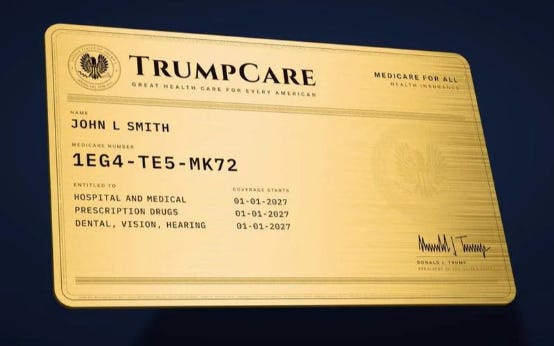
It is gold. It is the size of a credit card, and it says TRUMPCARE across the front in the sort of lettering a casino uses for the room you can’t afford. On the back it says the bearer may present it “at any doctor, hospital clinic, or pharmacy in the United States.” It was designed by Abdul El-Sayed, the incoming Democratic senator from Michigan, who ran on Medicare for All and beat a Republican to get there. On November 12 he posted it with a message addressed to the president: “Donald, this is on the table. Guarantee healthcare for every American, from cradle to grave.”
On Saturday, the president reposted it. He added no caption, no comment and no emoji. He took a Democrat’s proposal for universal government health insurance, the policy his party has spent fifteen years calling the end of the Republic, and set it on his own account in front of his own followers, the way a cat brings you something it found in the yard and waits to be told it’s wonderful.
Then he went on Fox News and said Democrats “have some good points on health care,” and that “there’s a chance we could get great health care” done “in a bipartisan way.”
Scholars will want a full reading of this artifact. We have examined it under good light, and the findings follow.
The silence. The most important thing about the repost is what isn’t in it. This is a man who has captioned hurricanes. He has issued statements, unprompted and in capital letters, on windmills, shower pressure, the Super Bowl halftime show and the acting of Meryl Streep. He has never in his public life encountered a thing and declined to say something about it. Here he said nothing. The silence is the sound of a man reading the word TRUMP in large gold letters and finding that the document requires no further edits.
The name. Consider how El-Sayed made the pitch. He did not lead with the cost. He skipped the coverage numbers, the hospitals and the uninsured. In a video he addressed the president as “habibi,” which means “my dear,” and told him he could be the most popular president in America. “You can put your name all over it,” he said. “You can even give them a gold card.”
Think about that as a negotiating strategy. For fifteen years Democrats tried to win Republicans over to universal coverage with studies, with budget tables, with stories of children with cancer. It went nowhere. Then a doctor from Michigan tried the one argument nobody had thought of, which was to offer to engrave it, and the President of the United States reposted it in nine days. The policy argument has been running for a generation. The font argument took a week and a half.
The envy. There is a precedent, and it explains a good deal. The last health care law was named after a president too. “Obamacare” was coined by the law’s opponents as an insult, on the theory that attaching the man’s name would sink it. The name stuck, the law survived, and its namesake now has his name on the thing millions of Americans carry to the pharmacy.
The subject has had to look at that for sixteen years. He spent seven months of 2017 trying to repeal it and lost by one vote. A reasonable person might conclude he objected to the policy. The repost suggests a simpler grievance. Barack Obama has a care, and he doesn’t.
The prior record. It helps to line up what the man has said about this exact policy over time. In 2000, in a book with his name on the cover, he wrote, “We must have universal healthcare.” In 2015, on a Republican debate stage, he said of single-payer, “It works incredibly well in Scotland.” In 2018, as president, he published an op-ed in USA Today warning that Medicare for All would end Medicare for seniors and lead the country toward Venezuela. He then called it socialism at rallies for six years.
So the record shows a man who was for it, then for it in Scotland, then against it as the road to Caracas, and is now for it again, on one condition. Historians looking for the principle that unites these positions will find that in 2018 the plan was named after Medicare.
The brand portfolio. To understand the repost, one has to place it in the catalog. The subject has, over fifty years, put his name on steaks, vodka, bottled water, a university, an airline, a mortgage company, a board game, a magazine, a mattress and a line of neckties made in China. In his first term he had his name printed on the pandemic relief checks, a first for an American president, which the Washington Post reported would delay them. In his second he launched the Trump Gold Card, a visa for wealthy foreigners; TrumpRx, a website for drug prices; and Trump Accounts, a savings plan for newborns, so that an American child can now be enrolled in a financial product named after the president before it has been named after anyone in its own family.
Viewed against this portfolio, TrumpCare is a product extension. A man who licensed his name to a mattress was offered the American hospital system, and he recognized premium shelf space when he saw it. Every waiting room in the country. Every wallet. The steaks never had that kind of distribution.
The plan he had. The subject has, in fairness, been promising his own health plan for some time. In 2019 he said it would arrive after the election. In July 2020 he said he’d sign one within two weeks. That September he signed an executive order called the America First Healthcare Plan, which mostly announced that a plan existed. In 2024, asked on a debate stage what would replace Obamacare, he said he had “concepts of a plan.”
The concepts were never released. They have spent two years in a drawer, presumably beside Infrastructure Week, waiting for someone to give them a name. Michigan has now supplied one, along with the plan.
The comprehension question. We come to the delicate part. One has to ask whether the subject knows what he reposted, and the evidence points to a specific kind of knowing. He knows the card is gold. He knows the name is his. He does not appear to know, or to have asked, that the thing printed on it is single-payer health insurance, a system in which the government replaces the private insurance industry. He has not said what it costs or who pays. He hasn’t said what becomes of the 150 million Americans insured through their jobs. He has not asked whether it covers dental, though if it’s his, one assumes veneers.
He reposted it with the specific confidence of a man who has never once read the back of a card.
Two hypotheses are available. The first is that he studied Medicare for All over the weekend, weighed the actuarial tables, and concluded the Democrats had been right since 1965. The second is that he saw a picture of a credit card with his name on it and pressed the button, the way a toddler presses the horn of a parked car. The reader may weigh these against fifty years of evidence.
The veto. The same day, on the same network, he supplied the other half of his position. If the Democrats don’t work with him, he said, “I could sit there for two years and one month and just veto everything.” Put the two statements side by side and the terms are clear enough. Call it TrumpCare and there’s “a chance.” Call it anything else and he’ll be sitting there. As far as I can tell, it’s the first time a signature on federal law has been offered for the price of a font.
The reaction. His party has not found its footing. These are people who voted, by the usual count, more than sixty times to repeal a health law named after the last president. They are now looking at a picture of a bigger one named after this president, on his own account, with no caption to tell them how to feel. To oppose it, a Republican would have to stand up in a primary and say the words “repeal TrumpCare” into a microphone. Somewhere tonight a senator is rereading a press release that calls it a socialist takeover, and wondering whether that’s still true, and if it is, who he’s allowed to blame.
The implications. The method, once discovered, is unlikely to stay in health care. One imagines the whiteboard in the Democratic cloakroom. The Donald J. Trump Voting Rights Act. Trump Child Care, with a gold bib. The Trump Clean Air Standard, under which the air is described as tremendous. A minimum wage, payable in a commemorative coin.
I’m joking, and I’m also not sure why it wouldn’t work.
The finding. Here is the part that’s easy to laugh at and harder to look at.
If El-Sayed is right, and the name is what it takes, then some thirty million uninsured Americans could get coverage because a man with a ballroom wanted a card. It would be a good thing done for the emptiest reason anyone ever did a good thing. Children would get insulin because a president wanted a logo. I would take that trade tomorrow. So would the children.
But look at what it says about how everything else gets decided. A doctor from Michigan found out, in public, that the most powerful man in the world will drop a position he campaigned on for years if you hand him something shiny with his name on it. Every lobbyist in Washington watched. So did every foreign ministry. Last week Xi Jinping met him at the airport in Shenzhen, and he called it a win before a word of the talks had been spoken. Flattery has always been the surest way to move this president, and on Saturday the Democrats learned it works in their hands too.
The man cannot tell you what is in his health plan. He can tell you, to the letter, how his name is spelled on it. That, as he understands it, is the job. It has turned out to be a door anyone can walk through, as long as they bring something gold.
I’d start on a name for the climate bill.
👏🏼👏🏼👏🏼 Great and funny report on an outside the box (dare I say brilliant) strategy.
If that’s what it takes, so be it.
One could always put a bit of duct tape over the name. 😆
This is one of those where the laughing and crying 😂 are not separate but equal.