


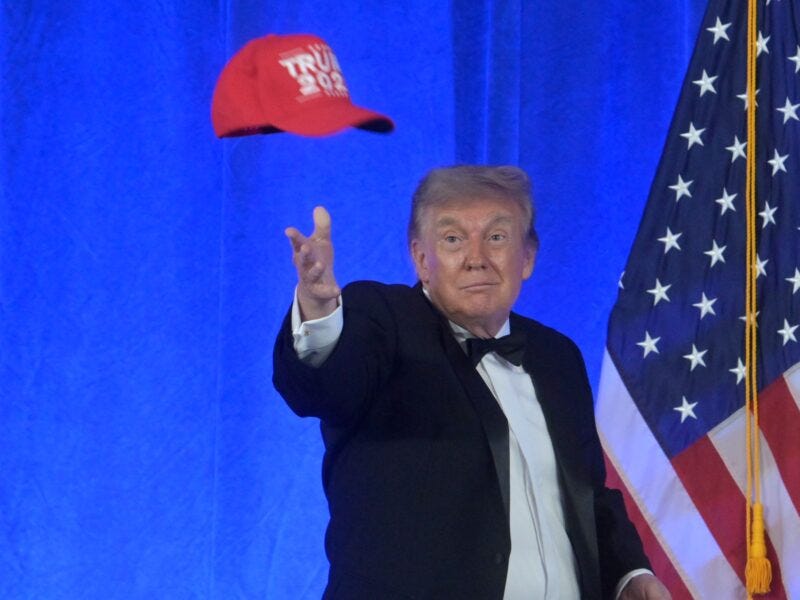
Late Saturday night the President of the United States posted that Republican senators must terminate the filibuster and pass the SAVE America Act before it is too late. He added that Democrats would do the same thing the moment they got the chance.
He has been saying versions of this since March. In February the White House press secretary said his patience was running out. He has said the bill supersedes everything else, and at one point said he would not sign any other legislation until it passed.
The bill would require documentary proof of citizenship to register to vote, which for most people means a passport or a certified birth certificate presented in person. It would impose photo identification at the polls. It would require states to submit their voter rolls to a Department of Homeland Security screening tool that has been documented to erroneously flag American citizens as noncitizens. It is aimed at noncitizen voting in federal elections, which is already illegal, already prosecuted, and vanishingly rare.
The House passed it in February, 218 to 213. It has been stuck in the Senate ever since, because it needs sixty votes and Republicans have fifty-three, and because Lisa Murkowski voted against even proceeding to it. It failed outright on June 4 as an amendment to an immigration funding package. John Thune has said repeatedly that his caucus is nowhere near having the votes to end the filibuster, and has reduced the whole matter to a sentence about votes and math. On Sunday, Joni Ernst went on the record refusing, saying the Senate would become a glorified House and the country would get whiplash.
So the filibuster is holding, against a president of the majority party who is demanding it be destroyed to pass an elections bill.
Which brings us to January 2022, and to two entries in this publication’s permanent Registry.
The mirror
In January 2022, the Freedom to Vote Act and the John Lewis Voting Rights Advancement Act were before the Senate. Both concerned federal protection of the franchise. Both had majority support. Neither could reach sixty.
Kyrsten Sinema, who had come up as a Green Party activist and who held one of the fifty votes needed to set the rule aside, went to the floor and delivered a speech defending the filibuster instead. Joe Manchin had spent months negotiating the Freedom to Vote Act, attached his name to it as lead author, and pledged to find ten Republicans to pass it through regular order. He found zero. When that premise failed its public test, he voted against a talking-filibuster exception that would have saved his own bill.
Both bills died. Neither senator is in the Senate now.
Their stated argument was not procedural fussiness, and it deserves to be stated accurately because it is about to be tested in front of us. The argument was that the filibuster protects the minority, that it forces the parties to negotiate, and above all that a Democratic majority which broke the rule for its own purposes would hand a future Republican majority the identical power to do whatever it wanted.
That was the case. Break it now and they will use it later.
Four years and seven months later, a Republican president is publicly demanding that the rule be terminated in order to pass a bill restricting voter registration, and is telling his own senators that Democrats would do it to them first.
So were they right
This is the uncomfortable part and it should not be skipped over, because skipping it is how a piece like this becomes worthless.
On the narrowest reading, the mechanism they described is functioning exactly as they said it would. The rule they preserved is currently the obstacle standing between the SAVE America Act and the President’s desk. Had the Senate gone to fifty-one votes in January 2022, it would be at fifty-one votes now, and fifty-three Republicans would pass this bill in an afternoon.
That is real and I am not going to pretend otherwise.
Here is why it does not redeem them.
The filibuster is a shield, and a shield preserves whatever is behind it. What was behind it in 2022 was the pre-existing state of American election law, which the Freedom to Vote Act and the John Lewis Act existed to repair, because it was already inadequate. By declining to pass those bills, Sinema and Manchin did not preserve voting rights. They preserved a gap. The rule is now guarding an absence they helped create.
And in the years since, nearly everything those bills would have protected has been dismantled by means the filibuster does not touch.
State legislatures have adopted SAVE-style proof-of-citizenship requirements across the country without any federal action at all. The Foreign Malign Influence Center, which tracked election threats, was declared redundant. CISA’s Election Security Program was eliminated. The FBI task force on foreign influence operations targeting elections was disbanded. The State Department’s counter-disinformation office was closed. The Multi-State Information Sharing and Analysis Center, which monitored the systems that actually run elections in eighteen thousand jurisdictions, was defunded.
Not one of those required sixty votes. Not one of them required a single vote.
And they are going around it anyway
The final piece is that the filibuster is not even holding the line it is credited with holding.
Republican leadership, unable to get the votes to break the rule, has turned to budget reconciliation, which requires fifty-one and cannot be filibustered. In July the House passed a reconciliation framework 216 to 214 containing ten billion dollars in election-related grants over ten years, structured to induce states into adopting the measures the Senate refused to pass.
Reconciliation has limits. Provisions must relate to taxes and spending, and the Senate parliamentarian decides which qualify. So the bill cannot pass in full this way.
But money can, and money is how the states get moved, and the states are where the registration rules actually live.
The filibuster stopped a bill. It did not stop the policy. It has produced a situation in which the same objective is being pursued through appropriations, executive action, agency closure, and fifty state legislatures, while everyone argues about a Senate rule that governs one of the five doors.
What it is worth
There is no principle here and there never was. The filibuster is sacred to whoever it currently protects and intolerable to whoever it currently blocks, and both parties have demonstrated this inside of four years with the same bill category, the franchise, sitting on the table.
Democrats in 2022 said breaking it would be an abuse and Republicans in 2026 are demanding it be broken. Republicans in 2022 relied on it and Democrats in 2026 are relying on it. Every argument now in the air was made in the opposite direction by the same institutions within a single presidential term, and everybody involved knows it, and nobody is embarrassed.
Sinema and Manchin were told at the time that they were trading a permanent protection for a temporary one. They said the temporary one was worth more.
The rule is still standing. The protections are gone. The offices that watched for interference are closed. The states are passing the bill themselves. And the president is on Truth Social at midnight demanding that the one thing they saved be terminated, which it may yet be, by a caucus that has not found the votes today and is not required to keep failing forever.
They gave up something permanent to preserve something that lasts exactly as long as fifty-three Republicans decline to change their minds.