


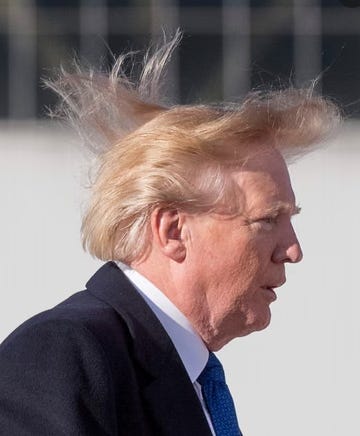
There is a man standing in the doorway of the United States Senate, and he will not let anyone leave.
The senators would like to leave. It is nearly August, and August is when they go home, and going home in an election year is not lounging by a pool, it is the part of the job where they stand in a parking lot in Ohio and convince strangers to return them to Washington. They want to go. Their leader wants them to go. And a man is blocking the door, arms folded, insisting that nobody moves an inch until the chamber passes a particular bill, which it has already declined to pass on several previous occasions, and which addresses a problem that does not exist, using a solution that would injure the people blocking the door on his behalf.
I want to examine this situation slowly, because it is genuinely one of the strangest things in American politics right now, and its strangeness has been buried under headlines about recess schedules, as though the interesting part were the calendar.
The Crime That Is Already a Crime
The bill is called the SAVE Act, which stands for Safeguard American Voter Eligibility, an acronym assembled with the care of a man naming a boat. Its purpose is to prevent noncitizens from voting in federal elections.
Here we must pause, at the very first step, because we have already encountered the difficulty, and the difficulty never goes away, it just gets larger.
Noncitizens voting in federal elections is already illegal. It has been illegal since 1996. It is a federal crime punishable by fines, imprisonment, and deportation, which is a fairly complete set of deterrents to offer a person for the privilege of casting one additional vote among a hundred and fifty million. And it essentially never happens. Study after study, including audits conducted by Republican officials in Republican states specifically hoping to find it, has turned up numbers so small they must be expressed in decimals. A review in one state found potential noncitizen votes at a rate of 0.0001 percent. This is not a loophole. This is not a crisis. This is a thing that is against the law and that nobody does, which describes most of the more exotic crimes, and for which we do not typically cancel the Senate’s summer.
So the bill’s entire purpose is to prevent something that is prevented, punish something that is punished, and stop something that is not occurring. It is a law against ghosts. It is a very serious padlock, forged at great expense, and bolted onto a door that was already locked, in a house nobody is trying to enter.
The man in the Senate doorway would like this padlock installed so badly that he will not let anyone go on vacation until it is done.
The Padlock Locks the Owner Out
Now we arrive at the part that would be the centerpiece of any competent farce, and which is, instead, simply the situation.
To prove you are a citizen under this bill, you must produce a document, in person, and the documents it will accept are essentially a passport or a birth certificate. This sounds reasonable for approximately four seconds, which is how long it takes to remember that half the country does not have a passport, and that a birth certificate has one job, which is to record the name you were given at birth, a name that tens of millions of Americans no longer legally use.
I am referring, of course, to married women.
Roughly sixty-nine million American women have changed their surname upon marriage. Their birth certificates say one name. Their driver’s licenses, their voter registrations, their entire adult lives, say another. Under this bill, the document proving they were born does not match the name under which they vote, and so, to exercise a right they already possess, they must go and assemble additional paperwork, in person, to reconcile the woman they are with the infant they were.
Consider who this describes. It describes the suburban wife. It describes the churchgoing mother of four in a red state who took her husband’s name in 1994 because that is what one did. It describes, with almost surgical precision, a substantial share of the exact demographic that the man in the doorway is counting on to keep him in power. He has designed a lock, and the person it most reliably shuts out is his own most loyal voter, standing at the registration table in a small town, holding a birth certificate with a maiden name on it, being told to come back with more forms.
The bill also lands hardest on rural voters, who now must travel great distances, in person, to register, in the parts of the country that are reliably his. And on lower-income Americans, only one in five of whom hold a passport. And on younger and working-class citizens generally, the passport being, as it turns out, a document that tracks income rather closely, which is why the people confidently waving theirs around tend not to have noticed that most of the country’s is in a drawer, expired, or was never obtained, because a passport is what you buy when you can afford to leave, and most people cannot.
He has, in short, built a machine to disenfranchise his own base, and he is willing to hold the Senate hostage to switch it on.
The Sixth Attempt at the Same Locked Door
And here is the detail that elevates the whole enterprise from farce into something closer to a myth about a man and a boulder.
This has already failed. Repeatedly. The Senate has taken up this bill and things like it multiple times, and it has not passed, because passing it requires sixty votes and the votes are not there and everyone involved knows the votes are not there. The leader of the Senate, a mild man from South Dakota named Thune, has now said so out loud, in the flattest and most devastating possible terms. “Show me how this ends,” he said. “We voted on it two, three, four, five times already.”
Two, three, four, five times already. He lost count of the failures, which is its own small poem.
The man in the doorway’s response to being told the bill cannot pass is to demand that it be passed anyway, and, when that does not work, to demand that the Senate simply abolish the rule requiring sixty votes, the filibuster, so that his party can, in his words, “quickly pass everything they ever dreamed of.” He would like to remove the lock on the entire building in order to install a lock on a door that is already locked. He is, at every level, at every scale, obsessed with locks, forever tightening a bolt on a thing that was never open, while the actual doors of the republic swing gently in the wind behind him.
Thune, to his credit, looked at the assembled press and asked the only sane question available to a man in his position. “Do you guys want to be here in August? What do you think?”
Nobody wants to be here in August. That is the one thing in this entire affair on which every human being agrees. The senators want to campaign. The staff want to breathe. The country is not asking for this. And a man is standing in the doorway, refusing to let summer begin, because the door that is locked is not, in his estimation, locked enough.
What the Lock Is Actually For
I have been calling it absurd, and it is absurd, and I want to be careful now, because the absurdity is the wrapping and not the thing inside.
He told us what it is for. He does not hide it, and he has never hidden it, and this is the part where the comedy has to stop, because he said, of this bill, that it would “guarantee the midterms.”
Guarantee. Look hard at the word, because it is not a word you use about a fair fight. You do not guarantee a race you intend to win on the merits. You guarantee an outcome you intend to arrange. The padlock against the crime that does not happen was never really about the crime that does not happen. It is a machine for deciding, in advance, who gets to vote, calibrated so precisely that it strains out the poor, the rural, the young, and the married woman with the mismatched certificate, and it is being sold as protection against a phantom so that the actual function, the thinning of the electorate, can happen under a respectable name.
That is why he will stand in the doorway. That is why he will burn his own senators’ campaign weeks and demand the destruction of the Senate’s own rules and lose count, with Thune, of how many times it has already failed. Because the prize is not the padlock. The prize is the quiet power to determine, before a single vote is cast, whose vote will count, and a man who has told you plainly that he wants to guarantee an election is a man describing, out loud, in the doorway, with his arms folded, the one crime in this entire story that is actually being attempted.
It is just not the crime the bill claims to stop.
It is the bill.
Hahahahahahahahahaha!
Let's see if this is the issue that will strengthen Republican Congressional spine.
Hahahahawhoooohahaha!
There is no cure for stupidity...