


Grover Cleveland signed Labor Day into federal law on June 28, 1894. Six days before that, he had ordered federal troops into Chicago to break the Pullman strike, over the objection of the governor of Illinois. Workers died. Eugene Debs went to prison. The holiday was, in the most direct historical sense, a gesture of conciliation from a president who had just used the army against the people it was meant to honor.
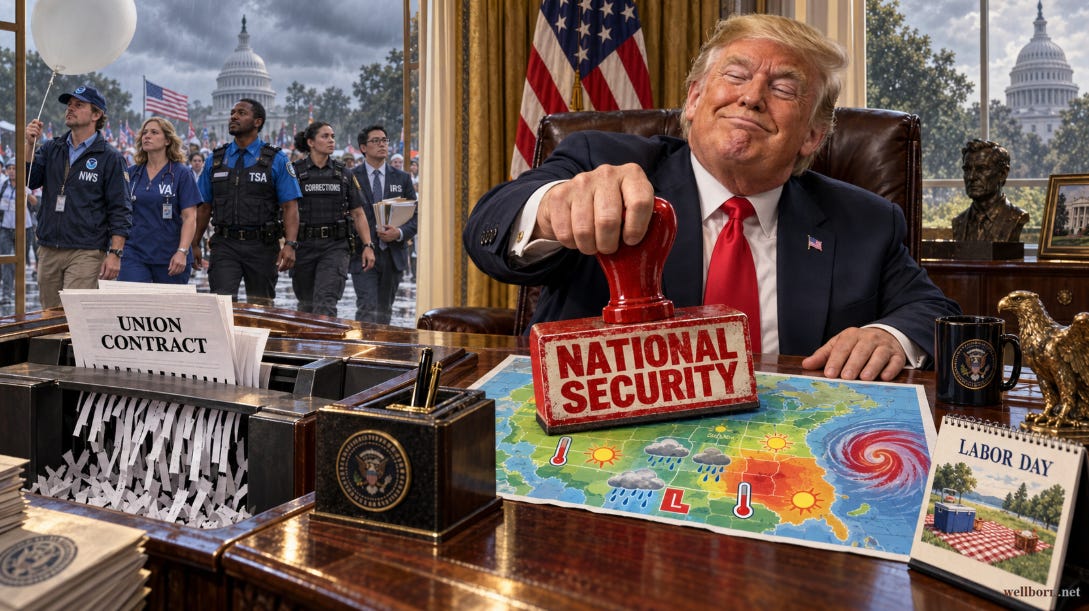
That history matters this morning, because the president currently presiding over Labor Day has done something Cleveland never managed. He has removed the right to bargain collectively from roughly 85 percent of the unionized federal workforce, more than 950,000 people, without passing a law, by invoking a national security exemption broad enough to cover the National Weather Service.
How it was done
The mechanism is two executive orders and one word.
Federal labor law has always contained an exception. The president may exclude an agency from collective bargaining if its primary function is intelligence, counterintelligence, investigative, or national security work, and if bargaining cannot be applied consistently with those requirements. It exists so that the CIA does not have to negotiate shift schedules with a union. It has been used sparingly for decades, by presidents of both parties, for agencies that plainly fit the description.
On March 27, 2025, Executive Order 14251 applied that exemption to more than a dozen agencies at once, including the Department of Defense, the Department of Veterans Affairs, the Treasury, the Justice Department, the FDA, the CDC, and the Environmental Protection Agency. On August 28, 2025, Executive Order 14343 extended it further, to NASA, to NOAA, and to the National Weather Service.
The stated rationale is that each of these agencies has national security as a primary function. That claim is made in the order’s own text. The people who forecast tomorrow’s weather in Des Moines are, for purposes of federal labor law, now a national security workforce, and therefore cannot have a union.
What followed
The orders were challenged immediately, and federal courts in Washington and California enjoined them, though those injunctions were later stayed on appeal. The administration filed its own lawsuits seeking a ruling that terminating the contracts was lawful, and when courts in Kentucky and Texas dismissed those suits, the administration withdrew its appeals and proceeded anyway, without the legal certainty it had gone to court to obtain.
On February 12, 2026, the Office of Personnel Management instructed agencies to begin cancelling or rewriting their collective bargaining agreements regardless of the pending litigation. The IRS terminated its contract with the Treasury employees’ union on February 27. The Department of Defense, whose largest union represents 300,000 workers, began terminating its agreements in April. The Bureau of Prisons cancelled the contract covering more than 30,000 corrections officers in September 2025, on the stated grounds that the union had become an obstacle rather than a partner.
The Veterans Affairs department cancelled an agreement covering 320,000 employees. A federal court found that cancellation was likely retaliation and ordered it reinstated. The department’s response to that ruling is not yet clear.
The day the House acted, and the day after
On December 11, 2025, the House of Representatives passed the Protecting America’s Workforce Act, a bipartisan bill to overturn Executive Order 14251 and restore bargaining rights. It is the only time in this Congress that the House has voted to reverse one of the president’s executive orders, and it did so with Republican votes.
On December 12, one day later, the Department of Homeland Security terminated the union contract covering 47,000 Transportation Security Administration officers, the people who screen bags at every airport in the country. An injunction had been in place blocking exactly that action since June. The department did it anyway.
That sequence is the whole story in forty-eight hours. Congress asserted itself, across party lines, for the first time on this subject, and the executive branch answered the next morning by doing the thing Congress had just voted against, in defiance of a standing court order, to the workforce most Americans encounter in person.
Why this belongs on the tracker and also in your kitchen
The pattern will be familiar to anyone who has followed the dismantling record here. No statute was repealed. No vote was taken. A pre-existing exemption designed for spies was stretched, by executive order, to cover meteorologists and prison guards and the people who process your veterans’ benefits, and once the exemption applied, the contracts could simply be cancelled. Courts objected. The objection produced rulings. The rulings produced no change in behavior.
But this one is different from the inspection cuts and the fired commissioners in one respect, which is that it touches people you meet.
The TSA officer at the airport this weekend. The VA nurse. The weather forecaster whose warnings you will rely on in hurricane season, which is now, with FEMA’s surge force at 240. The corrections officer. The IRS employee who processes your refund. Nearly a million people whose terms of employment were, until last year, negotiated, and are now set unilaterally by an administration that has spent eighteen months describing federal workers as the problem.
The MS NOW piece that ran this morning describes the unions as beaten and weakened but not busted, which is accurate and also the most optimistic available framing. The dues are down because the automatic deduction was cancelled along with the contracts. The grievance procedures are gone. What remains is a set of organizations that can still sue, still testify, and still turn people out, with considerably less money to do any of it.
The Cleveland precedent
Cleveland at least understood he had done something that required a gesture. He signed the holiday because the Pullman strike had made him, briefly, the most hated man in American labor, and a day off was cheaper than a reckoning.
There is no gesture this year. The White House will issue the customary proclamation, the one every administration issues, honoring the American worker in general terms. It will not mention the 950,000 specific ones. It will not mention the Weather Service. It will not mention that the House voted, on a bipartisan basis, to undo this, and that the answer arrived the next day at the airport.
Labor Day was created by a president who had just broken a strike, as an apology he did not quite make. The current one has removed the mechanism through which the next strike would have been negotiated, and has offered nothing in its place except the holiday itself, which was already on the calendar.
Enjoy the day off. Somebody bargained for it.
Proof that court rulings have no enforcement mechanism when the Federal Government is itself the problem.