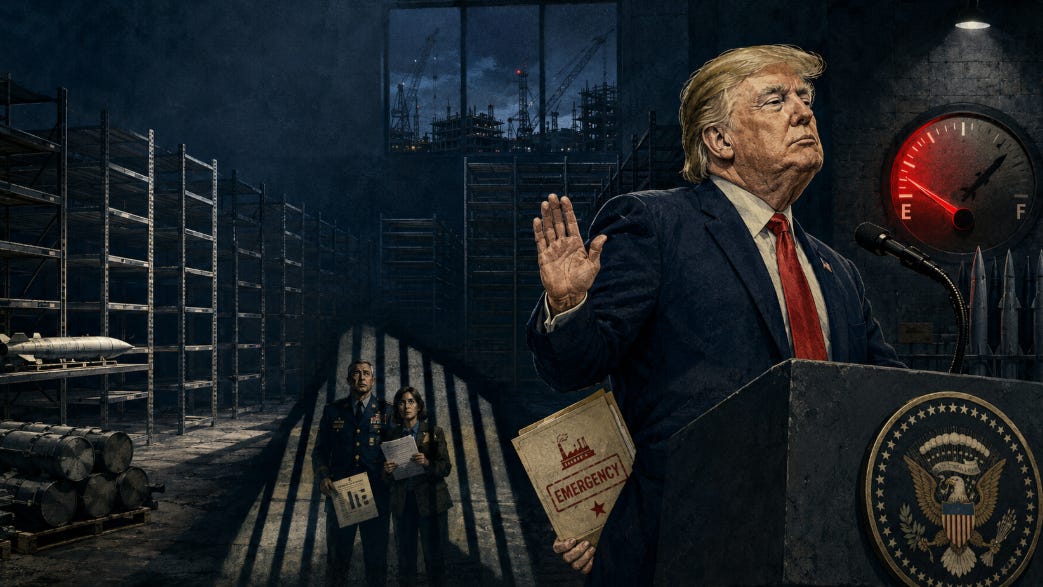
At midnight on Wednesday the President of the United States posted that the country has massive amounts of munitions, that large quantities are being manufactured and shipped in as needed, and that defense companies are building the largest number of plants and factories in American history.
Then he wrote that the leakers of these treasonous statements are being hunted down, and promised that long prison sentences would be sought.
The statements he was calling treasonous were these. Reuters reported that American supplies of the Army Tactical Missile System and the Precision Strike Missile were virtually all depleted. CNN reported that interceptor stocks had been heavily drawn down. CSIS put the remaining Patriot inventory at fewer than 827 units against roughly 2,200 before the war, with THAAD down about thirty-eight percent. The Washington Post reported that Trump had berated Pete Hegseth at Camp David over the shortage, which the White House press secretary said literally never happened and which Trump answered by declaring himself extremely happy with Hegseth’s performance.
Twelve hours after the midnight post, a reporter asked him why a multibillion-dollar supplemental request was necessary if there were no shortages.
He said that certain munitions are very powerful and in virtually unlimited supply, and that there are others where it is a little bit tighter.
That is the whole story, and it took half a day.
The memo
Here is the part that has not been reported alongside the rest, and it should be.
In June, Trump invoked the Defense Production Act to accelerate munitions manufacturing. The presidential memorandum that did it cites industrial-base constraints. It warns that slow production rates threaten the national defense. It orders federal agencies to give priority support to critical munitions programs, directs the Pentagon to identify the most urgent production bottlenecks, and instructs the government to find supply-chain dependencies that could slow replacement rates during a prolonged conflict.
That document says the United States cannot replace what it is spending fast enough, in a prolonged conflict, and that this is a national security threat.
It carries his signature.
So the position as of this week is that the munitions shortage is a fabrication invented by traitors, and also the reason he invoked emergency wartime production authority two months ago, and also the reason his administration is preparing to ask Congress for a sum that Hegseth has publicly floated at around two hundred billion dollars, explaining that it takes money to kill bad guys.
The general told him first
Before the war began, according to Washington Post reporting, the Chairman of the Joint Chiefs of Staff, General Dan Caine, warned the White House that weapons shortages and limited allied support would significantly increase the risk both to the mission and to American troops.
That is the same information now classified as treasonous. It reached the president through the ordinary chain of command, from the highest-ranking officer in the armed forces, before a single American aircraft launched.
He was not leaked to. He was briefed.
Since then the Pentagon has told Congress the operation consumed roughly $5.6 billion in munitions in its first two days and about $11.3 billion by day six. NBC has reported that commanders in the region have begun declining to intercept incoming Iranian missiles headed toward unpopulated areas of American bases, in order to conserve interceptors. Six American soldiers had been killed as of that reporting.
You do not ration air defense over a stockpile that is massive.
What he is actually objecting to
Note what he did not do. He did not produce a number. He did not release an inventory. He did not have the Pentagon publish a rebuttal with figures.
He threatened to imprison the people who talked.
That distinction matters, because it tells you what the complaint is. If the reporting were wrong, the remedy is the correct number, and the administration has the correct number and has had it all along. Officials told reporters privately that the president’s concern is that the shortage stories make the United States look weak in negotiations.
That is not a claim that the reporting is false. It is a claim that the reporting is inconvenient, which is an entirely different thing and which he has never once been asked to reconcile.
The apparatus already exists
The threat is not idle and it is not new.
Last month the Justice Department subpoenaed four New York Times reporters and sought their phone records to identify who told them about Secret Service concerns regarding the Qatari-donated aircraft Trump has been using as Air Force One. That probe was later dismissed, but the subpoenas were real and the phone records were sought.
Hegseth imposed restrictions on Pentagon press access last year that made routine defense reporting substantially harder. Information about munitions inventories is largely classified, which means the only way the public learns the stockpile is drawn down is precisely the way it learned it: somebody inside tells a reporter.
So the mechanism is complete. Classify the number. Restrict the reporters who cover the building. Then, when the number reaches the public anyway, announce that transmitting it is treason and that the transmitters are being hunted.
The thing underneath
Strip out the posts and what remains is an arithmetic problem that does not care what anyone says about it.
The United States produces 183 of the high-end Patriot interceptors a year. Contract to delivery runs about three and a half years. CSIS estimates replenishment takes at least three years and describes a window of vulnerability for a Western Pacific conflict. Deliveries to Japan, Australia, and the Netherlands have reportedly been delayed to backfill American stocks.
None of that changes based on whether anyone is permitted to say it out loud. The interceptors do not come back because the people who counted them go to prison.
And that is the actual danger in a president who responds to a supply problem by hunting the people who reported it. Not the lie, which is transparent and lasted twelve hours before he corrected it himself in front of reporters. The danger is that the next officer who notices something going wrong now understands exactly what happens to people who mention it, and the president has spent eighteen months removing everyone whose job was to tell him things he did not want to hear.
He signed the memo in June. He knows the number. He has always known the number.
What he wants is for the number to be a secret from everyone except the people who have to fight with it.