


At the UN General Assembly on September 22, Donald Trump described the future of Iran as a choice between two outcomes, stated back to back, in his own words: “Will a deal be made with Iran that lets them rebuild and create a far greater country than it ever was before? Or do I annihilate the Islamic Republic and do it quickly, never giving them a chance to kill and destroy people?”
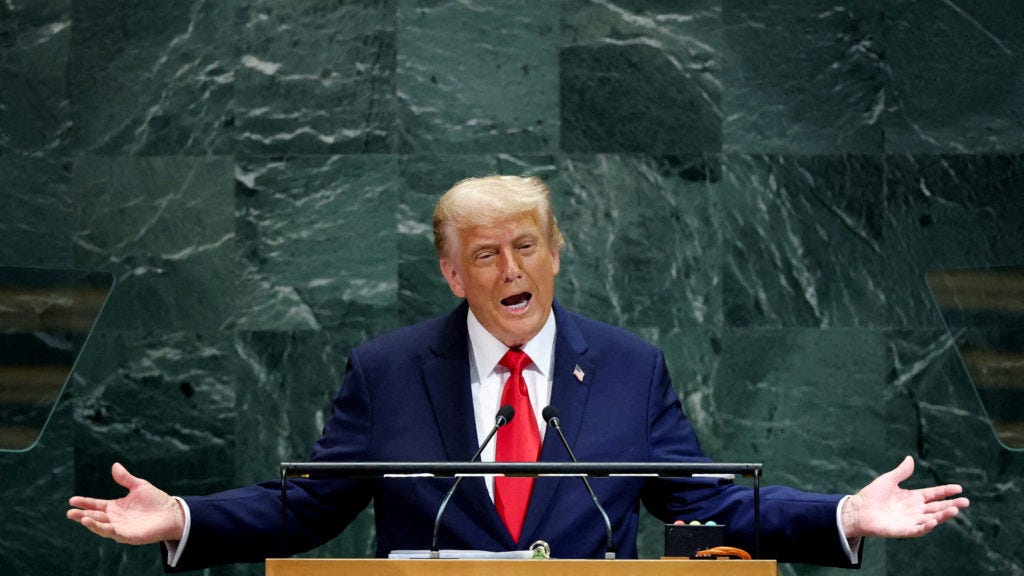
He then put a date on it. He predicted the deal would arrive “right after the election,” in November, and said Iran was stalling negotiations “to see how I do in the midterm election.” In the same speech he said the opposite: “I am not running. I gave absolutely no credence and will not give credence to the election when it comes to Iran.” Both statements are on the record, minutes apart, from the same man describing the same decision.
The speech arrived on top of a live standoff, not ahead of one. A ceasefire between the US, Israel, and Iran has been renegotiated four times since April, each round following documented violations on both sides: Iran keeping the Strait of Hormuz effectively closed and charging shipping over a million dollars a vessel to pass, Israel striking Lebanon under the operation name Eternal Darkness, the US imposing a naval blockade and hitting Iranian vessels and infrastructure directly. The most recent memorandum of understanding is from June 17. What Trump described at the UN is the fifth round of that same standoff, this time delivered to the entire world at once instead of negotiated behind closed doors.
The administration’s case for the posture is not frivolous and belongs in the record next to everything above it. Trump’s stated bottom line, that Iran will never have a nuclear weapon, is a goal most of Washington shares regardless of party, and the diplomatic track has produced two signed agreements this year, however fragile. Kushner and Witkoff reportedly had what Trump called a good meeting with Iranian representatives on the sidelines of the same UN gathering, meaning the talking and the annihilation threat are running in parallel, not sequence. A president keeping “anything could happen with me” on the table, as he put it, is a page from a deterrence playbook that predates him by decades: uncertainty as leverage.
The problem is what he attached the uncertainty to. Nuclear brinkmanship built on genuine unpredictability is one thing. Nuclear brinkmanship with a publicly stated release date, tied to a midterm election, in the same breath as a denial that the election has anything to do with it, is a different thing. Say the decision truly turns on Iranian conduct and nothing else. Then the election date is irrelevant, and there was no reason to say “right after the election” out loud, twice, in front of every foreign ministry on earth. Say instead that domestic politics genuinely shapes the timing, which is what “how I do in the midterms” describes Iran as calculating around. Then the president just confirmed, at the UN podium, that the credibility of an annihilation threat against a nation of ninety million people is downstream of a House and Senate map. Both readings are worse than the one he offered, which is that the two statements simply don’t have to reconcile with each other for him to have said them.
Four ceasefires in five months looks less like a plan working than like a plan being renegotiated on a rolling basis, while a full-closure toll still sits on the Strait of Hormuz and diesel prices sit at a record set the same week. The war has yet to restart, and it has yet to end either, which is exactly the condition under which a threat this specific, delivered this publicly, gets tested before November by whichever side decides to call it.
Trump's ballroom Hitler bunker and sniper arch come to mind when he says the midterms don't matter. And the United States under Donald Trump is THE preeminent nuclear threat to the world.