


The USS Theodore Roosevelt left San Diego on Sunday. It is a Nimitz-class carrier with Carrier Air Wing 11 aboard, F-35Cs and Super Hornets, escorted by the cruiser Chosin, and it is sailing for the waters around Iran.
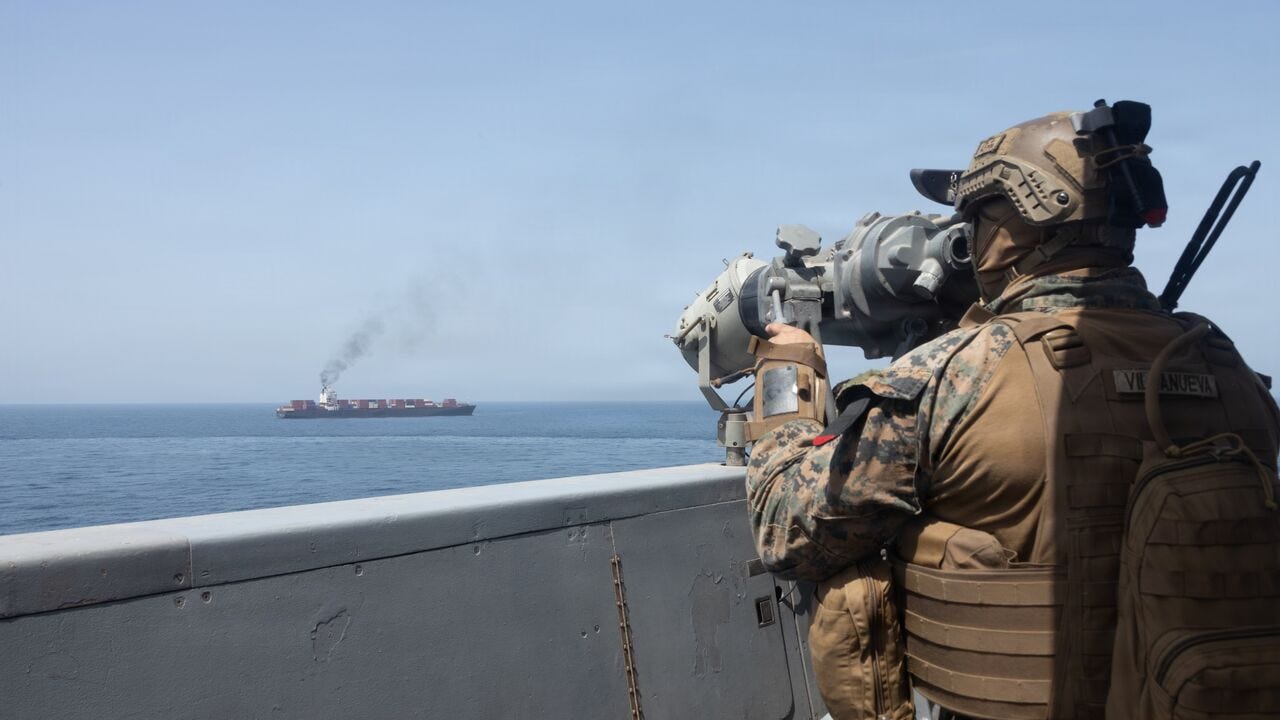
Behind it goes the amphibious group built around the USS Makin Island, with the John P. Murtha and the Anchorage, carrying the 13th Marine Expeditionary Unit, more than 2,000 Marines. Together that is roughly 9,000 additional sailors and Marines. When they arrive they will join two carriers already on station, the George H.W. Bush and the George Washington, and the Boxer’s amphibious group, which will put three American carrier strike groups and two amphibious ready groups around one country at the same time. The last time the United States had three carriers in that region at once was 2003, in the weeks before the invasion of Iraq. By the time the deployment is complete, more than 60,000 American military personnel will be in the Middle East. The Roosevelt is expected on station in late October. The midterm election is November 3.
Those are the facts of the deployment, and on their own they describe a decision that has not been announced. The rest of this piece is about the three things that sit around it: what the president said this war would be, what he has said about when he will decide its next phase, and what it is already costing the people who vote in thirty-two days.
What he said it would be
On March 1, the day an Iranian strike killed six Americans at the port of Shuaiba in Kuwait, Trump said the war would last “four to five weeks.” On March 2 he repeated the estimate and added that the military had the “capability to go far longer.” On March 7 he called it “a short excursion.” On March 9 he said it was “pretty much” complete. On March 11 he told Axios it would end soon because there was “practically nothing left to target.” On March 26 he said the mission had been estimated at “four to six weeks” and was “way ahead of schedule.” On April 1, thirty-two days in, he gave a prime-time address asking the country for “a little bit more time,” and said strikes would continue “for the next two or three weeks.” On April 20 he said a deal would “all happen, relatively quickly.”
It is now October 2. The war is in its eighth month. The ceasefire that followed the April address has been renegotiated four times, most recently in a June memorandum that has since collapsed into a naval blockade, a tolled Strait of Hormuz, a Houthi drone strike on a Saudi power station last week, and a FlyDubai copilot who stabbed his captain on Wednesday and tried to put an Israel-bound airliner into the ground. The Pentagon has completed its withdrawal from Iraq, which the Iranian-backed militias there had demanded for years. Iran’s Revolutionary Guard published a letter to American voters on Monday. The four-to-five-week war has outlasted every date its author gave it, and the force now sailing toward it is larger than the one that started it.
What he said about when
Here the record is unusually direct, because the president supplied it himself at the United Nations on September 22. He told the General Assembly that the choice was between a deal with Iran and annihilating it. He predicted the deal would arrive “right after the election.” He said Iran was stalling the negotiations “to see how I do in the midterm election.” And he said, in the same speech, that he was not running and would “not give credence to the election when it comes to Iran.” This publication noted at the time that the two statements cannot both be operative. He has since made the calendar more explicit, not less. On September 26 he rejected Iran’s seven-day ceasefire proposal, which would have reopened the strait in exchange for lifting the blockade and the oil sanctions, and said “things that I wouldn’t have approved a year ago I wouldn’t have today.” Asked whether he would strike Iran before the midterms, he said he did not want to say, then “it’s possible,” then again that he did not want to say. The Wall Street Journal reported that he expects to resume bombing after the vote. And on Wednesday, asked about the FlyDubai incident and whether Iran was behind it, he said “they’ll be hit very hard, don’t worry,” and then, in case the sentence had been missed, “they’ll be hit very hard.” Asked where, he said he could not say, because “you’re asking, where are you going to bomb?”
The two records contradict each other on the only point that matters. The president has said that the decision on the next phase of the war is tied to the election, and he has said the opposite, and while saying both he has moved the largest American force since the Iraq invasion to arrive in the last days of October. Either the decision is a military one, driven by Iranian conduct, in which case the election date is irrelevant and it was gratuitous to say “right after the election” to the United Nations. Or the decision is being held until the votes are counted, in which case 60,000 Americans are being positioned around a House map. The administration has not chosen between those readings in public, and the ships do not require it to.
There is a third possibility, and fairness requires stating it. The buildup may be the lever, with the blow never intended to land. Treasury Secretary Bessent said this week that Iran’s economy will collapse within two weeks; the rial crossed 2.5 million to the dollar on Tuesday, a record. Oil exports through the Oman lane are at their highest since the war began. A credible threat of overwhelming force, arriving on a visible schedule, is how a negotiator extracts the deal he could not get with a seven-day proposal on the table. Trump told Axios he expects talks to resume this week. If the Roosevelt’s purpose is to make Tehran sign before it arrives, that is a defensible use of a carrier. The problem is that the president has attached the deadline to his own election rather than to anything Iran can control, and a threat whose timing is domestic reads, in Tehran and in Riyadh, as a threat about domestic politics. The Iranian military’s own response this week, per Reuters, was to review retaliation targets beyond the region. Patriot batteries went to Saudi Arabia and Qatar in the same news cycle. Nobody in the Gulf is reading the Roosevelt as a bargaining chip.
What it has already cost
The Pentagon’s own figure, reported to Congress on September 18, is $43.6 billion through September 3: $11.2 billion in operating costs, fuel, combat pay, medical care, and $32.4 billion in munitions and aircraft that have been expended or destroyed and not replaced. That number has risen with every estimate. The Defense Department’s inspector general had it at $33.4 billion through June; the Congressional Budget Office at $38.1 billion through July; Hegseth testified in July that it would be $37.5 billion through the end of September, which it passed in early September. The department says the war now costs $2 billion to $3 billion a month and has requested a $67.1 billion supplemental appropriation. Nearly every Democratic senator and both independents signed a letter demanding a full accounting. The Roosevelt’s deployment is not in any of those numbers yet.
The casualties are counted two ways. The Pentagon’s Defense Casualty Analysis System listed 19 American dead and more than 820 wounded as of September 18, the day it identified the nineteenth, Captain Bianca Wilkerson of Norfolk, who died in Qatar. Five U.S. officials told the Washington Post the real figure is at least 22; a sixth said 23. In July an Iranian-linked drone attack in Jordan killed American service members, and the intelligence assessment that leaked last week says Chinese groups helped Iran aim it. Those are the costs borne by the people who were sent. The costs borne by everyone else arrived in the bond market this week.
On Wednesday the yield on the ten-year Treasury note reached 5.34 percent, the highest since 2002. The thirty-year is near 5.6. The analysts quoted by Reuters named the drivers: central banks raising rates against inflation, enormous capital demand from the AI buildout, and, in the words of one, “large government deficits.” A $67 billion war supplemental on top of a deficit that was already the subject of the debt-ceiling fight is the kind of thing that moves that number, and the number is the one that sets mortgage rates, car loans, and the cost of every business that borrows. Brent crude spent last week between $103 and $108 and is just under $100 this morning. Diesel set a national record last month. A Reuters/Ipsos poll in late August found 59 percent of Americans disapproved of the strikes on Iran, 54 percent said the war had not been worth it, and the cost of living was the top concern going into November. The war the president said would take five weeks is, by the government’s own accounting, the single largest new line in the budget, and by the bond market’s accounting it is being paid for at the highest interest rate in twenty-four years.
What Congress did
Nothing that held. The War Powers Resolution gives a president sixty days from notifying Congress of hostilities before he must have authorization or withdraw. The administration’s notification was dated March 2. The clock ran out May 1. On April 30, hours before the deadline, the Senate rejected a resolution to end the war 47 to 50, with Susan Collins and Rand Paul the only Republicans in favor; it was the sixth such resolution to fail. The administration’s legal position, as stated by Hegseth, is that the sixty-day clock pauses during a ceasefire, which would mean that every one of the four ceasefires since April reset the authority the statute was written to limit. No court has ruled on that theory. No authorization for the use of force against Iran has been introduced by the administration or passed by either chamber. The Roosevelt is sailing toward a war that Congress has declined to authorize and declined to stop, which is the condition under which every American war since 1973 has been fought, and which has never before been combined with a president publicly dating his next decision to an election.
The thing to watch
The administration has set up a sequence that will be hard to read from the outside. Talks resume, or do not. The Roosevelt arrives in late October. The election is November 3. The president has said the deal comes after that, has said the bombing may come after that, and has said the election has nothing to do with it. Any of those outcomes will be described afterward as the plan.
What can be said now is the record. A war promised at five weeks is in its eighth month. Nineteen Americans, or twenty-three, are dead. The cost is $43.6 billion and rising at $2 billion to $3 billion a month, financed at the highest rates since 2002. The force now moving is the largest since 2003. And the man who ordered it has told the United Nations, the Wall Street Journal, and a press scrum on the South Lawn that the next phase waits for November 3, while insisting that November 3 has nothing to do with it. Voters are entitled to decide which of those they believe. The ships will arrive either way.
"the man who ordered it has told the United Nations, the Wall Street Journal, and a press scrum on the South Lawn that the next phase waits for November 3, while insisting that November 3 has nothing to do with it."
Well Trumpty, if it's about which party holds Congress after the midterms, it was never about Iran having nukes – now was it? We could name each "war" phase in between the cease-fires. Operation Epstein Fury to begin, Operation Insurrection Action coming in November.