

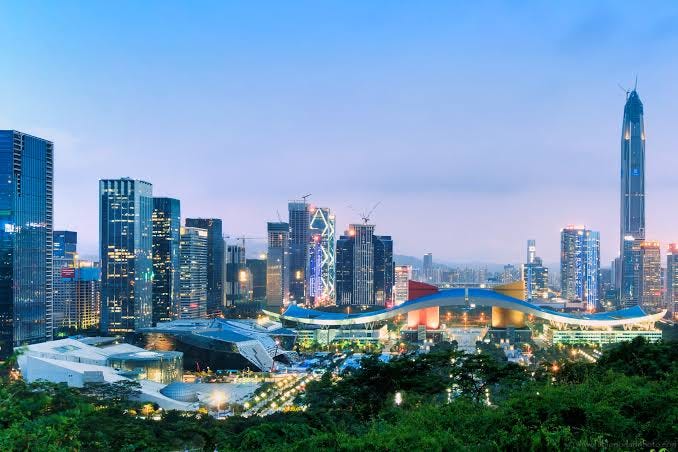
The meeting happened. On Thursday, at a round table in a state guesthouse called the Kylin Villa, the presidents of the United States, China and Russia sat down together for the first time. It lasted a little over an hour. “We are really making history,” the American president said at the top, and in the narrow sense he was right, since nobody had done it before.
On Monday I wrote that a president with a full hand goes to a meeting like this to get something, and a president two weeks off a midterm loss goes to be seen. I gave four things to watch. Here is how each came out, then the things I missed, then the ledger.
What’s on paper
Start with what exists. Reuters reported that the three leaders made no statements at the close. Chinese state media then published a four-point “Declaration toward Peace,” and The National printed its text. I can’t find a White House release of it as I write, so read what follows as Beijing’s version of what all three agreed to.
The four points: reform the United Nations. Increase the supply of refined petroleum and keep “stable energy flows.” Respect the immunities of state officials, with a warning that the International Criminal Court and bodies like it must not abuse their jurisdiction. And a reaffirmation that “a nuclear war cannot be won” and must never be fought, with a three-way dialogue to follow on nuclear risk.
Hold on to the third point. I’ll come back to it.
One: Taiwan language
I said any new phrasing on Taiwanese independence, however small, was the concession that would cost him nothing at home this week and a great deal later.
By the reporting so far, there was no new phrasing. According to an account based on Xinhua, the president said, “The United States does not support Taiwan independence.” That is the sentence American presidents have used for decades. Beijing has long wanted the verb changed to “opposes,” and it didn’t get that.
Two cautions. The sentence reached the world through Chinese state media, which chose to feature it. And the two governments agreed to draw up what they called a “constructive strategic stability action plan,” with no details and no timeline, in which Taiwan is expected to figure. Xi told him the United States must “do the right thing.” The $14 billion arms package for the island is still delayed. So the words held, and the place where new words could appear now has a name.
Two: chips
I said anything that loosened export controls, or promised to, would be read in Washington against the Nvidia timeline.
Nothing was loosened on paper. A White House official had said before the meeting that export controls were not up for negotiation. But the Associated Press reports that the president held off on tougher limits on China’s access to advanced AI chips, the ones Congress has been pushing since the scandal broke, and he said beforehand that he wouldn’t raise the spying allegations at all. The trade truce now runs to January 10.
One analyst, Craig Singleton, put Beijing’s aim plainly: “China wants chip access that it can negotiate with the president.” What it got this week was time. The tougher rules didn’t arrive, the truce outlasts this Congress, and the subject of how those chips reached China went unmentioned by the one person in the room with standing to mention it.
Three: Hormuz
I said that if the end of the Iran war were traded for something, the question would be what.
It wasn’t traded, because it wasn’t ended. The president said he and Xi both feel strongly that oil has to keep moving through the Strait of Hormuz. The declaration’s second point says the same thing at more length and adds a plan to boost refined fuel supply. Xi did not mention Iran by name in the room. The war is where it was on Wednesday.
That leaves a sentence all three could sign because it commits none of them to anything. China wants the strait open and has wanted it for months. Now it has the American president’s signature under the sentiment, and the strait is still shut.
Four: the picture
I said three men at one table was Putin’s whole objective and half of Xi’s, and that it would exist regardless of what was said.
It exists. Putin used his remarks to call the three countries “victors in World War II” who share responsibility for the peace, which is the Yalta frame his side floated last week. The American president called him “my friend” and said, “Wonderful things can come out of this.” They met separately for about forty minutes. Ukraine and its European allies weren’t in either room.
What I didn’t have on the list
Three things.
The first is that third point. The declaration says the immunity of state officials is of paramount importance and that the International Criminal Court must not abuse its jurisdiction. One of the three signers has been under an ICC arrest warrant since March 2023. If the text is accurate, the United States has put its name beside Russia’s and China’s on a sentence about whether sitting leaders can be charged. The administration has its own quarrel with that court, so this may have cost the president nothing he valued. It is still the most concrete line in the document, and it’s Putin’s. That’s my reading, and I’d want to see the White House’s own text before putting more weight on it.
The second is sanctions. The AP reports the president rejected new sanctions on Russia. Putin arrived days after a bridge to Crimea was crippled, by Reuters’s account, and left without the pressure increasing.
The third is the guest. On Monday the president said Kim Jong Un “may come,” and that it was up to Xi. No account I can find has Kim in Shenzhen. The train stayed home.
A few smaller notes from the wire. Chinese officials barred a Bloomberg reporter from the three-way session after she asked a question at the earlier one. Japan’s prime minister got no welcoming ceremony. And Japan and Taiwan both reported Russian military aircraft near their airspace during the week of the summit.
The ledger
Putin leaves with the photograph, the wartime-allies frame, a private forty minutes, no new sanctions, and a line about immunity.
Xi leaves having hosted it. He met the American president at the airport, which the president himself called a “win.” He has the chip rules where they were, a truce through January 10, an energy sentence, a Taiwan sentence on his own state media, and an “action plan” with a blank where the contents go.
The American president leaves with the phrase “making history,” a nuclear sentence, and a dialogue.
About that nuclear sentence. “A nuclear war cannot be won and must never be fought” was first said by Reagan and Gorbachev in 1985. All five permanent members of the Security Council, these three included, put out the same words in January 2022. His own official said before the trip that no agreement was expected, and that turned out to be exact. The dialogue has no date and no numbers. China, with around 600 warheads to the others’ 5,000-plus each, has said it won’t join limits written for bigger arsenals, and nothing reported from Thursday changes that.
The best case for it
There is one, and it should be stated.
The last treaty limiting American and Russian weapons expired in February. Three nuclear powers talking is better than three not talking. Nothing on Taiwan or chips was signed away. And the Reagan-Gorbachev sentence, when it was new, was also all that the 1985 Geneva summit produced. Two years later it was a treaty that eliminated a class of missiles. Dialogues are where those start.
The difference is in what each side needed. Reagan in 1985 had just won 49 states. He could wait, and the other side knew it. This president arrived two weeks after losing both houses, in the middle of a scandal about the very technology the host wants, and the other two men knew that as well. Analyst Scott Lucas called it “a summit of Trump’s ego, Putin’s tactics, China’s strategy.” On the evidence of the ledger, that’s about right.
What to watch now
January 10, when the trade truce expires and chips come back to the table. The Taiwan arms package, and whether the new Congress moves it over his objection. The Russia sanctions bill he has paused. Whether the “action plan” ever gets contents. And whether the White House publishes the declaration in its own words, including the third point.
He went to be seen, and he was. The other two went to collect.
"Three nuclear powers talking is better than three not talking."
Next time he should leave the bottle of Clairol.