


Yesterday I wrote that the president’s push to reinstate Jensen Huang was corruption, because Washington takes a cut of Nvidia’s China sales. I left something out. He owns the stock.
The Financial Times went through the president’s filings with the Office of Government Ethics and found that his investment accounts held as many as 370,000 Nvidia shares as of September 30. The low end of the range is about 32,000. On Monday, after the board brought Huang back, the stock rose more than 30 percent. If the holdings hadn’t changed, the FT estimates, that one day added between $1.3 million and $15 million to their value.
The same president spent the weekend working on the board. The FT says he “applied pressure.” Semafor reported that he called into Sunday’s board meeting. He told CNBC, “I spoke to them,” and then, “I made the deal.”
What’s going around
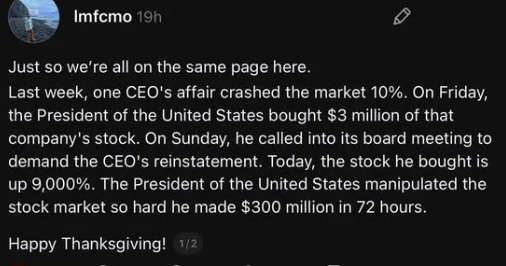
A version of this story is circulating with bigger numbers. It says the president bought $3 million of Nvidia after the scandal broke, that the stock is up 9,000 percent, and that he made $300 million in three days.
I can’t find support for any of the three. No filing shows a purchase after Huang resigned on November 12. The public disclosures stop at the end of September, so nobody outside his money managers knows what the accounts did this month. And Nvidia was worth roughly $3 trillion before the rebound. A 9,000 percent gain would make it worth more than every public company on earth combined. The stock rose about 31 percent on Monday.
I’m spending a paragraph on this because the true version doesn’t need the help, and a number that falls apart hands the White House an easy way to wave off the whole thing.

What the record does show
The trading history is long. CNBC counted at least 103 Nvidia trades in the president’s accounts since January 2025, worth a combined $27 million to $97.5 million. The Washington Post estimated the stake at $13 million to $62 million at the end of August. At the end of 2024 it was $615,000 to $1.3 million.
Some of the timing is hard to look at. In August 2025, about a week after the president confirmed a deal giving the government a share of Nvidia’s China revenue, his accounts bought $5 million to $25 million of the stock. The latest filing, released last week, shows purchases of up to $265,000 in September.
The White House’s answer
It has one. A spokesman said in October that third-party financial institutions manage the portfolio independently, and that it tracks “recognized indexes, such as the Schwab 1000.” He added, “There are no conflicts of interest.” CNBC noted that the disclosures contain no evidence the president directed any trade.
Take all of that as true. A portfolio that tracks a big index will hold Nvidia as a matter of course, and that’s a fair point. Suppose he has never picked a stock in his life. He still signs the disclosures, so he knows Nvidia is in there. A fund manager following an index can’t make a share price jump 30 percent in a day. A president who gets on the phone with a board and gets a chief executive reinstated can. The conflict sits in the official act, whoever placed the orders.
The law, such as it is
Here’s the part that’s hardest to explain to people. A federal criminal statute, 18 U.S.C. § 208, bars executive branch employees from taking part, in their official roles, in a matter that affects their own financial interests. A Commerce Department official who owned a meaningful amount of Nvidia stock and lobbied its board over the CEO would be exposed to prosecution.
The president is exempt. So is the vice president. A neighboring section says so in plain words. The usual reasoning is that a president can’t recuse himself from running the country. I’m not a lawyer, and that’s a summary, but the exemption is in the text. A cabinet secretary who held that stock and did what he did this weekend would have a criminal statute to worry about. He doesn’t.
What to ask for
Senator Ruben Gallego said it in one sentence: “We need to investigate what stock positions took place before the announcement.” That covers everybody who knew the call was coming, and the president’s own accounts are on that list.
Federal law gives him at most 45 days to report a trade. So whatever his accounts did between November 12 and November 23 has to be reported by early January, and made public after that. Democrats don’t have to wait for that. They can write to the money managers for the November records now, ask the White House who knew about the board call and when, and follow with subpoenas when they take both chambers on January 3.
If the accounts sat still, that’s easy to show. If they bought during the eleven days the stock was down, the viral post will have had the amount wrong and the substance right.
Either way, the president pressed a company’s board for a decision that, by the best estimate available, raised the value of his own holdings by millions, and then said on television that he made the deal. That much needs no inflation.
It’s become blatantly apparent that if you’re wealthy, you are above the law and you can commit any crime, even treason and not be held accountable under the corrupt pedophile Trump regime!!