


The result nobody expected is in the second line of the Gallup release, and almost every outlet walked past it.
In July, Gallup asked 1,200 American adults what they make of unidentified anomalous phenomena. Thirty-seven percent said at least some are alien spacecraft. In 2021 that number was 41. Over five years spanning congressional hearings, whistleblower testimony, a presidential executive order, and five separate tranches of previously classified files, belief that we are being visited went down.
Skepticism fell as well. Forty-nine percent now say every sighting has a human or natural explanation, against 50 percent in 2021 and 60 percent in 2019.
Both positions lost ground. The category that grew was the third one. Americans with no opinion rose from 7 percent in 2019 to 13 percent today, close to a doubling.
That is the measurable outcome of the largest deliberate disclosure operation in American history. The campaign persuaded the public of nothing, and moved roughly one American in twenty from holding a position to holding none.
What the campaign actually consisted of.
In February the president directed the Pentagon and other agencies to identify and release government files on UFOs and extraterrestrial life. He told reporters at the time that he had no opinion on the subject and never discussed it, which is worth remembering when the campaign is described as his personal crusade.
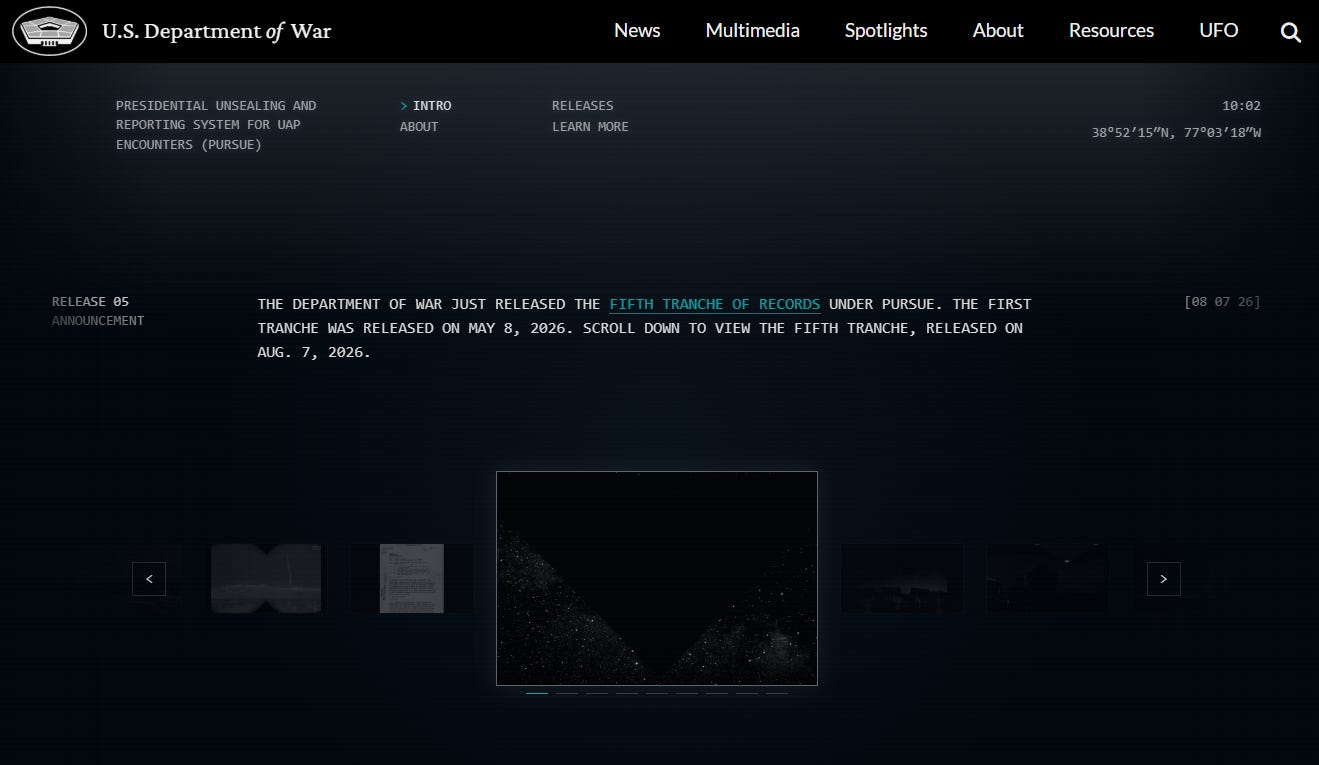
The Pentagon published its first batch in May, and four more followed. A UAP Governance Board convened for the first time in June. That same month the Office of the Director of National Intelligence stood up a UAP Science Advisory Council and named the Harvard theoretical physicist Avi Loeb as its chairman, a choice some of his colleagues publicly criticized.
By any procedural measure this is real. Documents that were classified are now on a government website. A structure exists. Scientists are attached to it.
The chairman’s assessment.
Loeb has said something this year that deserved more attention than it received.
Asked about the concealment claims circulating in Congress, he told the Associated Press that his impression is the government is baffled by its own inability to determine what some of these objects are. Not withholding an answer. Lacking one.
He has also said that if the evidence resolves into drones, classified human systems, and known natural phenomena, scientists should be prepared to accept that and move on.
The man the White House appointed to chair its science council has declined the premise the council was built on. Baffled and concealing are not mutually exclusive states, and an impression is an impression, and Loeb is one person with one vantage point. But this is the most consequential thing anyone inside the program has said in public, and the week it surfaced, the coverage went instead to a throwaway line he gave an interviewer about aliens not caring who the American president is.
The number that is being oversold.
The headline most outlets ran was that more Americans now believe the government is withholding information. Seventy-eight percent, against 71 percent in 1996.
Seven points across thirty years is not much of a trend, and the poll carries a margin of error. Anyone building an argument on that movement is building on sand.
The level is the story. Seventy-eight percent believe information is being withheld, and that measurement was taken in the middle of an unprecedented release program, three months after the first tranche went public.
A caveat belongs here, because the question is a low bar. A person can believe the government classifies UAP material routinely, which is simply true, without believing anything about recovered craft. The 78 percent is not 78 percent of Americans endorsing a cover-up.
What it does measure is whether the releases were persuasive. Five tranches went out. More than three quarters of the country still assumes the important part has been kept back. On that specific question the campaign accomplished nothing at all.
Why release produces uncertainty.
The mechanism is visible in the files themselves.
The fifth tranche, published August 7, was assembled around a single substantive document, an Air Force Special Operations Command intelligence report describing an AC-130 crew’s encounter over the Gulf of Oman. That document went through its own mandatory declassification review and was stamped approved for release in March. It was published four months and twelve days later.
The rest of the tranche was material that cost almost nothing to include. Two CIA files digitized in 1997 and untouched since. A 1947 intelligence digest whose UFO content is one chapter in a survey otherwise concerned with Soviet foreign policy. Correspondence about Project SIGN that has appeared in UFO literature since the 1960s. A pair of 1963 State Department cables that together debunk a Brazilian sphere story the embassy checked and found fabricated, closed sixty-three years ago and included anyway.
And three documents, D034 through D036, are absent from an FBI sequence the government itself numbered, with everything on either side of the gap present and no explanation offered anywhere in the release.
A reader who works through that comes away knowing less confidently than when they started. Not because they were lied to. Because they were handed a large volume of material, most of it inert, organized around one genuine document that sat approved on a shelf for four months, with three files missing and nobody accounting for them.
Do that five times and you have taught the public that releases do not resolve things. The rational response to that lesson is exactly what Gallup measured, which is to stop having a view.
On the question of intent.
It is tempting to call this deception, and the temptation should be resisted, because nothing in the available record establishes it.
An agency doing the minimum required by an executive order, padding a release with cheap archival volume because pulling it is easy and the deadline is real, produces precisely this file. So does an agency managing perception. The timestamps are identical. The outcome is identical.
That ambiguity is not a technicality. It is the entire problem, because it cannot be resolved from outside, and a government that has arranged things so its indifference and its concealment look the same from the public side has removed the only tool citizens had for telling them apart.
Which means the honest conclusion is worse than the accusatory one. Nobody has to be scheming. The machinery produces this result on its own, reliably, and will produce it again with the sixth tranche, and the seventh.
What would actually count.
There are three specific things, and none of them require anyone to believe anything about aliens.
An explanation, in writing, of what happened to D034, D035, and D036, entered into the public record alongside the files.
An account of why a document approved for release in March was published in August.
And a serious response to what the Pentagon’s own All-domain Anomaly Resolution Office has said repeatedly, which is that its ability to resolve cases is limited by a lack of timely and actionable sensor data. That is a government office stating that it cannot identify these objects because the instruments are not there. It is also, incidentally, the strongest argument available that the question remains genuinely open, and it comes from the government rather than from anyone’s speculation.
None of that is classified. All of it is procedural. Any of it would do more to settle the public mind than another two hundred pages of 1947.
The disclosure campaign was premised on the idea that the obstacle was secrecy. Seven months and five tranches in, the country is measurably less certain than it was, three quarters of it still assumes something is being held back, and the scientist the White House put in charge of the science says the government appears to be as confused as everyone else.
Call it disclosure if you like. It is a different act from telling people what you know, and the country has now spent seven months learning the difference.
This topic is another facet of the big picture: We're realizing how deftly we've been manipulated, for generations. About *everything*. A push here, an omission there....
I think it's only another feeble attempt by DT to take attention off his involvement with Epstein. This is just another stupid and costly diversion. Sinking drug boats, Venezuela, Cuba, Israel, Iranian war... And I'm pretty certain I've forgotten at least twice this.