


On Saturday morning, a CNN photographer walked up to the security booth at the White House, was refused entry, and had the passes taken on the way out. A CNN correspondent found that a badge had been deactivated overnight. An MS NOW correspondent was told the same thing, and security kept the badge. A Politico reporter was turned away at the same gate.
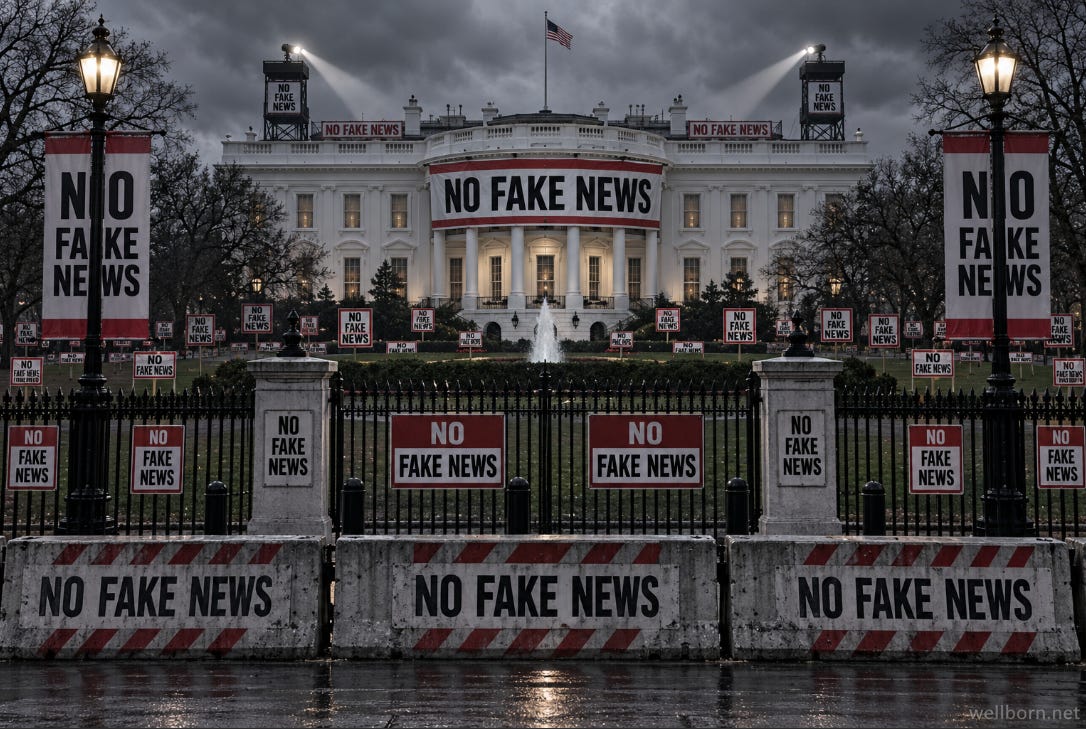
None of them had broken a rule. None had been accused of a security violation. What they had in common was their employers, and the fact that the President of the United States had posted the night before that he did not like what those employers publish.
“Effective immediately,” Donald Trump wrote on Truth Social on Friday, he was banning “Fake News CNN,” MS NOW, and Politico from the White House. He said media outlets “shouldn’t be able to constantly write or report FICTION and LIES” about him. He did not identify a single false story. Asked about a trigger, he said there wasn’t one, and that the decision reflected “cumulative stories over the last few years.” He added a line that deserves more attention than it has received so far: “Other Fake News Media Outlets to follow.”
So the ban is framed as the first round, with more to come.
What happened, precisely
The facts are narrow and they matter, so here they are without adornment.
Three news organizations, by name, were excluded from the grounds of the White House on the stated basis of the content of their reporting. Their credentialed journalists, who had passed the Secret Service background checks that every White House hard pass requires, were physically stopped and had their credentials confiscated or disabled. The individuals were given no notice and offered no hearing, and the only explanation anyone received was a social media post calling their work fake.
CNN said it has “a right under the U.S. Constitution” to report “without hindrance or interference.” MS NOW said it will take “any and all steps necessary” to defend its First Amendment rights. Politico’s editor in chief, Jonathan Greenberger, said the paper will “vigorously defend” them. The White House Correspondents’ Association, whose president, Jacqui Heinrich, is a Fox News correspondent, framed it as an injury to “the right of the American people to receive a full and independent account.”
Two of the specifics Trump offered in his posts deserve a note. He mocked MS NOW for changing its name, which it did after its corporate separation from NBC. He accused Politico of taking an “$8 Million Dollar subscription” from the Biden administration and called it corruption. That figure refers to federal agencies paying for Politico Pro, a trade subscription service that government offices under both parties have bought for years, the way they buy Bloomberg terminals and legal databases. When the claim first circulated in 2025, it was examined and found to be ordinary procurement. It is now being cited as grounds for expelling a newsroom.
Why this has never happened before
Presidents have always hated the press, and some of them have acted on it. The record is worth stating accurately, because accuracy is what makes the comparison land.
Richard Nixon, furious over Watergate, told his staff that no reporter from the Washington Post was “ever to be in the White House” again. What his staff actually did was exclude Post reporters from covering White House social events. They never pulled the paper’s credentials. George Condon, a longtime White House correspondent and historian of the press corps, has said he knows of no instance since the correspondents’ association was founded in 1914 of any newspaper having its White House credentials revoked.
Trump’s first term came closer. In November 2018 the White House pulled the hard pass of one CNN correspondent, Jim Acosta. A federal judge Trump himself had appointed, Timothy Kelly, ordered it restored within two weeks, on due process grounds.
In his second term the escalation has been steady and documented. In February 2025 the White House barred the Associated Press from the Oval Office and Air Force One because the AP kept using the name Gulf of Mexico. That same month, the White House seized control of the press pool rotation from the correspondents’ association, which had run it for decades, and began choosing for itself which outlets would stand closest to the President. In October 2025, the Pentagon demanded that reporters sign a pledge not to seek unauthorized information, and roughly thirty outlets, Fox News among them, handed in their passes rather than sign. A federal judge struck that policy down in March 2026, and struck down the Pentagon’s revised version a month later.
Each of those was a step, and each was smaller than this one. The AP was kept out of certain rooms, Acosta was one person, and the Pentagon imposed conditions that outlets chose to refuse. What happened this morning is different in kind. A sitting president has named three news organizations and removed them from the building where the executive branch conducts the public’s business, because of what they publish, and he has announced that the list will grow. Nothing like it has happened in the more than a century since the correspondents’ association was founded.
The law is on the reporters’ side
In 1977, in Sherrill v. Knight, the federal appeals court in Washington held that once the White House opens its facilities to credentialed journalists, it cannot deny a pass “arbitrarily or for less than compelling reasons,” and that any denial requires notice, a chance to respond, and a written statement of reasons. That case has governed White House credentialing for nearly half a century. It is the reason Acosta got his pass back in 2018.
None of what Sherrill requires happened this weekend. There was no notice, no hearing, and no statement of reasons beyond the President’s opinion of the coverage.
Jameel Jaffer of the Knight First Amendment Institute at Columbia put the constitutional problem plainly: if the ban extends to the press pool, it is “doubly unconstitutional,” because the pool is a public forum and the President “can’t exclude journalists from it on the basis of their viewpoints.” Seth Stern of the Freedom of the Press Foundation said it is difficult to imagine a more blatant First Amendment violation than banning outlets “from the People’s House for criticizing the government.”
The courts have not been uniform, and an honest account says so. In the AP case, a district judge ruled for the AP in April 2025, but a divided appeals panel let the White House keep the AP out of the Oval Office and Air Force One while the case proceeds, on the theory that those are the President’s private spaces. That case is still pending. The grounds of the White House, the briefing room, and the press offices sit on the other side of that line. They are exactly the facilities Sherrill was about.
So the likeliest legal outcome is that the three outlets sue and win, at least in part. The likeliest political outcome is that it will not matter to the man who did it. He will lose slowly in court, and in the meantime the three newsrooms stay outside the gate, every other newsroom learns what happens to organizations that displease him, and the promised next names arrive before any judge rules on the first three.
Why the word is fascism
The word gets used carelessly, so it needs to be used precisely here.
The first move fascist regimes made against the press was rarely closing newspapers outright. More often it was deciding which journalists were permitted to practice journalism. In Italy, Mussolini’s press laws, beginning in 1925, required every newspaper to have a government-approved responsible editor, and created a professional register that journalists had to be on in order to work. In Germany, the Editors Law of October 1933 made journalism a licensed occupation and required editors to be politically reliable. In both countries, most papers kept publishing. They published what the state tolerated, because the state had made itself the gatekeeper of who counted as the press.
The American version this weekend is a much smaller act. No one has been arrested. CNN, MS NOW, and Politico are still publishing, and nobody has been required to join a registry. That distinction is real, and pretending otherwise would make the argument easier to dismiss.
But the principle underneath the act is the same principle. The head of state has claimed the authority to decide which news organizations are legitimate, on the basis of whether their coverage pleases him, and to use the physical power of the state, uniformed Secret Service officers at a security booth, to enforce that judgment against named institutions. That is what makes it fascist in method, and it is why “more to follow” is the most important phrase in the President’s post. A licensing regime does not need to be written into law to function. It only needs every newsroom in the country to understand that access now depends on approval, and to begin adjusting.
And they will adjust, because the incentives point that way. An editor deciding whether to run a hard story about the President now has a new line item to weigh against it: the reporter’s badge. Most editors will run the story anyway, while some will soften it and a few will hold it, and the ban works through the ones who soften and hold, and nobody will ever be able to count them.
The press corps is also where the public gets its view of the presidency when the President does not want to be seen. The reporters at the gate this morning are the people who shout the unscripted question, who notice who walked into the West Wing and who walked out, and who are standing there when something goes wrong. Remove enough of them, replace them with outlets chosen for loyalty, and the White House becomes a stage with an audience the performer selected.
What we can do about it
Outrage alone accomplishes very little here, so what follows is specific.
Support the three outlets directly. Subscribe to Politico, which is the most financially exposed of the three. Watch and share CNN’s and MS NOW’s White House reporting, especially what they produce from outside the gate. A ban meant to shrink their audience should have the opposite effect.
Fund the legal defense of the press. The Reporters Committee for Freedom of the Press, the Knight First Amendment Institute, and the Freedom of the Press Foundation are the organizations that will be filing briefs and bringing cases. They run on donations.
Call your senators and your representative. The Capitol switchboard is (202) 224-3121. Ask one question and ask it on the record: does your member of Congress support the President banning news organizations from the White House because of their coverage? Republican offices especially need to hear it, because their silence is what lets this continue, and they need to be made to answer before the next names are announced.
Pay attention to who stays silent in the briefing room. The remaining outlets, including the ones the President favors, will decide in the coming days whether to treat this as someone else’s problem. When nearly every major outlet walked out of the Pentagon together in 2025, the policy collapsed in court within months. The walkout, and the lawsuit that grew out of it, beat that policy. Notice which newsrooms show it this time, and reward them with your attention.
Vote on November 3. The midterms are six weeks away. The House controls oversight, subpoenas, and appropriations for the executive office. A Congress willing to use those powers is the only check that does not depend on a judge’s calendar.
Keep the date. September 18, 2026, was the day a president named three American newsrooms and told them to leave. The next names will be easier for him if this one fades from memory before they arrive.
The White House belongs to the public. The press stands in it on our behalf, because we cannot all fit in the briefing room. When the President decides who may stand there, he is deciding what the rest of us are allowed to know.