

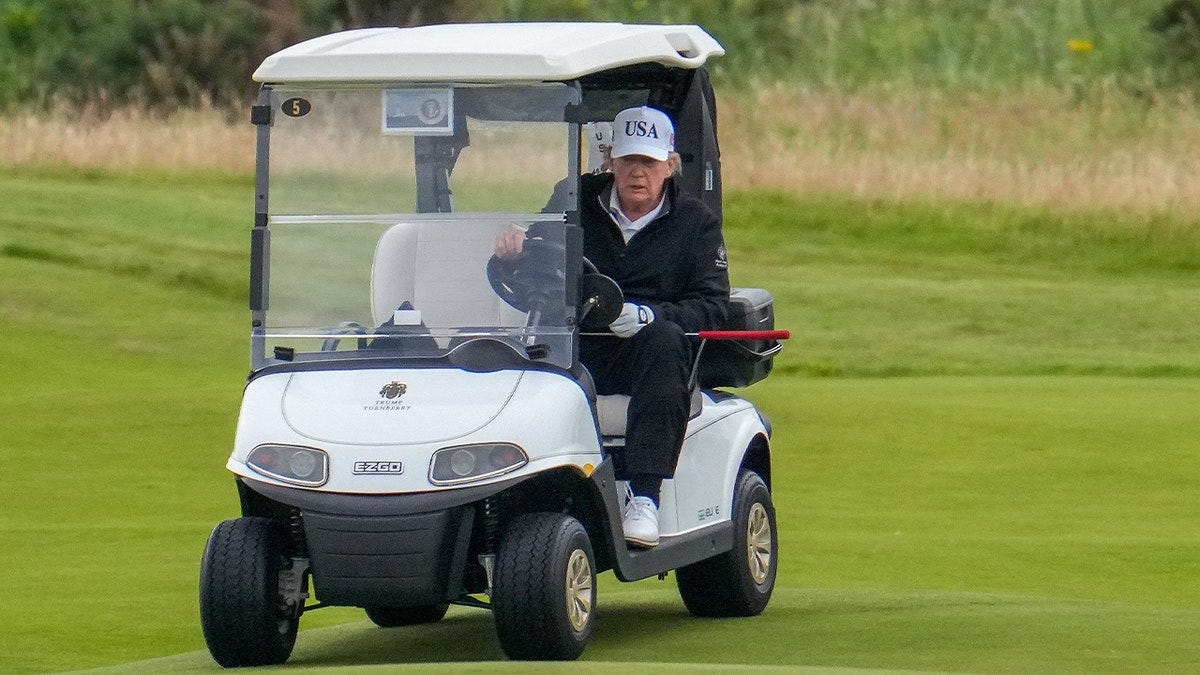
Let us begin with the golf cart.
In May 2017, at a summit in Sicily, the leaders of the seven largest democracies walked seven hundred yards together through the old town of Taormina, uphill, in the sun, talking. Six of them did. The seventh waited for a golf cart, and rode up behind them at the speed of a man being delivered. He had been president for four months. He had spent the previous eighteen calling one opponent “low energy” and telling a debate audience that another “doesn’t have the stamina,” and the first time the free world went for a walk, he took a vehicle.
In July 2025 this same man signed an executive order bringing back the Presidential Fitness Test, the one that made three generations of American schoolchildren hang from a bar in front of their classmates. He said the country needed to be strong. So we have administered it. The events follow in the traditional order, with the standard note that the subject is eighty, that being eighty is no offense, and that the only reason any of this is our business is that he made it the business of everyone else who ever ran against him.
The theory. Before the test, the subject’s training philosophy, which he has explained to more than one biographer. He believes the human body is like a battery, born with a fixed charge, and that exercise runs it down. This is why he gave up sports after college. It is why, by his own account, his workout is standing at a podium. Friends who exercised were told they would pay for it later, with the specific confidence of a man who has confused his body with a flashlight. The battery theory has one testable prediction, which is that a man who never exercised should have plenty left at eighty. We turn to the data.
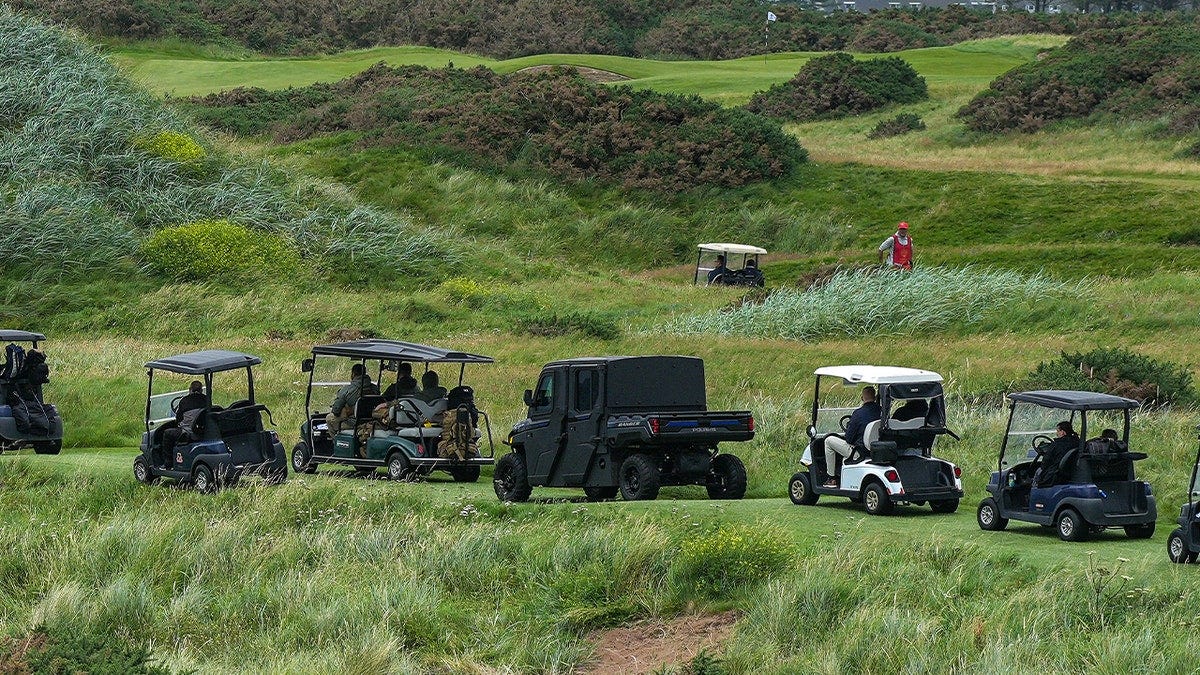
The mile. The test begins with a distance run, which we have converted to a distance walk, as a courtesy. In Sicily he took the cart. On his own golf courses he takes the cart onto the green, which is the one place on a golf course a cart is forbidden, and where the walk he is avoiding is about eleven feet. In June 2020, at West Point, he came down a shallow ramp beside a general, in small sideways steps, like a man descending a staircase made of other, smaller staircases. He then spent a quarter of an hour at his next rally explaining the ramp. It was long and steep, he said, and slippery, and he had been wearing leather-soled shoes, which nobody had asked. This Wednesday, in Manila, on a red carpet beside the president of the Philippines, his own White House’s video shows him drifting off the line and stopping several times in the space of a few yards. A red carpet is the easiest walk in public life. It has edges. It tells you where to go.
The pull-up. This event measures whether a person can lift his own weight. We substituted a glass of water. At West Point that same afternoon he raised one to his mouth with his right hand, and then brought the left hand up to help, the way you steady a full pot. At the rally he re-enacted the drink one-handed, to cheers, and threw the glass. In 2018 he climbed the stairs to Air Force One in the rain, reached the door, and simply let go of his open umbrella, leaving it on the landing for the weather to deal with, because closing it had been judged not worth the charge. His hands have been bruised for most of this term. The White House says the cause is frequent handshaking and a daily aspirin, 325 milligrams of it. In Manila the wire photographs showed makeup on the back of the right one. A man who has shaken so many hands that it shows is, on the White House’s own account, a man being injured by greeting people.
The sit-up. The schoolchild’s version counts how many times you can raise yourself in a minute. We simplified it to remaining upright and conscious while seated. He was reported asleep at his own criminal trial in 2024, repeatedly, by reporters sitting behind him. In November 2025 a Washington Post review of an Oval Office event found he spent close to twenty minutes fighting to keep his eyes open while his guests talked about drug prices. A month later it was a cabinet meeting, on camera, while his secretaries took turns praising him, which is the one activity that has never before failed to hold his attention. He told an interviewer at New Year’s that he had only been blinking. On Thursday, in Shenzhen, at the first meeting of the American, Chinese and Russian presidents in history, the Associated Press reports that Chinese state television showed him looking drowsy as the session began. The host’s cameras chose that shot. It was the most important hour of the trip, and the footage of it now belongs to the other side.
The shuttle run. This one measures how fast a person can get from one line to another when it matters. The subject’s best time was posted in 1968. He had received four student deferments from the draft, and when those ran out he received a fifth, a medical one, for bone spurs in his heels. He was by his own description the best baseball player in New York at the time. In 2016 he could not recall which foot had been the problem, and his campaign said both. The New York Times later reported that the daughters of a Queens podiatrist, a tenant of the subject’s father, said the diagnosis had been a favor to the landlord. There’s no paper, and he denies it. What is on the record is that the spurs healed without treatment, and that he later described dodging infections as a single man as his “personal Vietnam,” and said of a man who spent five years in a Hanoi prison, “I like people who weren’t captured.”
The flexibility. The last event is the sit-and-reach. The subject has never needed to be flexible, because he has always been able to find a doctor who was. In 2015 his physician released a letter saying he would be “the healthiest individual ever elected to the presidency.” The physician later said the patient had dictated it. In 2018 the White House doctor credited “incredible genes” and suggested that with a better diet he might have lived to two hundred. This May, after a visit to Walter Reed, the report came from the subject himself: “Everything checked out PERFECTLY.” When his ankles swelled last summer, his office did disclose a cause, a vein condition common in people over seventy, and to its credit said so plainly. That is the one time in eleven years the public has been told something about this body that the body’s owner didn’t write.
The borrowed strength. Here is what a man does who admires strength and has none to spare. He stands next to it. He fills the stage with wrestlers and the box with fighters, and for his eightieth birthday he had a cage built on the South Lawn so that other men could hit each other while he watched from a chair. He picks generals who look like generals. He wanted tanks on Constitution Avenue and got them. The handshake, the famous one, the yank, is a strength move designed for a man with exactly one second of strength in him: you pull the other fellow off balance before he finds out. He says “strong” the way other people say “um.” Strong borders, strongly consider. It is the most used adjective of his public life, and he has spent that life arranging to be photographed beside its examples.
The standard. None of this would be worth a paragraph about anyone else. People get old. The legs go and the afternoons get heavy, and none of it is a moral failing, and a decent country doesn’t laugh at it.
But he taught the country to laugh at it. He stood on a stage in 2015 and jerked his arms to mock a reporter with a disability. He made “sleepy” the entire case against one opponent and “stamina” the case against another. He demanded that the last president take a cognitive test, and built a second campaign on the sight of an old man moving slowly. The Atlantic reported that he didn’t want wounded veterans in his parade because nobody wants to see that, which he denies. Weakness, in his telling, is the one thing a leader may never show and the one thing an enemy may always be mocked for. That was the standard, and he wrote it.
The finding. Against his own test, the subject cannot complete the walk, needed assistance on the lift, did not remain conscious through the seated portion, and holds the school record in the run from 1968. His flexibility scores were provided by the subject. An Ipsos poll in April found that 55 percent of Americans think he isn’t physically healthy enough for the job, and 59 percent doubt his mental acuity. His spokesman says he “remains in excellent health,” which is what the last White House said about the last one, in nearly those words, until the night it couldn’t.
Here is why it matters past the comedy. This week he sat across a table from two men who have spent twenty years watching for exactly this. One is 73 and one is 74, and both of them stage their own vigor for a living. Diplomats told reporters before he landed that the world now sees him as weakened, and they meant the election. The cameras in Shenzhen meant the other thing. A strongman’s whole offer is that he is the strong one, and when that goes, what’s left is an old man in a room with people who know it, surrounded by staff whose job is to say he was only blinking.
The battery theory was wrong, by the way. He saved it all up, for sixty years, and it ran down anyway.
He looks like the old guy that everyone discreetly starts avoiding…we wave and say we are late for an appointment. We don’t want to be rude but we are fed up with his behavior. He’ll end up alone with only paid help. Hmmm
I’m only a year younger than Orange Jealousness, but the bruising on the hands and probably the forearms is a common problem. If I have an unkind thought about my forearm, it bruises. Just bumping against the door jam results in a bruise. Regardless, this person is the worst President in our history. He’s a walking bruise on our democracy!