


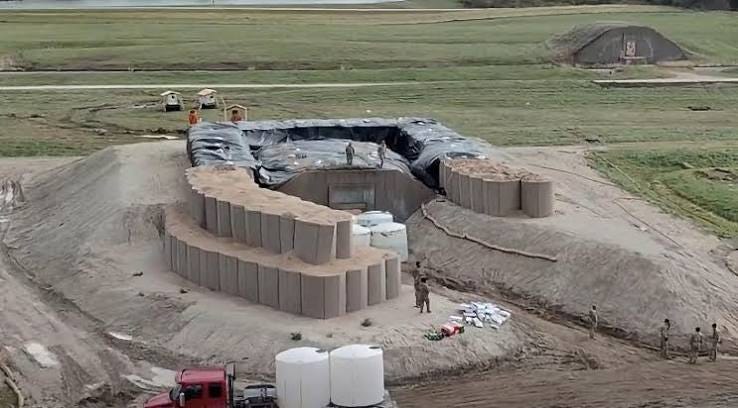
The detonation in Middletown worked. On Wednesday the Army destroyed about five tons of degraded lead azide, and the EPA’s real-time monitors showed no airborne lead across the region. Lab results on soil, dust and water are still to come. Nobody was hurt, and the people who did the work deserve the credit they’ve been given.
The president and vice president have since explained how the drums got that way. The vice president said the material was stored “back in 2009 under the Obama administration” with “no real plan.” The president posted at 12:08 on Thanksgiving morning about “Obama caused carcinogens.”
I can’t check the 2009 claim. Nothing I’ve read documents it, and one Iowa official calls the stockpile “decades-old.” So take it as true. It still leaves out the fifteen months that count.
What the record shows
Iowa Public Radio built the timeline from court filings, contract documents and a sworn declaration. Here it is in order.
August 2025. The plant’s contractor warned a munitions-cleanup firm, MuniRem, that 68 drums might contain unstable lead azide. That’s by the account of MuniRem’s chief executive.
September 2025. The plant’s operator asked MuniRem for a disposal quote. From that month on, the water and ethanol mixture that kept the explosive stable went unchecked and unreplenished. The Army colonel who led the operation says the drums couldn’t be opened safely to refill it.
March 12, 2026. The Army notified the EPA, according to the regional administrator’s sworn declaration.
March 19. A panel of Army specialists, Johns Hopkins laboratory staff and EPA representatives voted to recommend chemical neutralization as the safest treatment. The Army hired MuniRem six days later.
May 4. MuniRem submitted its detailed treatment plan.
May 8. The Army secretary at the time, Dan Driscoll, selected an in-place controlled detonation. The same day, a contracting officer asked MuniRem for a technical meeting. It never took place. Within a week the Army dropped the treatment work.
November 16. The EPA published notice of the permit. The first blast date was November 20.
Every one of those dates falls in this administration.
The Army’s side
It has one, and a court accepted it. The colonel says his team was “never able to find a viable alternative,” and that chemical treatment “proved to be an unsafe method.” The Army’s stated worry was that crystals had worked into the lid assemblies, where opening a drum could set it off. On Monday the Eighth Circuit found that the Army and the EPA had adequately considered other methods. Iowa’s Republican governor called the result “a best-case scenario.”
MuniRem’s chief executive still says neutralization was viable. He also runs the company that lost the contract, and that should be weighed.
What nobody has explained
Three gaps, and none of them is about 2009.
The first is March to May. A panel that included the Army’s own specialists recommended one method. Seven weeks later the secretary chose another, four days after the alternative plan arrived. The Army says the decision had “technical consensus” behind it. Iowa Public Radio couldn’t find what changed, and neither can I.
The second is May to November. The decision to blow up five tons of lead compound near a town was made on May 8. The public notice is dated November 16. Residents were taping their windows that week.
The third is who was told. CBS News reports, citing unnamed officials, that senior White House leaders learned the extent of the problem on November 19, on the flight home from China, and that the acting Army secretary knew in September and didn’t brief up. The vice president says the administration learned “about six months ago,” which matches the May decision.
Both accounts can’t flatter the White House. If it knew in May, it sat on a decision affecting three states for half a year. If it found out last week, its Army chose to detonate the nation’s stockpile of an explosive and didn’t mention it to the people in charge.
Not a partisan complaint
Representative Ashley Hinson, an Iowa Republican, said, “This is a total failure and Iowans deserve better,” and asked why the treatment work was dropped. The Democratic governor-elect, Rob Sand, said the lead-up “should never have been so chaotic and unclear” and asked for “immediate transparency.” The president’s reply to Sand, on Truth Social, ended with “I will remember.”
What should happen
This is my list. The Army should release the March 19 panel’s recommendation and whatever analysis reversed it. It should release the inspection logs for the stabilizing liquid from September 2025 on. Someone should say, under oath, when the Army secretary’s May decision reached the Pentagon and the White House. And the EPA should publish the lab results as they come in.
The Obama line asks Iowans to look at 2009. Everything a hearing would need is dated 2025 and 2026, and most of it is already in a court file.
Per the US army website, issues with the site were known during Georg W. Bush's first term (even though the article itself is from 2014) : "ARDEC's green primary explosives project started in 2004 in response to the Department of Defense's concerns over a 40-year-old stockpile of lead azide deteriorating at the Iowa Army Ammunition Plant in Middletown, Iowa." (https://www.army.mil/article/122127/Picatinny_aims_for_green_with_new_type_of_primary_explosive/).
🤣🤣🤣🤬