


Let us begin with the stone.
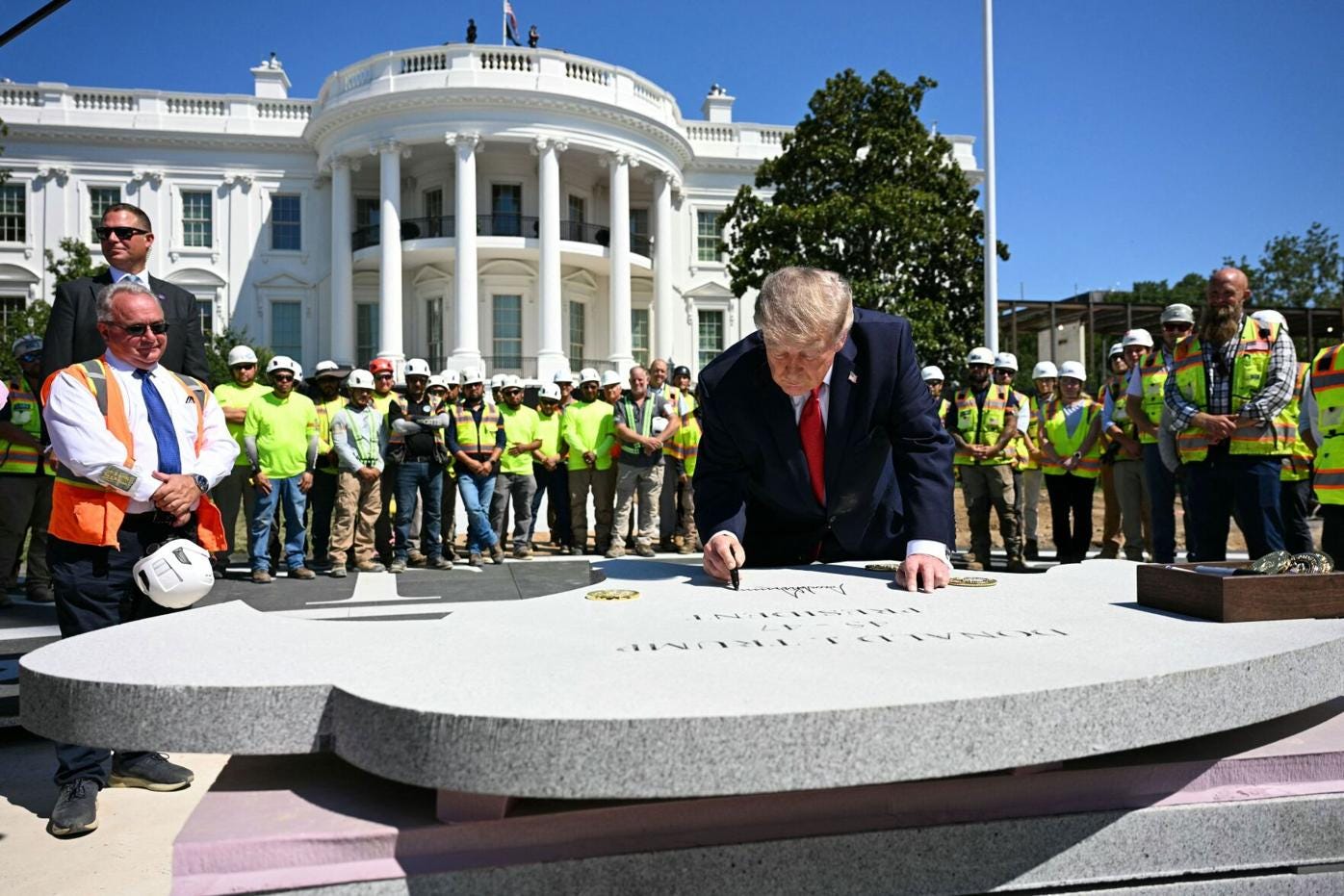
On Wednesday afternoon the President of the United States walked out onto the South Lawn of the White House, gestured at some paving material, and told the assembled press corps that it could withstand thirty-five thousand pounds per square inch of pressure.
He was not asked. There had been no question about the paving. He had summoned the reporters himself, on impulse, for the specific purpose of showing them the ground.
He then explained, at length and without interruption, why granite is superior to asphalt. He noted that the stone would last over a million years. He described it as very special stone and as very strong stone, deploying both formulations within the same remarks, because a man who has decided a rock is important will find more than one way to say so.
And then he leaned down and signed it.
I want to be precise about the sequence, because the sequence is the whole thing. He had the reporters brought out. He talked about the granite for several uninterrupted minutes. And then, in front of the White House press pool, on the South Lawn of a building that has stood since 1800, the forty-seventh President of the United States bent over and autographed a piece of rock, with the specific confidence of a man who has concluded that the only thing preventing a paving slab from being a monument is the absence of his name on it.
The topic
Here is the finding that turns this from a curiosity into something worth eleven hundred words of your afternoon.
PolitiFact reviewed his public remarks across 2026 and established that he has spent more time talking about these construction projects than about any other subject, with a single exception.
The exception is the war.
Not the economy. Not the border. Not the midterms, which are in November and which his own party is currently describing in terms normally reserved for weather events. Not inflation, not the courts, not any of the eleven agencies he has taken apart. In the eighth month of a year in which American forces are engaged in a shooting war and roughly a fifth of global oil trade is disrupted, the topic to which the President of the United States has devoted the second-largest share of his public speech is a room he is having built, and the ground in front of it.
The itinerary
The remarks included a full description of how a visiting head of state will experience the new arrangement, and I am going to walk through it as he laid it out, because he laid it out very carefully and it is the most revealing thing he has said in a month.
The dignitary arrives on the beautiful new roadway, which is a driveway, which is being replaced.
The dignitary gets out of the car.
The dignitary walks down the path to the helipad, which is new, and which is where the helicopter will be, and which he mentioned would leave foreign leaders very impressed.
The dignitary has cocktails, outside.
The dignitary then proceeds into the ballroom.
Now read his own summary of the arrangement, which he offered unprompted and which I have not shortened: without even having to go into the White House.
That is the pitch. That is the feature. The design objective of a two-hundred-million-dollar reconstruction of the executive grounds, stated aloud by the man commissioning it, is that a visiting head of state can arrive, drink, dine, and depart without ever entering the White House.
He has built a bypass around the building. He is proud of it. He explained it to reporters in the manner of a man walking you through the smart features of a new kitchen, entirely unaware that he had just described the residence of the American presidency as a thing to be routed around.
The amenities
The ballroom will have bomb shelters.
It will also have space outside for cocktails.
Those two facts were delivered in the same set of remarks, in close proximity, without any apparent sense that they sit oddly together, and I have been unable to stop thinking about the man who ordered both. Somewhere there is a plan set. Somewhere there is a contractor who received a scope of work specifying a cocktail terrace and hardened blast protection, and who did not blink, because the invoice cleared.
The room is intended to hold state dinners. Xi Jinping arrives next month and the President mentioned him by name as somebody who would be impressed by the helipad.
I would like to note, without editorializing, that the leader of the People's Republic of China has landed in a great many countries and has presumably been driven across a number of surfaces, and that the odds of the pavement being the thing he remembers are not high.
The demolition
None of this is being added to the White House. That is the part that gets lost in the granite.
The East Wing is gone. It was demolished in October to clear the site. Not renovated, not incorporated, not preserved in any respect that would trouble a wrecking crew. Removed.
The East Wing was where the First Lady's offices were. It was where the visitors' entrance was, the one through which schoolchildren and tour groups came into the building. It was built in 1902 and expanded in 1942, and in 2025 a man decided he wanted a bigger room, and now it is not there.
In November he indicated the East Room during an event, told the audience that in about two years they would be using a much bigger room, said the new entrance would be right there, and suggested that the project might require removing more of the existing White House.
Might require removing more of the existing White House.
He said that in the East Room, to a room full of people, as an aside, in the tone of a man mentioning that the wallpaper in the hall may have to come off.
The public
He has said repeatedly that the ballroom has become very popular.
Polling does not support this. It has never supported it. He says it anyway, at intervals, in the way he says everything he would prefer to be true, which is loudly and to a room that is not going to check.
He is also rushing it. Construction is proceeding at speed while legal challenges work through the courts, and the reporting on this is not subtle about why: the objective is to have the thing built before a court can order it stopped. It is difficult to unpour a foundation. It is very difficult to unpour two hundred million dollars of foundation, and everyone involved understands that a completed building is a much stronger legal position than a set of drawings.
That is the strategy. Not to win. To finish first.
What the stone is for
He said the granite would last over a million years.
I have thought about that number more than the man who said it did. A million years ago there were no modern humans. The species arrived somewhere around three hundred thousand years back, which means that if his estimate is even loosely correct, the paving slab he autographed on Wednesday afternoon will outlast our species by a factor that does not fit on a chart.
That is what he was reaching for. Not durability. Durability is a specification and specifications are boring and he has never in his life been interested in one. He was reaching for permanence, which is a different thing entirely, and which is what a man wants when he has begun to suspect that the other kind of legacy is not going to arrive.
He is eighty. His approval is thirty-three percent, the lowest of his presidency. His own senators are describing the war as a mess in front of cameras. The party is preparing for November the way people prepare for a storm. Whatever he thought he was going to be remembered for is not currently on schedule.
So he has poured a very hard rock into the lawn of a house that does not belong to him, and he has put his name on it, and he has told everyone in earshot how long it is going to be there.
The White House has been standing for two hundred and twenty-six years and has never once required a signature.
He signed the ground in front of it.
Trump's pronouns are me, me, me!
Excellent piece you had me laughing out loud and I loved it so much I read it out loud to my wife, so I could laugh some more!! Thanks, it was much needed tonight