


On August 21, at a rally in Myrtle Beach for Senator Darline Graham, the president made a request of the crowd. He explained the problem first, which is that Republicans win when his name appears on a ballot and lose when it does not, and then he asked them to solve it with their imaginations. <cite index=”95-1”>”So what I really want you to do is pretend, please, that I’m on the ballot.”</cite>
Six days later Sean Hannity previewed a Trey Gowdy interview in which the president made the same ask nationally, and Speaker Mike Johnson told a Texas audience that at the party’s Dallas convention Trump would <cite index=”94-1”>”look right into the camera”</cite> and tell voters he is on the ballot even though he is not. The Atlantic reported an Oval Office meeting to plan a television blitz on the same theme.
It is a strange request to make of an electorate, and it has an obvious answer, which is that the president’s name is in fact printed on nothing this November and no amount of collective visualization will change that. But the request is more interesting than it looks, because the pretending was already underway. It was simply running in the opposite direction.
Seven and counting
The Washington Post reviewed the campaign websites of Republican House candidates in battleground races and found at least seven that had removed or de-emphasized the president and his priorities between the primary and the general election. This is a small number in a party fielding hundreds of candidates, and it would be easy to inflate. The pattern matters less for its size than for who is in it: these are, almost without exception, people who won their primaries by advertising the endorsement they are now taking down.
Start with Kentucky, because Kentucky supplies the cleanest record.
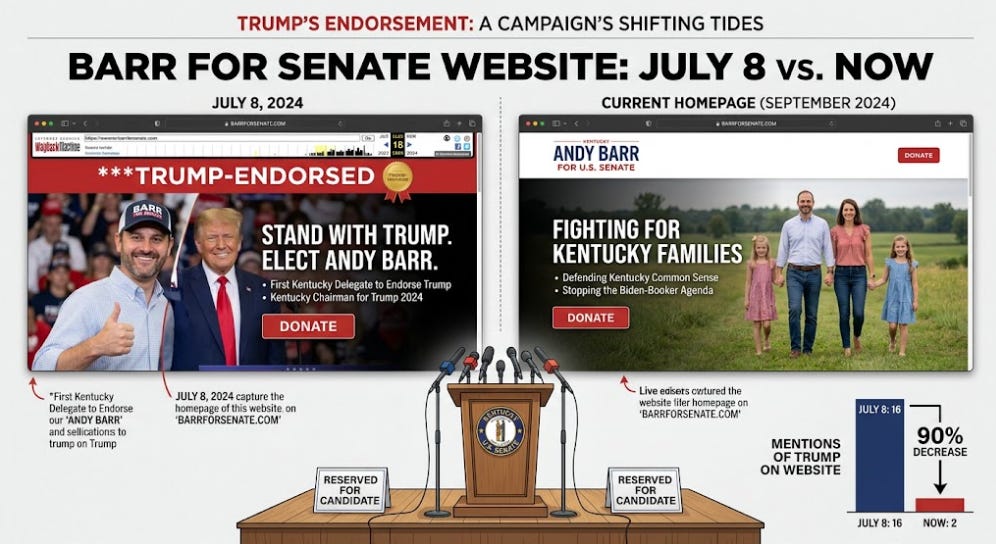
Andy Barr won the Republican Senate primary in Kentucky this year running explicitly as the president’s candidate. As recently as July 8, according to Internet Archive captures, the top of barrforsenate.com carried a “Trump-Endorsed” banner and a photograph of the two men standing together, and the site described him as one hundred percent America First. The current homepage leads with a photograph of Barr and two of his children, and the text says he is Kentucky First Always.
The Lexington Times, which went through the archived captures alongside the public modification feed that WordPress publishes for every page on the site, put a clock on it. The homepage was saved at 9:40 in the morning on July 16. The biography page was saved nineteen minutes later. The issues page was saved at 1:37 that afternoon. Sixteen references to the president came out of the visible text in the course of a single working day, in between a new coalitions page and a press release about the Fancy Farm picnic. Whatever else this was, it happened inside a single Thursday rather than drifting into place over a season.
Barr did not remove the endorsement itself. It survives, listed among his other endorsements, in the manner of a mildly embarrassing credential that cannot be denied but need not be led with. His campaign says Kentuckians know perfectly well that he is proud to have it, and that the congressman is focused on the state.
Forty miles up the road, in the open Sixth District seat around Lexington, Ralph Alvarado did something similar and slightly bolder. NBC News reported that his site stopped calling him an America First fighter and started calling him independent leadership for Kentucky, and that language describing him as an ally of the president came out. His spokesman dismissed the story, noted that the campaign has proudly touted the endorsement, and pointed out that a photograph of Alvarado with the president is still on the site, which is true, and which is also the entire point in miniature. The photograph stays. The sentences go.
In Florida, Mike Beltran’s about page mentioned the president four times in July. It said he had <cite index=”68-1”>”stood with President Trump every step of the way”</cite> and that he was one of only seven Florida legislators who never endorsed Ron DeSantis for president, standing firm from the escalator onward, and it added that this was conviction rather than calculation. The day after Beltran won the nomination, that passage came off the site, along with the references to the One Big Beautiful Bill Act. His campaign says the edits had nothing to do with the president.
In California, Young Kim’s landing page in June said she was a proven fighter who would <cite index=”101-1”>”Stand with President Trump to deliver a bold America First Agenda.”</cite> It now says she is taking on career politicians to restore the American dream. Kim was drawn into the same district as Ken Calvert by Proposition 50 and advanced to a general election against a fellow Republican, which makes her case the least representative on the list and the most revealing about what the campaigns believe motivates the wider electorate.
The Bouchard variant
Michigan’s Tenth is the race to watch, because Mike Bouchard did something more precise than the others and it exposes the logic.
Bouchard is a former Army captain and Bronze Star recipient who won the primary with 72 percent of the vote after the president endorsed him and appeared with him at the GM proving grounds. He is running in an open seat that John James vacated to run for governor, in a district the president carried by six and a half points in 2024, and the forecasters have it somewhere between tilt Republican and toss-up.
His website has not scrubbed the president. It still says he supports the president’s efforts to protect Michigan manufacturing, defend American jobs, and keep the future of the economy in the hands of American workers rather than China or Washington bureaucrats. That sentence is doing careful work. It invokes the president in the one policy area where the association is an asset in Macomb County, and it does not invoke him anywhere else.
So the president survives on Bouchard’s site as a co-signer on tariffs and factories, and does not appear as a reason to vote for Bouchard. The president has been reduced on that site to a co-signer, kept where he helps and filed away everywhere else.
The defense, which is real
Every campaign accused of this says the same three things, and the honest version of this piece has to put them on the table before knocking any of them down.
The first is that candidates always move after a primary. This is true and it is not a scandal. A Republican primary electorate in Kentucky is a different set of human beings from a Kentucky general electorate, and a smart campaign talks to the second group differently than it talked to the first. Tres Watson, a Republican strategist in Kentucky who hosts a politics podcast there, made exactly this argument about Alvarado, noting that a candidate who fought off a hard-right primary opponent will naturally pivot toward a more moderate general electorate. The Post’s own framing concedes the point: candidates in both parties have been rewriting their pitches after primaries for as long as there have been primaries.
The second is that website copy gets refreshed all the time, that nobody sits in a war room deciding to delete a president, and that reading intent into a content management system is the work of people with too much time and an axe to grind. National Republican committees have issued no directive to mute the president’s name, and none of these candidates has criticized him, broken with him, or declined his help.
The third is timing. Jonathan Miller, a Kentucky political analyst, observed that if Alvarado were going to pivot, August was the month to do it, when most people are on vacation and nobody is paying attention, rather than late October when everyone is. That reads more as an appreciation of the craft than a defense of it, but it belongs here, because it explains why all of this happened in a five-week window rather than in the last fortnight.
Take all three seriously and you still have a problem, and it is the one thing none of the three explains.
They kept the policies
Not one of these candidates changed a position.
Beltran’s platform page still says he stands one hundred percent with the president on immigration, wants the wall finished, and wants criminals and fraudsters deported. Bouchard still runs on the tariffs. Barr still lists the endorsement and still notes that he chaired the president’s 2024 primary campaign in Kentucky. Alvarado still has the photograph. If the pivot were a moderation, you would see it in the substance, and the substance is untouched.
What came out was the name. What came out was the sentence structure that made the candidate an extension of the man rather than a person with an agenda that happens to overlap with his. Beltran did not stop supporting the immigration policy; he stopped saying that watching the escalator in 2015 was what made him want to serve. Kim did not become a moderate; she stopped promising to stand with somebody.
That is a specific judgment about a specific liability, and it is not about ideology. These campaigns have concluded, independently, in four states, that the agenda polls better than the man, and that the most efficient way to keep the first is to stop mentioning the second. The internal polling is not public. The websites are.
The numbers underneath it
The summer polling these campaigns were looking at is worth laying out honestly, including the parts that complicate the story.
Reuters and Ipsos put the president’s approval at 33 percent in early September, his lowest in their polling, against 65 percent disapproval. A Financial Times poll conducted by Focaldata and released September 5 found the same 33 percent among registered voters. The Civiqs rolling tracker had him at 34 approve and 60 disapprove on September 4, underwater in every major battleground. A University of Massachusetts poll taken in late August had 32 and 64.
Against that, the Harvard CAPS/Harris survey released September 2 had him at 44 percent, up two points since July, with the share of voters calling the economy strong up as well. One outlier does not overturn four polls, but a piece that reports only the 33 and hides the 44 is doing to its readers what the campaign websites are doing to theirs.
The figure most likely to have moved these campaigns is not the topline at all. The UMass poll found approval among Republicans down from 89 percent in April 2025 to 75 percent, and approval among 2024 Trump voters down ten points. A president at 33 with a unified base is a turnout problem for the other side. A president at 33 whose own voters are drifting is a turnout problem for his own candidates, and it is the exact condition that makes a Trump-Endorsed banner ambiguous rather than useful.
Which is also why the request from the stage in Myrtle Beach makes sense as strategy even as it fails as arithmetic. He knows perfectly well that his name is on nothing, and he is trying to solve the drift by converting a midterm into a referendum on himself, at a moment when the people running under his endorsement have concluded that a referendum on himself is the last thing they want.
Kentucky has done this before
In 2014, Alison Lundergan Grimes ran for the Senate in Kentucky against Mitch McConnell while Barack Obama’s approval in the state sat somewhere in the low thirties. Asked repeatedly whether she had voted for the president of her own party, she declined to say, on the grounds that the sanctity of the ballot box forbade it. She lost by roughly fifteen points.
The lesson is not that distancing is dishonorable. It is that it seldom works, because the voters who like the president notice the distance and the voters who dislike him notice the party. A Republican in Kentucky who removes the president from his website in July does not thereby become a person who never wanted the endorsement. He becomes a person who wanted it in May and did not want it in July, and the Internet Archive has both versions, and so does his opponent.
In 2006, congressional Republicans made a similar calculation about a president in the mid-thirties and lost thirty seats. In 2018 they mostly declined to make it and lost forty. Neither the distance nor the embrace is a strategy. Both are symptoms of the same underlying number.
What the record shows
The Coward Files, on this publication, has spent twelve entries on Republicans who said something true about this president and then unsaid it under pressure. The pattern in those cases is that candor arrives late, after the seat is lost or the career is over, when it costs nothing and buys nothing.
This is the same instinct arriving early, which is a novelty. Nobody here has said anything true out loud. They have said it in the only place a campaign is fully honest, which is the part of the operation that costs money and is optimized against measured voter response. A staffer opened a content management system on a Thursday morning in July and removed sixteen instances of a name, and that action contains a more candid assessment of the president’s standing in Kentucky than anything any Kentucky Republican has said into a microphone this year.
He asked the country to pretend he is on the ballot. In four states his own candidates were already pretending something, and it was not that.
Eight weeks from now the votes get counted, and the archived captures will still be sitting there, timestamped, showing what each of these campaigns believed about their own leader at the moment they thought nobody was looking.
*Dear Leader is such a lewser
I think this is something that always happens during a president's second term. I remember how Pres. Obama became something of a pariah during the midterm election campaigns in 2014, and it saddened me because I liked him so much. Candidates didn't want him joining them on the campaign trail, and didn't talk about him much while speaking. I don't know if he was taken off websites - I didn't really pay attention to that.
It's true, though, that there's a marked difference between how Trump sees himself and how candidates see him. Not to mention how many of us here see him.