


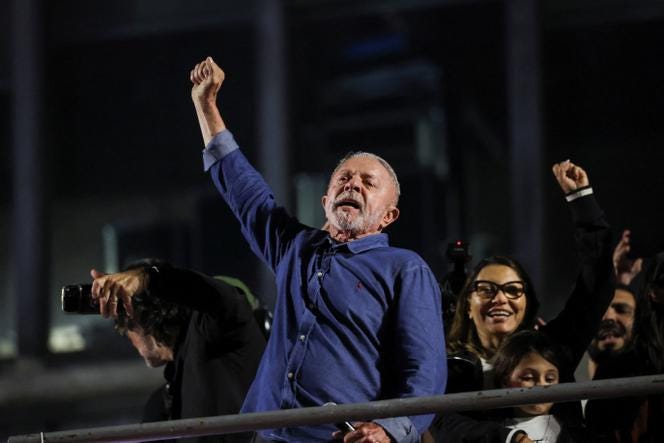
Two men lost elections on Sunday night, on two continents, within hours of each other. In Belgrade, with the ballots still being counted, Aleksandar Vučić, whose party has governed Serbia since 2012, told the country: “It is clear that we have lost these elections.” In São Paulo, Flávio Bolsonaro, trailing by more than four million votes, told his supporters it was “impossible to recognize the election results” and that he would ask a court to annul them.
Same night, opposite responses. The difference is the subject of this piece, because in eight days the United States votes, and the attorney general has already filed the response.
The year’s ledger, with the loss column first.
Hungary, April 12. Trump had endorsed Viktor Orbán on Truth Social in February, calling him a “truly strong and powerful leader,” and J.D. Vance campaigned beside him in Budapest the week before the vote. Péter Magyar’s Tisza party took 53.65 percent and 138 of 199 seats, a two-thirds constitutional majority, against 37.76 percent for Fidesz. Orbán, after sixteen years, called the result “painful,” told supporters “I congratulated the victorious party,” and phoned Magyar to say so. Magyar said as many as six million people voted in a country of nine million.
Sweden, September 13. The left bloc won 176 seats to 173. The Sweden Democrats, who had propped up the government from outside and been promised Cabinet seats if it won, fell eleven seats to third place. Ulf Kristersson posted his resignation after the final count.
Serbia, yesterday. The movement began in November 2024, when a railway station canopy collapsed in Novi Sad and killed sixteen people, and grew over two years of protest into a student list that ran doctors and teachers with no political experience. Vučić resigned the presidency in September to run for prime minister against it. Turnout hit 64.9 percent by six in the evening, the highest since Yugoslavia broke apart. By his own projection from the sample count, the students take 135 to 140 seats of 250 against 105 for his list. He conceded while the commission was still counting.
Brazil, yesterday. Lula, 80, had trailed Flávio Bolsonaro 47 to 45 in the first round on October 4 and won the runoff 51 to 48, a fourth term. The father, Jair, is serving 27 years for plotting the coup that followed his own loss in 2022. Washington’s hand in this one was heavier than an endorsement: Trump put 50 percent tariffs on Brazil last year citing the prosecution, and Reuters reported that State Department officials pushed sanctions aimed at weakening Lula and returning the family to power. Asked whom he wanted to win, Trump said, “I don’t want to get into that, but we are watching.” Flávio’s grievance is a two-hour extension of voting ordered by a Lula-appointed justice over transport disruptions. His own campaign had asked for an extension that day because of rain in the south. Donald Trump Jr. complained about the hours from here.
The counterexample, which stays in.
British Columbia, Saturday. David Eby’s New Democrats had governed since 2017. He called an election two years early and opened it by saying “Donald Trump is attacking our workers,” then shifted to housing and affordability. The Conservatives, who had changed leaders five weeks earlier when Kerry-Lynne Findlay quit and Lorne Doerkson took over, won more than sixty seats on 48 percent to 37. Eby resigned as leader that night and congratulated Doerkson. Trump shared the news twice on Sunday, once at two in the morning.
The lesson there is narrower than either side wants. A nine-year government that ran against a foreign president lost to a party that wasn’t him. Voters don’t cast ballots against a man who isn’t on their ballot. On November 3 he is on ours, through the suit his own department filed in Alaska and the rallies he has held in every district he could reach, which is a different election from the one Eby tried to run.
And 2025 cut both ways, so the scoreboard argument is a wash and anyone making it is choosing rows. Carney in Canada and Albanese in Australia won on the Trump effect, and Dutton lost his own seat. Nicușor Dan beat the far right in Romania in May. Against those: Nawrocki in Poland in June, a month after his Oval Office visit; Babiš in the Czech Republic in October; Milei’s midterm sweep in Argentina after the $20 billion swap line; Kast in Chile in December. If the question is whether Trump-aligned parties win or lose abroad, the answer across the last two years is both, and the piece ends here.
What isn’t a wash.
The question that sorts the year is what the loser did when the count went against him, and on that the ledger is clean.
Orbán, sixteen years in power, the closest thing Trump has to a European twin, with the vice president beside him in Budapest a week earlier: conceded that night, by phone and in public. Vučić, fourteen years, who had spent the last two of them denying everything the students charged: conceded before the count. Kristersson: resigned on the final numbers. Eby: resigned on the projection. Each of them had something to lose and lost it.
Flávio Bolsonaro refused, named a Supreme Court justice as the author of his defeat, and is going to court over an extension of the kind his own campaign had requested the same day. The thing that separates him from the other four is what concession costs. Orbán and Vučić go to opposition. The Bolsonaros go to prison, or stay there. The father is in a cell for what he did after the last result, and the son’s clearest route to getting him out ran through the office he just lost. A man concedes when losing is survivable. The refusal measures what he thinks he has to lose.
Which brings the ledger home.
The United States, where the refusal was filed first.
On Thursday the Department of Justice sued the State of Alaska to keep a Democratic Senate win from being certified while a retired schoolteacher with the same name as the Republican incumbent remains on the ballot. The president, asked about it Friday: “Well, I’m the one that said, ‘do it.’” The attorney general spent Sunday morning on two networks saying the suit is “not saying, ‘don’t certify,’” and then saying that if a court found confusion the state should not certify, and, asked what crime had been committed, “It depends.” I took the complaint apart on Friday; its only legal authority is a purpose clause with its first six words removed.
Nobody in Hungary or Serbia or even Brazil filed to withhold a result before the vote. Flávio at least waited for the count. Our government filed first. Twelve days before the election it put a document in a federal court that says: if this seat goes the wrong way, hold it. The same administration spent the summer running a grand jury nobody can find a subpoena from, and last week calling a retired schoolteacher fraudulent. What it has to lose on November 3 is the list Democrats have already published: Oversight on DOGE, Foreign Affairs on USAID, Science on the NASA contracts, the Starshield cap, Musk under oath. It is behaving, in advance, like a man whose father is in prison.
The open line.
Israel votes tomorrow. All three major final polls on Friday put Netanyahu’s bloc at 50 seats in a Knesset of 120, seventeen fewer than it holds, with Likud at 20, down from 32; the opposition bloc under Eisenkot at 52 to 56. The pro-Netanyahu Channel 14 has him at 60 and is alone. Trump endorsed him on October 18 with a warning that defeat would have consequences for the relationship, and posted again last night: “Vote for Bibi Netanyahu for Prime Minister,” and then, “we have to finish the job that we started!” Axios reports Netanyahu called him twice in three days asking him to double down and suggested the language. Likud denies it.
Netanyahu is a defendant in his own corruption trial and has asked for a pardon. On the measure this piece uses, he sits in the Bolsonaro column: concession has a price he may not be able to pay. Official results are due November 4, the day after ours. What he says on election night is the first reading. What ours say on November 25, when Alaska is scheduled to certify, is the second. The count will tell you who won. The concession, or its absence, tells you what kind of country is doing the counting.