


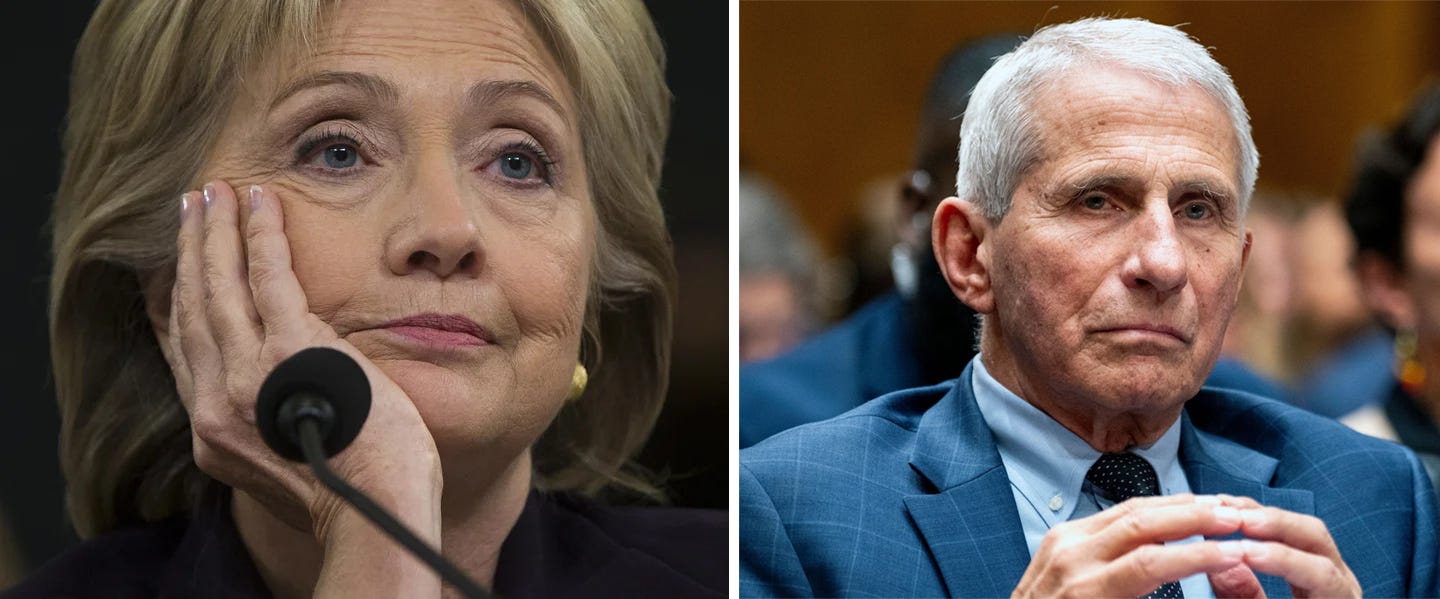
On October 22, 2015, Hillary Clinton sat in a hearing room for eleven hours. The session opened just after ten in the morning and Trey Gowdy gaveled it closed just after nine at night. She spent roughly five hundred minutes in the chair answering questions. It was the third time she had testified publicly about Benghazi, before the eighth congressional committee to investigate it, in the twelfth investigation overall.
Afterward, reporters asked Gowdy what new information the committee had learned. He could not produce an answer.
On July 29, 2026, Anthony Fauci sat in a hearing room and invoked the Fifth Amendment more than one hundred times. He answered nothing. Rand Paul announced that the committee would vote on holding him in contempt of Congress, and that the Justice Department would then decide whether to take it up.
Two witnesses in the same chair, eleven years apart. One answered everything. One answered nothing. Both outcomes were the same outcome, which tells you the questions were never the point.
What the machine cost the first time
The House Select Committee on Benghazi was created in May 2014 to investigate an attack that had killed four Americans in September 2012, an attack that had by then already been examined by seven congressional committees and an independent Accountability Review Board.
It ran for two years. It cost roughly seven million dollars. It interviewed around eighty new witnesses and logged more than sixteen thousand pages of transcripts. It ran longer than the congressional investigation into Watergate and longer than the 9/11 Commission took to investigate an attack that killed nearly three thousand people.
Its final report, released in December 2016 and running past eight hundred pages, found no new evidence of wrongdoing by Hillary Clinton. It reaffirmed what the previous investigations had already established: that security gaps at the compound were obvious and that help could not have arrived in time. Gowdy, pressed repeatedly on whether Clinton was at fault, declined to say. His position was that he reported facts and the public could draw conclusions.
Four Americans died in Benghazi. Their families were owed an investigation. They got twelve, and the twelfth one produced a document that most of the people who demanded it never read.
The night the purpose slipped out
On September 29, 2015, three weeks before Clinton testified, Kevin McCarthy went on Hannity to make his case for becoming Speaker of the House. Asked what Republican leadership had accomplished, he offered the committee as his example. Everybody thought Hillary Clinton was unbeatable, he said. They put together a Benghazi select committee. Her numbers were dropping. Nobody would have known any of it if they had not fought and made it happen.
Hannity told him he deserved credit.
The reaction was immediate and bipartisan in its alarm. Jason Chaffetz said the remarks were absolutely wrong and should be withdrawn. McCarthy went on Bret Baier’s program two days later to say he had never intended to imply the work was political. Clinton said it demonstrated unequivocally that the exercise had always been partisan, and that it dishonored the memory of the four men who died. Democrats forced a floor vote to disband the committee, which was tabled along party lines. McCarthy’s bid for Speaker collapsed within a week.
What made it a scandal was that it was an accident. McCarthy had been asked to name an accomplishment and reached for the true one. The committee’s legitimacy depended on nobody in charge ever saying out loud what it was for, and he said it on cable television while auditioning for the second most powerful job in the country.
Nobody needed a gaffe this time
Rand Paul did not slip.
He has said for years, publicly and repeatedly, that he wants Anthony Fauci in prison. Fauci said it to his face at the hearing, describing an unhinged obsession and stating that the purpose of the proceeding was to get him to say something, anything, that would vindicate Paul’s repeated public pledges that Fauci end up behind bars.
Paul did not deny it. He said he had hoped for an apology, perhaps some acknowledgment that errors in judgment were made, and that the committee had not heard any of that.
Consider what has changed between 2015 and now. In 2015, a Republican leader accidentally admitting that an investigation existed to damage a specific person was a career-ending event, condemned by members of his own party, and it triggered a floor vote. In 2026, a committee chairman states the target and the desired outcome in advance, for five years, in public, and it is simply how the committee is described in the press. Paul’s stated goal is not a gaffe to be walked back on Bret Baier. It is the committee’s mission statement, and it is on his own Senate website.
The scandal was never that they hid the purpose. The scandal was that hiding it used to be necessary.
What Fauci learned from watching
Here is the part that makes this more than a comparison.
Clinton cooperated. She testified three times. She sat for eleven hours in a single day, took responsibility publicly for what happened on her watch, and answered every question they put to her. The committee produced nothing on her, and the chairman could not name a single new insight when asked.
And it did not end there, because ending was never available. The eleven hours did not close the matter, they generated the next matter. The committee’s genuine yield was not a finding about Benghazi at all. It was the discovery of a private email server, which became its own investigation, which produced a letter from an FBI director eleven days before a presidential election.
That is the lesson available to anyone who might someday be seated in that chair: full cooperation does not end the process. It extends the surface area. Every hour of testimony is an hour of transcript, and every transcript is raw material for the next referral.
Fauci had already testified before the House Oversight Committee in 2024. He has answered these questions repeatedly, in multiple forums, for years. This time he sat down and said nothing at all, and he explained why with precision: he was not protecting a secret, he was avoiding a perjury trap set by a man who has promised for half a decade to imprison him.
Whether you find that sympathetic or evasive, it is a rational response to the documented history of the process. He watched what eleven hours of candor bought Hillary Clinton, and he declined to buy it.
The shield turned into the sword
Then there is the pardon, which is where this gets genuinely novel.
Before leaving office, Joe Biden preemptively pardoned Fauci, explicitly to protect him from politically motivated prosecution by the incoming administration. That is what the pardon was for. It was a shield.
Paul’s argument for contempt is that because Fauci holds a pardon, he faces no criminal jeopardy, and therefore the Fifth Amendment does not attach, and therefore his refusal to answer is not a protected right but an obstruction of Congress.
Read that again. The instrument issued to protect him from prosecution is now the stated basis for prosecuting him. Accept the argument in full and it means that any pardoned person can be compelled to testify without limit, and jailed for declining. The protection becomes the mechanism of exposure.
Paul acknowledges it is an unresolved legal question. He scheduled the vote anyway.
The question that actually exists
Something should be conceded here, because the piece is weaker without it.
There are real questions about the origins of COVID-19 and about American funding of coronavirus research in Wuhan. The lab-leak hypothesis is not a fringe position and has never been definitively excluded. Whether federal agencies were candid with the public in early 2020 is a legitimate subject for congressional oversight, and Paul is not inventing the topic.
Richard Blumenthal put the distinction correctly at the hearing. If there are valid scientific questions about the origins of the pandemic, they should be addressed. Not in a show trial. Not as part of a continuing vendetta against a single individual.
That is the whole matter in two sentences. A legitimate question does not sanctify any method used to pursue it, and the method here is the evidence of the purpose. You do not need a subpoena, a diary dump, and a contempt referral to establish a scientific fact. You need those things to break a person.
What it is for
More than a million Americans died in the pandemic. Four died in Benghazi. In both cases the underlying event was real, the grief was real, and the questions deserved asking.
And in both cases the apparatus assembled around them was aimed at one individual, ran long past the point of producing information, and was defended by its architects as a neutral search for facts while its actual purpose was visible to anyone who cared to look.
The difference is that in 2015 the purpose had to escape by accident, and its escape ended a man’s bid for the speakership. In 2026 the chairman states it in advance, on the record, in his own voice, and schedules the vote.
Eleven hours of answers were not enough. Now silence is the offense. There was never a way to comply, because compliance was never what was wanted.
Thank you for this excellent side-by-side analysis. I am getting more and more outraged at the fact that we pay taxes for this political BS, when we could actually be pursuing real investigations that we could learn from. Not to mention harassing good people and dishonoring the ones whose lives were lost. 😞 Our politicians are no longer doing their actual jobs, which is to represent and help their constituents. They are simply helping themselves to all the power and money they can get their hands on while in office. Guess it’s no surprise, when you have a grifter in chief leading the way. It’s disgusting 🤮 And it has to stop.
It seems to be a part of the whole fabric of the plan....to continue to run cover for the actual crimes the repub party is committing. This is rand's small part. One he can do to keep his place in the greed operation, but also a guy who many believe to be NOT AS RABID. All a part of the same pattern. Directive from on high: do at least something or become a target yourself. Rand's been sniffing the perm solution for too long.