


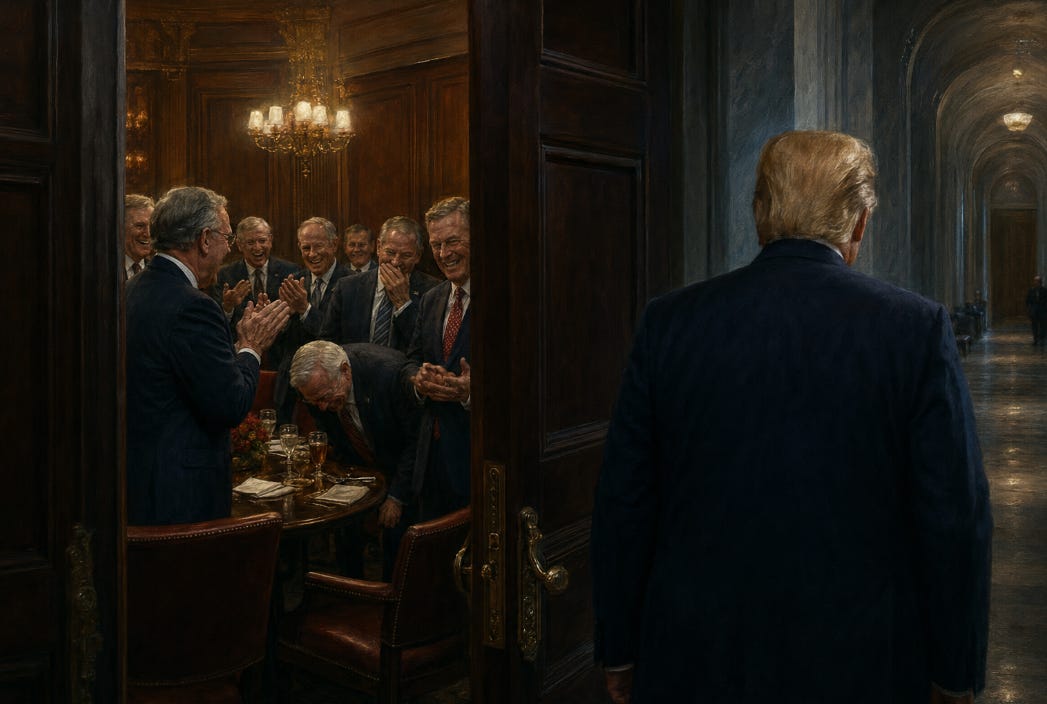
The scene comes from Mitt Romney’s private journals, which he handed over to a biographer, and it is the most useful thirty seconds in the entire documentary record of the last decade.
The Senate Republican caucus meets for lunch every week. Trump came to one of them. He boasted. He rambled through his remarks. When he finished, the senators rose and gave him a standing ovation. Then he left, and the door closed, and the room burst out laughing.
Hold onto that, because it disqualifies the explanation everyone reaches for first.
Cults do not laugh when the leader leaves. That is the one thing a cult cannot do. The defining feature of genuine capture is that the belief persists in private, when there is no audience and no cost to abandoning it. What happened in that dining room was the precise opposite. The performance ran while he was in the room and collapsed the instant the door shut, which means every person clapping knew exactly what he was clapping for.
And then they went out and voted for everything he wanted anyway.
That is the actual mystery, and it is a harder one than enchantment. Enchantment would at least be comprehensible. What we have instead is a group of people who find the man ridiculous, say so to each other, and hand him the country regardless.
What the private record says
Romney was not guessing about his colleagues. He talked to them.
Almost without exception, he told his biographer, they shared his view of the president. They would not say it publicly because they feared their voters would turn on them. They said it to him privately, repeatedly, in the specific register of men confiding a burden. I sure wish I could do what you do. Gosh, I wish I had the constituency you have.
Set that alongside the public record and the gap becomes the whole story.
In February 2016, JD Vance wrote to a Yale classmate that Trump was either a Nixonian cynic or America’s Hitler. In May 2016, Ted Cruz stood at a podium and called him a pathological liar, utterly amoral, a narcissist, and a bully. In July 2015, Lindsey Graham called him a race-baiting xenophobic bigot who was appealing to the dark side of human nature, and the following May said the Republican Party would deserve to lose if it nominated him. In December 2020, Bill Barr told the Associated Press, as sitting Attorney General, that there was no fraud sufficient to change the outcome, and told Trump to his face in the Oval Office that the stolen-election claims were, in his word, bullshit.
Every one of those men later served him. Not reluctantly. Vance took the vice presidency. Cruz voted to object to the certification after the Capitol was attacked. Graham flew to Mar-a-Lago. Barr endorsed him in May 2024.
None of that is the behavior of people who were fooled. It is the behavior of people who were correct, and who then decided that being correct was not worth what it cost.
The arithmetic, which is boring and explains most of it
Before January 6, the mechanism was not mysterious and it was not psychological. It was a denominator.
In a safe Republican seat, the general election is decorative. The only contest that can end a career is the primary, and primary turnout runs somewhere in the neighborhood of fifteen percent, and among that fifteen percent the president’s approval has run near ninety. A senator who defects does not lose a general election in November. He loses a primary in March, to someone whose entire campaign is the defection.
Nothing about Lindsey Graham had to change between 2015 and 2017. The party changed. In 2015 the Republican electorate was genuinely contested and calling Trump a bigot was a viable position inside it. By 2017 it was not a contested electorate anymore, and the same sentence had become a resignation letter.
This is why the conversions look instantaneous in the clip packages and were not. Graham’s denunciation to his endorsement is fourteen months. Cruz’s is four. Vance’s private text to his nomination acceptance is eight years. Nobody flipped a switch. Each of them took a series of small steps, and each individual step was defensible on its own terms, and the sum of the steps was a career spent serving a man they had accurately described.
Then it stopped being about elections
After January 6 the category of fear changed, and here the record is specific enough that it should be read slowly.
On January 2, 2021, Angus King warned Romney that a Pentagon official had told him right-wing extremists online appeared to be planning an attack on the sixth. They were talking about guns and arson and bombs, and about targeting members of Congress they considered traitors, a list that included Romney. Romney texted Mitch McConnell that night. There were calls to burn down McConnell’s home, to smuggle guns into Washington, to storm the Capitol. He wrote that he hoped sufficient security plans were in place and that he was concerned the instigator was the president, who commanded the reinforcements the police might need.
McConnell never answered.
Four days later the building was attacked. And in the weeks after, a new calculation appeared in the private conversations.
A Republican congressman told Romney he had wanted to vote for the second impeachment and did not, out of fear for his family’s safety. His reasoning was arithmetic: House Democrats had the votes with or without him, so why put his wife and children at risk for an outcome that would happen anyway.
Then, during the Senate trial, a member of Republican leadership told a small group of colleagues that he was leaning toward voting to convict. They talked him out of it. You can’t do that, one of them said. Think of your personal safety, said another. Think of your children.
He decided they were right.
Romney had been paying five thousand dollars a day for private security for his family since the attack, roughly two million a year, and he understood that almost none of his colleagues could afford anything like it.
So the answer to whether it was fear, and which kind, is that it was both, in sequence. It was career fear until the sixth of January and physical fear afterward, and the physical fear was not paranoia. Those people had just watched a mob build a gallows outside the building they worked in.
What fear does not cover
Now hold the sympathy for one moment and look at what that explanation actually accounts for.
Fear for your children explains a vote to acquit. It explains silence. It explains a man deciding that a symbolic gesture is not worth an unpredictable risk to his family, and honestly, most people reading this would make the same call at three in the morning with their kids asleep upstairs.
It does not explain anything that came after.
It does not explain flying to Mar-a-Lago three weeks later to have your photograph taken. It does not explain four years as the most visible surrogate in the country. It does not explain accepting a nomination, or running a Justice Department for a former client, or endorsing in 2024 after a decade of watching. Fear is a reason to stay quiet. It is not a reason to campaign.
The distance between “I was afraid to convict” and Lindsey Graham’s actual biography is enormous, and fear covers about two inches of it. Somewhere past that two inches, something else takes over, and that something else is where the real answer lives.
The order of operations
Here is the part that inverts how most people think about this.
The assumption is that belief changes first and behavior follows. Something converts them, and then they act converted. That is what makes it feel like a spell.
It runs the other way. The behavior moves first, for boring reasons, and then the belief renovates itself to match.
Once a man has endorsed someone he called America’s Hitler, he is carrying two things that cannot coexist. He can hold that he is a person of integrity, or he can hold that he knowingly served a fascist for career reasons. One of those has to give, and the cheaper one to abandon is always the assessment of the other guy, because the assessment lives out in the world where evidence is contestable, while your sense of yourself lives inside your own head where you are the only witness.
So the belief drifts. He was exaggerating in 2016. The media distorted it. He has grown. The alternative is worse. The policy outcomes justify it. Each revision is small and each one makes the next one easier, and after a few years of this the man is not lying when he defends Trump on television. He believes it. He arrived at belief through the back door, by way of a vote he cast for reasons that had nothing to do with belief at all.
That is why they seem sincere. They are sincere. Cruz was sincere in May 2016 and Cruz was sincere in January 2021, and what happened in between was not a conversion experience. It was one act of compliance, followed by a mind catching up to a body that had already moved.
You do not need a cult for that. You need a career, a primary, and an ordinary human inability to hold contempt for yourself.
Everyone thinks he is the only one pretending
There is one more mechanism, and the laughter in the dining room is its perfect illustration.
When everybody in a room is performing a belief none of them holds, each person can see the performances and cannot see the private doubts. So each of them concludes that he is the sole holdout in a room of true believers. The senator who thinks Trump is ridiculous looks around at fifty colleagues giving a standing ovation and concludes he is alone and had better clap.
Romney’s entire testimony is that they were not alone. Almost without exception, they agreed with him. Every one of them was standing there thinking some version of the same thing, and every one of them was measuring the room and reaching the same conclusion about what the room required.
This is why the private and public records diverge so violently, and it is why a structure like this can look monolithic right up until the moment it does not. The whole arrangement is held in place by mutual misestimation, and it costs one person almost nothing to break it and costs the first person to try absolutely everything.
Which is exactly why nobody goes first.
No exit
The final piece is that there is nowhere to go.
The anti-Trump right is not a constituency. It is a green room. There are no voters in it, no primaries to win, no seats to hold. A Republican who breaks does not join a faction. He becomes a guest on programs his own voters do not watch, and then he becomes a former senator.
Romney’s own entry in this Registry is precisely this error. He held himself in reserve for a post-Trump Republican Party, declined to endorse the only candidate who could have stopped the return, and retired three months later. The party he was saving himself for did not exist. It has never existed. It was a room he had furnished in his imagination and nobody else was ever going to move in.
What it actually is
So: not a cult. Something worse, and considerably more fragile, and much harder to talk about, because a cult at least has the dignity of conviction.
What holds this together is a large number of people who privately find the man absurd, who have said so to each other, who laughed at him the moment the door closed, and who have concluded independently that the cost of saying it out loud exceeds what they are prepared to pay. Some of that cost is a primary. Some of it, after January 6, is a genuine and reasonable fear for their children. And a great deal of it is simply that they have already gone too far to stop without admitting what the last ten years were.
Romney had a stock answer for the colleagues who told him they wished they could do what he did.
There are worse things than losing an election, he would say. Take it from somebody who knows.
He was the 2012 nominee of that party. Sixty-one million people voted for him. He left the Senate with his own voters calling him a traitor, paying two million dollars a year to keep his family safe, having been proven right about every single thing and having accomplished, in the end, nothing at all.
They heard him say it. They laughed at the man he was warning them about. And they went out and did it anyway, and they will do it again in November, and most of them will still be there in January, and the ones who are not will be writing books about how they always had concerns.
This is very close to the descriptions given by Germans who lived through the rise of Hitler. "It went drop by drop...sort of like an anesthetic," is a common refrain. Americans, however, are not as "good" at following rules or respecting authority as traditional Germans were--and that might be our salvation.
What a frightening assessment of those selected and elected senators!
I understand fear for self and family...I will NEVER understand the insanely blind-to-factual evidence the followers of this hollow man possess and proudly display.
I am left pondering and wondering what it will take to convince them.