There is a file in the second PURSUE release that does not belong in a press dump. It is catalogued as DOW-UAP-PR051, titled in the flat institutional monotone of the archive as Syrian UAP instant acceleration, and it sits on a Department of War web page between weather balloons and procedural noise like a single coherent sentence dropped into static. The portal around it has logged more than a billion visits, which is to say it has been consumed the way everything is consumed now. Scrolled, clipped, captioned, argued over for an afternoon, and abandoned by morning. Strip away the billion clicks and the provenance squabble and the partisan theater that attends every government gesture in this exhausted year, and what actually remains is roughly forty seconds of thermal video.
I want to read those forty seconds the way I read a scene. Slowly, without forcing them, frame by frame, because that is the only honest way to watch something that may not want to be understood. The disclosure conversation has been poisoned for decades by two species of impatience that present themselves as opposites and are secretly the same animal. The believer who needs the object to be a craft from somewhere else, and the debunker who needs it to be a Mylar balloon catching the wind, are both in a hurry to stop looking. Both lunge for the meaning before the watching is finished. I am proposing the contrary discipline, the one a Russian filmmaker spent his entire life defending, and I am proposing to apply it to a piece of footage shot by a machine that was built to kill.
Sculpting in time
Andrei Tarkovsky distrusted the cut. He regarded montage, the rapid assembly of fragments that Sergei Eisenstein had elevated into the native grammar of cinema, as a kind of well-mannered lie, a way of deciding on the viewer’s behalf what mattered before the viewer had any chance to feel it for themselves. In his book on filmmaking, he insisted that the true material of the medium was not the image but time itself, and he described the director’s labor as sculpting in time, carving sense out of raw duration the way a sculptor carves a figure out of resistant marble. So his camera held. It held past comfort and past convention, past the precise moment when any sensible editor would have moved the audience gently along, until the duration stopped functioning as a container for events and quietly became the event. You stop waiting for something to occur. You begin, gradually, almost against your will, to see what was standing in front of you the whole time.
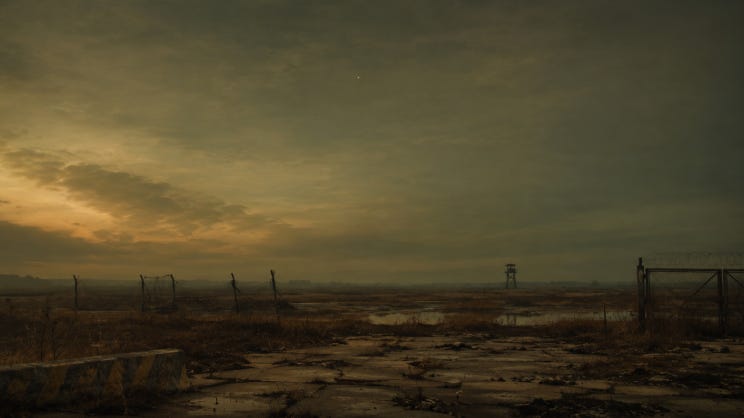
Stalker, his austere 1979 adaptation of a Strugatsky brothers novel, is the purest distillation of that faith. Some unnamed visitation has left behind a region called the Zone, sealed off and ringed by soldiers, where the ordinary laws of space and motion no longer reliably hold. You cannot cross it in a straight line. The guide, the Stalker of the title, leads his two paying clients by throwing metal nuts wrapped in strips of cloth ahead of them, reading a path that rearranges itself and refuses to be mapped. At the dead center of the Zone waits a Room rumored to grant the visitor his most secret and authentic wish. The Writer goes seeking inspiration he has lost. The Professor goes, we eventually learn, carrying a bomb. The film moves at the pace of dread and patience, the mundane outer world rendered in exhausted sepia and the Zone breaking open into damp green color, and Tarkovsky dares you to look away from puddles and wet concrete and the back of a man’s head until the looking itself becomes a moral act.
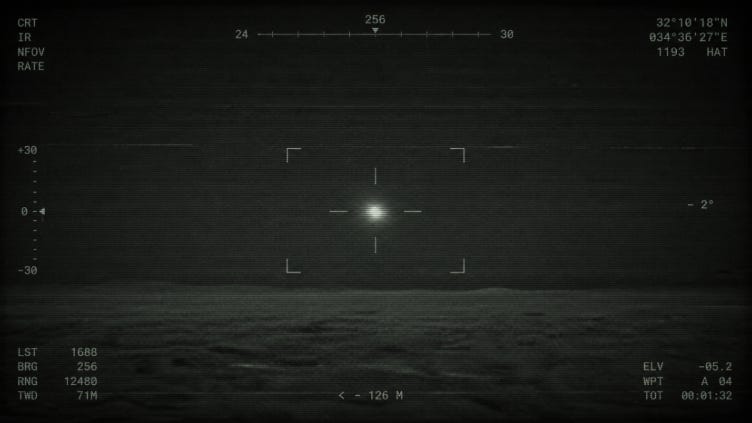
A gun-camera feed is Tarkovsky’s discipline imposed by circuitry rather than conviction. The Multi-Spectral Targeting System slung beneath an MQ-9 Reaper holds no theory of art and harbors no patience to be tested. It simply does not cut. It locks onto a point of heat, and it stares, indifferent, continuous, recording the passage of time, whether or not anything moving through that time consents to be explained. If you set out to design an instrument that filmed the world the way Tarkovsky believed the world ought to be filmed, you could do considerably worse than a targeting turret that has been ordered to hold its gaze and does so without blinking, without flinching, without the editorial cowardice of the cut.
The unblinking turret
So here is the scene, read as a scene. The year is 2021. The platform is operating somewhere inside the United States Central Command area of responsibility, and the resolution office that later assessed the footage would commit only to the cautious phrase that the clip was likely derived from an infrared sensor aboard a military aircraft. Likely. The most surveilled and instrumented military on the planet, hedging about the authorship of its own recording. The imaging point sits near the Jordanian border at roughly thirty-two degrees and five minutes north, the coordinates rendered to a precision that pins the gaze inside a hundred-meter square of the earth. The Zone, in the film, was a place no map could hold. This Zone has a street address, accurate to the meter, posted on a federal server.
Because the medium is thermography rather than visible light, the world arrives stripped of color and texture and reduced to temperature. The object reads as a warm smear against the cooler ground, a bright point of radiated heat that the reticle has found and decided to keep. There is no surface to it, no skin, no insignia, none of the detail a credulous eye could furnish a story from. There is only heat, holding position, and around the edges of the frame, the quiet liturgy of the instrument: the corner telemetry ticking through its numbers, the slow involuntary drift of the aircraft, the reticle making its small constant corrections to stay married to the point.
For most of the duration, nothing dramatic happens at all, and Tarkovsky spent a career teaching us that the long nothing is precisely where the seeing lives. The drone drifts. The numbers tick. The object persists, tracked, behaving itself, a patient mote suspended in the crosshairs of a hunter-killer aircraft. The technical term for what the system achieves on it is a weapons-quality lock, and that phrase deserves to be sat inside rather than skimmed across. A weapons-quality track means the targeting solution was stable enough, accurate enough, persistent enough that the operators could have killed the thing. This is not a wonder instrument operated by mystics in a desert tent. It is a precision homicide apparatus operated by the most literal-minded readers of the sky our civilization has yet produced, technicians whose entire profession consists of putting ordnance exactly where an object is, and exactly where it is about to be, and being right.
The moment
And then, in a small handful of frames, the object is no longer where it was.
That is the whole of it. There is no flash, no maneuver you can narrate as a turn, no graceful arc out of the frame that the eye can follow and reassure itself with. The warm point that the killing machine had pinned for the length of the encounter simply stops being in the place it occupied, and the gap between one state and the next is too small for the imagination to fill comfortably. Downstream, the analysts who examined the recording did not reach for the language of dreams or saucers. They reached for the cold administrative vocabulary the state reserves for performance it cannot reconcile with its own physics, and they wrote down instantaneous acceleration, one of the so-called observables, the short grim lexicon of behaviors that the relevant offices have agreed to treat as the signature of something that does not fly the way our machines fly.
What does an operator do in the ground control station, in the seconds after the locked target is suddenly and inexplicably gone? We are not shown that. We are shown only the frames, and the frames are enough to constitute the problem. A thing was held by an instrument designed to hold things long enough to destroy them, and the thing did something the instrument was not built to account for, and the recording was kept rather than deleted, which is itself a quiet and underrated form of testimony.
What a single eye cannot know
Here I have to stop and be honest, because a forensic reading that only flatters the anomaly is not forensics, it is liturgy, and Tom’s readers have been promised the skeptics taken on directly rather than waved away.
The hardest truth about every clip of this kind, the one that both camps tend to hurry past for opposite reasons, is that a single passive thermal sensor cannot tell you how far away anything is. The Multi-Spectral Targeting System carries a laser rangefinder, but a passive infrared track of an airborne unknown rarely carries an independent range solution to that unknown, and without range, you do not have size, and without size, you do not have speed, and without speed, you certainly do not have acceleration in any absolute and physical sense. You have angular motion only. You have the rate at which a bright dot crosses the field of view of a camera that is itself moving, slung under an aircraft that is itself moving, pointed by a gimbal that is itself moving. A small object close and slow, and a large object distant and fast, can paint very nearly the same trace across that frame. The apparent leap that reads to the heart as impossible velocity can, in cold geometry, be a far more ordinary thing seen from an unhelpful angle through a sensor that resolves temperature beautifully and range not at all.
This is not a debunker’s trick. This is the actual epistemic floor under the entire genre, and it constrains the believer and the skeptic with perfect impartiality. It is the reason the famous Navy clips remain genuinely contested two decades on. It is why an instrument that can hold a weapons-quality lock can still, in principle, be fooled about the most basic facts of what it is holding. The honest viewer has to carry this limitation into the frame with them and keep carrying it, the way the Stalker carries the knowledge that the Zone will punish any straight line. You do not get to set it down because it is inconvenient to your preferred ending.
The Professor’s bomb
In Stalker, the Professor hauls a twenty-kiloton nuclear device into the Zone because he cannot bear the existence of a sacred he is unable to reduce. Confronted with a Room that might grant the deepest wish of whoever enters it, his instinct is not awe, and not even scientific curiosity, but elimination. Better a crater than a mystery he cannot dissolve into a mechanism. He arrives armed to make the unbearable thing simply cease.
The serious skeptics carry that same bomb to this file, and I mean the serious ones, the forensic community around Metabunk and the patient frame-by-frame work of analysts like Mick West, not the reflexive snickerers who treat any witness with two decades of clearance as a hayseed. Their case has real and considerable weight, and intellectual honesty requires stating it at full strength rather than in a weakened form built to be knocked down. The released clip carries the telltale signatures of a screen being re-filmed rather than original sensor data, the faint tearing and synchronization artifacts you get when a camera is pointed at a monitor instead of at the raw feed. The apparent acceleration, on their reading, may be nothing more exotic than a localized gain adjustment, an automatic brightness correction in the imaging chain that makes the warm point appear to shrink and bolt at the very instant it is actually just dimming. Using their reconstruction tools, they have modeled the drone’s track and the geometry of the ground beneath it, and they argue that what looks like a violation of physics is the mundane behavior of an imaging system doing exactly what imaging systems do. A re-recorded screen, they note correctly, multiplies every avenue by which an ordinary thing can masquerade as a miracle, doubling the degrees of freedom available to misperception.
None of that is stupidity. All of that is the discipline working as it should, and anyone who finds it threatening rather than clarifying has mistaken their faith for evidence. If the choice were between the believer’s certainty and the debunker’s, the debunker would win on rigor alone, every time, and deserve to.
The seam
But honesty has to cut in both directions or it is merely preference wearing a borrowed lab coat, and there is a detail that the careful debunk does not fully close. Even within the forensic reconstruction, the artifact that supposedly explains the vanishing is observed to reach into the on-screen display, distorting not only the filmed world but the overlaid numbers and symbols that are painted onto the feed by the instrument rather than captured from the air. The analysts themselves flag this as odd. An imaging glitch that altered only the picture would be a clean and sealed and load-bearing explanation, the kind a bomb is supposed to be. A glitch that reaches up into the instrument’s own readout is something stranger, and it leaves a seam. The Zone, in the film, is exactly this kind of place, the place where the mundane account very nearly holds and then, at one stubborn point, does not quite. And it is worth remembering that the Professor, at the threshold, with the bomb finally assembled in his hands and the Room in front of him, cannot bring himself to detonate it. He pulls the device apart and throws the components into the standing water, because at the last moment, even he understands that you do not get to obliterate the mystery simply because you arrived equipped to.
The other thing that survives the elimination is the designation. Long before two journalists surfaced this footage in February, long before it was laundered through a partisan transparency initiative and posted to a government domain in May, the people inside the chain who first examined it did not file it under balloon or birds or atmospheric inversion or swamp gas. They held it within their intelligence collections; they ran it through the offices whose entire purpose is to resolve such things into the boring and the explicable, and the boring explanation did not come. The resolution office could manage only that hedging is likely. The catalog entry held the anomalous behavior in the official vocabulary, and the catalog entry was never quietly amended away. These are not people predisposed to wonder. They are the most concrete, the most ballistic, the most professionally unromantic readers of the sky we have, and they wrote down that a tracked object did a thing their physics does not permit, and then they kept the note.
The refusal to cut
The posture Tarkovsky modeled across every glacial frame of his work was neither belief nor debunking, because both of those are species of impatience, and both decide the meaning before the watching is complete. The Writer’s exhausted cynicism and the Professor’s bomb are the same gesture aimed in opposite directions, two different ways of refusing to stand at the threshold and simply keep your eyes open in the presence of something you cannot yet name. The honest posture, the one that costs the most and yields the least comforting reward, is the refusal to cut. You sit inside the forty seconds. You watch the warm point persist and persist and persist, you feel the long nothing become the thing itself, and then you watch it not be there, and you let the mundane hypothesis do its genuine and necessary work, and you mark with precision the one place where it strains and fails to fully close.
What remains when the rigorous skeptic has finally finished his honest labor is not proof of anything from elsewhere, and anyone selling you that conclusion is selling, and should be distrusted with the same energy you would bring to the man insisting it was certainly a balloon. What remains is smaller and far harder to wave off. A thermal frame, weapons-quality, government-catalogued, in which an object did something the men paid to track it could not resolve into the ordinary, surfacing on a public server with a seam in the explanation that the most competent debunk in the world has not been able to stitch shut. That is not a saucer. That is a question the state has now been forced to ask in public and cannot answer in public, which in this country, in this year, is its own small uncanny miracle.
Philip Dick spent his life worried that the reality handed to us is a screen laid over something else, that consensus is a kind of managed footage, and that the seams, when you find them, are the only honest thing in the picture. This file is a seam. The Zone has coordinates now, thirty-two degrees and five minutes north, rendered to the meter and left sitting there on a server for anyone with the patience to look. The frame is not going anywhere. It is unblinking, continuous, indifferent to whether we resolve it. The only question Tarkovsky ever truly asked, across all those long, unbearable takes, was whether we still possess the patience to keep our eyes on the thing instead of reaching, in our terror of not knowing, for the bomb.