


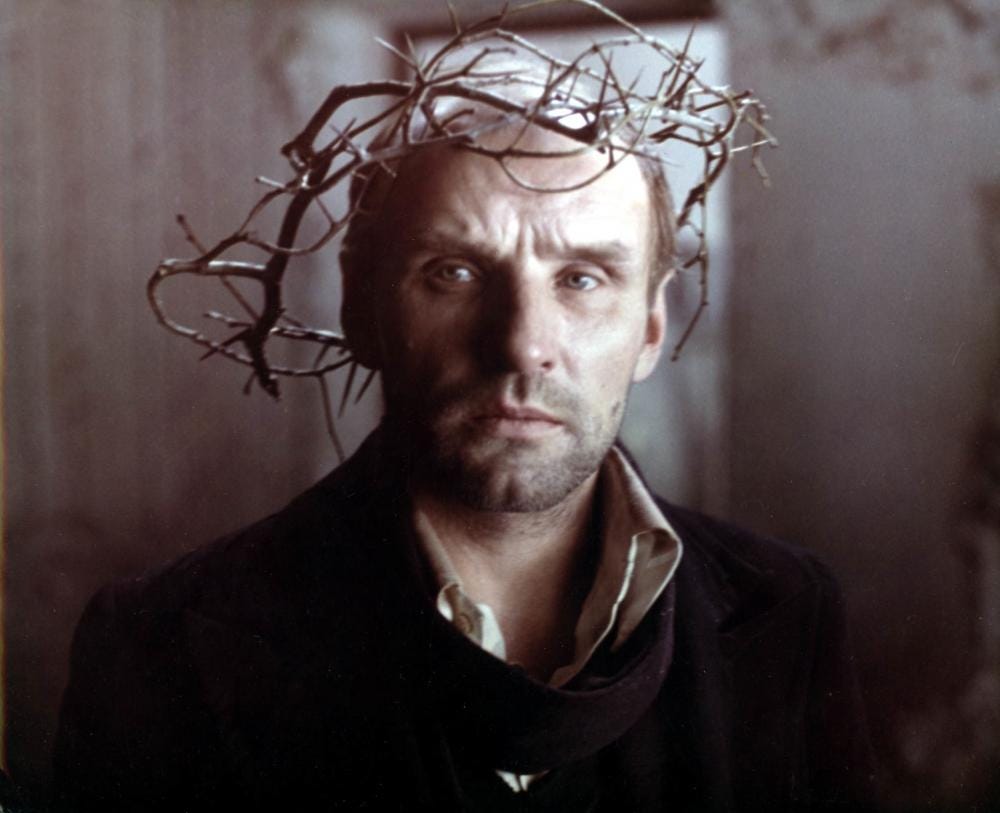
He emerges from the meat grinder wet, lit from above, and the wreath is on his head. Wire and brambles. Hair pasted to his forehead. He doesn’t touch it. Nobody points to it. The camera holds.
Christ’s crown was placed by his executioners. Mockery. The point of the symbol is that the suffering belongs to someone else, that the man under the thorns is dying for transgressions he didn’t commit. Borrowed pain on behalf of a population that doesn’t deserve him. The iconography only works in one direction.
The Writer’s crown is self-issued. He came to the Zone hungover, sarcastic, hunting inspiration like a man hunts groceries. He’s been pierced by nothing. His suffering is the suffering of a man who has eaten too much of what he wanted and now finds himself tired of it. The wreath sits on his head because the meat grinder put it there, but the meat grinder is just a corridor. He walked through it. He didn’t bleed.
So the symbol is stolen. Tarkovsky knows it. He shoots it anyway, in the same hushed register he uses for the dunes and the dog and the dripping ceiling. The collision is the meaning. Put the holiest costume in Western art on the least worthy man in the frame, and let the audience decide what to do about it.
Triangulate. The Stalker has a vocation. He believes. His suffering is real, and on behalf of others, the pilgrims he leads who can’t lead themselves, his daughter, the Zone itself, which he treats as a thing to be served rather than used. He wears no crown because he doesn’t need one. The thorns are inside him, and they’ve been there the whole film. Tarkovsky doesn’t dress him up because dressing him up would be redundant.
The Professor wears no crown either, but for the opposite reason. His suffering is small and private and corrosive. A grievance carried in a backpack, twenty kilos of righteousness disguised as twenty kilos of plutonium. He doesn’t believe in anything large enough to martyr him. He believes in his hurt, and the bomb is a way of making the hurt loud. The Professor would never accept the crown. He’d find it embarrassing. He’s a small man with a small wound and he knows the scale he operates at.
The Writer is in the middle, which is the worst place to be. He’s not the believer and not the grievance-carrier. He’s the performer. He has no Zone of his own, no bomb, no daughter, no vocation. What he has is an audience, and the audience is the engine of every word out of his mouth in this film. He talks about readers constantly. Who reads him. Who doesn’t deserve him. Whether genius exists. Whether anyone is listening. He came to the Zone not for a wish but for a refill, because the audience has eaten him hollow and he needs to be made full again so they can eat him some more.
That audience is what places the crown. Not Roman soldiers. Not mockers. Readers. The role of artist-as-martyr survived the death of the god who invented it, and the audience still demands the role be filled, because the role flatters them too. They get to be the crucifiers and the mourners at the same time. They pay him in suffering and call it royalties. He complains about wearing the costume. He never takes it off. He couldn’t. Without the costume he is a man with appetites and no excuse for them.
This is why he refuses the Room. The Room shows you what you actually want. The Stalker won’t enter because he suspects he wants nothing pure enough to deserve granting. The Professor won’t enter because he came to destroy the place, and his bomb is a confession he isn’t ready to make out loud. The Writer won’t enter because the Room would strip the crown. Whatever wish surfaced would be small. Recognition. Revenge on a critic. A woman. The fame back. And once seen, the costume couldn’t be put back on. He would have to live as the man under it, and the man under it isn’t interesting enough to sustain him.
So he stays on the threshold and gives the speech. The speech is brilliant. The speech is also a stalling tactic. As long as he’s articulating the test, he doesn’t have to take it. The crown holds.
Tarkovsky’s cruelty is that he respects the costume even while exposing the man. He doesn’t film the wreath as a joke. He films it as an icon. The icon survives. The man inside it does not. We are meant to see both at once and feel the gap, and the gap is where the essay lives. Secular sainthood is a posture available to anyone willing to suffer publicly on their own behalf and call it suffering for art. The culture still hands out the crown. The culture still genuflects. The crown still means something even when the head inside it is empty, which is perhaps the bleakest theological claim the film makes.
He walks out of the Zone in the rain, still wreathed, still uncrucified, still performing. Nobody points to the thorns. The camera does. You do. He doesn’t. He’ll go back to the bar and the bottle and the readers, and the wreath will dry and fall apart on the train home, and he’ll write something about the trip, and the readers will eat it, and the crown will reissue itself by Monday.
The Stalker carries his belief home to a wife who has stopped being surprised by him. The Professor carries his unexploded bomb home to whatever apartment houses a man like that. The Writer carries the only thing he ever had. The costume. The audience. The hunger the costume is designed to hide and the audience is designed to feed.
Three men leave the Zone. One is a saint without a halo. One is a terrorist without a target. One is a martyr without a cross, wearing the crown anyway, because someone has to.
The series: https://tomwellborn.substack.com/s/stalker-a-tarkovsky-film