


On Thursday the White House added an Arcade section to its digital footprint: five browser games on their own federal address, arcade.gov, also reachable from the main White House site. One lets users fly a bald eagle over the National Mall. One turns a newborn savings program into a coin-collecting exercise. One touches the administration’s school nutrition push. Two are about immigration enforcement.
The first is called Build the Wall. It runs on Tetris mechanics: stack bricks against a horde described in the game as zombies and aliens, and lose if the wall falls behind, at which point the screen flashes that the border has been breached. Tetris’s own corporate account posted publicly that it had no involvement in the game and objected to the use, adding that the brand believes in bringing people together rather than dividing them.
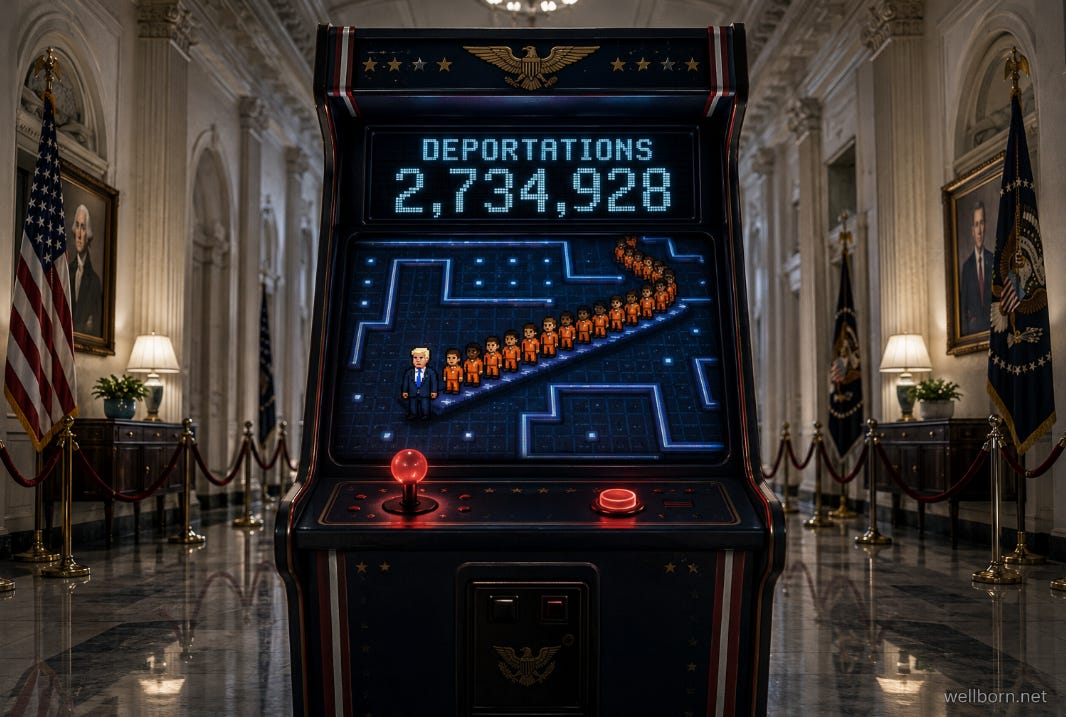
The second is called Rio Run. It is a reskin of Snake, the game where a line grows longer every time it picks something up. Here the player controls a man in a suit moving along a grid beside the Rio Grande, and AFP reported the character is a digital likeness of Tom Homan, the border czar Trump installed to run immigration enforcement without Senate confirmation. Every person the player catches falls in line behind him and counts as a deportation, extending the trail. KRDO, working from CNN’s pool reporting, described the people being caught as drawn in a range of skin tones, while the player character is an older white man in a blue tie. When caught, a person’s on-screen appearance changes to an orange jumpsuit and joins the line.
A White House official told CNN the arcade exists to draw a contrast between a culture of fun and winning and what the official called Democrats’ dark socialist vision for the country.
What this is not
No family is deported by playing this game. No child is separated from a parent because a browser tab scored well. The word terrorize does not belong here, and using it hands away the argument to the first person who points out, correctly, that this is pixels on a federal web page.
What the game does is take an action the government is actually taking, at scale, right now, and convert it into a mechanic with a score attached. That is a narrower claim than the inflated one, and it is also worse, because it does not require exaggeration to be disturbing.
The pattern, which predates Thursday
This is not the administration’s first attempt to make enforcement entertaining, and the history matters more than any single game does.
In February 2025, the official White House account posted footage of a group of detained people being loaded onto a deportation flight from Seattle, captioned as ASMR, the genre of content built around soft, satisfying sounds meant to relax the viewer. That same spring, the account posted a deportation video set to a well-known 1980s pop song about a breakup, drawing criticism from the band whose earlier song had also been used without permission on a similar post and who objected publicly.
Read in sequence, the throughline is not any one bad decision. It is a repeated choice, made by different people over more than a year, to treat the forcible removal of human beings from the country as content that should feel good to consume. ASMR is designed to soothe. A breakup song is designed to be catchy. A high score is designed to make you want another turn. Each format asks the viewer to enjoy watching enforcement happen, and each is a step further from the people the enforcement is happening to.
Rio Run is simply the version with a game engine attached, and a game engine adds something the earlier posts did not have: participation. A video is watched. A game is played, repeatedly, competitively, by choice, and the player’s own action is the one that produces the reward.
The skin-tone detail, sourced carefully
The most serious specific claim circulating about the game is that the people being caught are rendered in a range of skin tones while the player character, styled after a named federal official, is white. That claim traces to AFP’s reporting, relayed through outlets covering the story, and it describes what is visible in the game’s own artwork rather than an inference about anyone’s intent.
That distinction matters for how the piece should be read. Nobody needs to know what any individual designer meant by it. The finished, published product on a federal domain shows what it shows, and what it shows is checkable by opening the page.
What actually deserves scrutiny here
Set the game aside for a moment. What surrounds it is the part that deserves scrutiny.
Immigration enforcement is not a background issue this year. Deportation numbers have been rising, ICE has expanded its use of private contractors, and enforcement actions have produced real confrontations in American cities, including a shooting in Minneapolis this year in which American citizens were killed after ICE activity in the area. That is the material reality the arcade game sits on top of. The game did not invent any of it. It repackaged it.
A government that wanted to defend its immigration policy on the merits had that option available. It could have made the case that removals target people with no legal basis to remain, or that enforcement deters unlawful crossings, or any of the arguments its own officials make in congressional testimony. Instead, on an official domain, it chose Snake.
That choice says something the policy arguments do not. It suggests an administration confident enough in its base’s appetite for the subject that it did not feel the need to argue for the policy at all, only to make playing along feel good.
Trump is an old fuck who never played a game in his life. This is the little boys, hegseth and miller. They thought it up and pitched it as reaching more thugs. I'd lay money on it.
Sick fucks. 🤬