


There is a security camera video, and it is classified, but it has been described to reporters by people who have seen it.
A restaurant in Istanbul. Two FBI agents on vacation, sitting at a table with their families. An ordinary evening. A man with a backpack walks in.
And everyone at the table grabs their head.
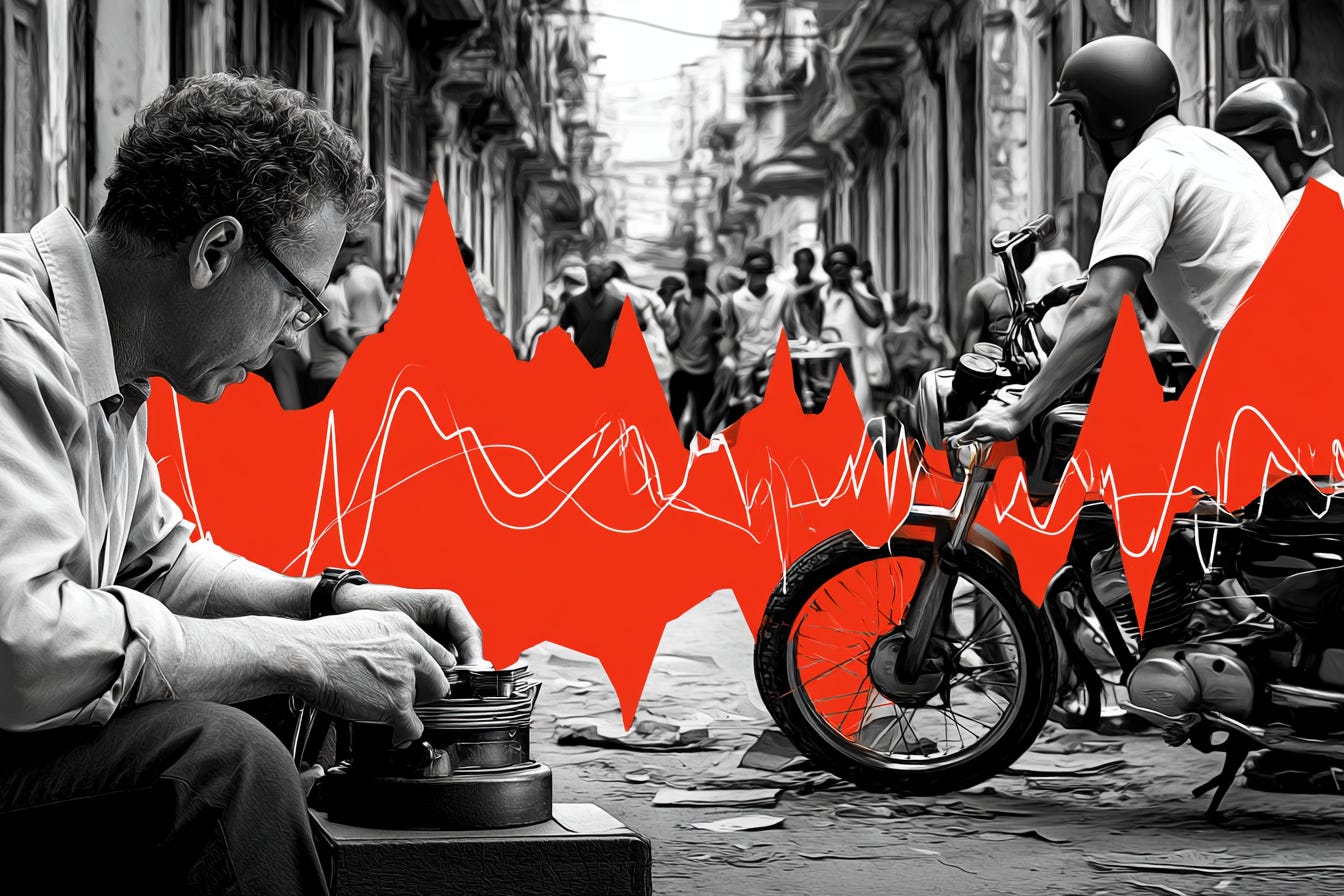
That video is part of a collection the United States government has assembled of Americans being struck by something. The videos are classified. The victims are not hypothetical. And for nearly a decade, the official position of the American intelligence community has been that it is very unlikely any foreign actor used a novel weapon or prototype device against them.
I want to lay out, in order, what has now been established about that position, because the sequence is the story, and the sequence should alarm anyone who has ever been asked to accept an official denial at face value.
The Denial
Havana Syndrome, which the government prefers to call Anomalous Health Incidents, surfaced in late 2016 when a cluster of American diplomats in Cuba began reporting symptoms consistent with traumatic brain injury: vertigo, crushing headaches, cognitive impairment, a sensation of pressure inside the skull. Cases followed in other countries. Intelligence officers, diplomats, military personnel. Some never returned to work.
The official response was, from the beginning, a slow and steady exercise in narrowing the possible.
In 2020, the National Academies of Sciences examined the evidence and concluded that directed, pulsed radio frequency energy was the most plausible mechanism for the injuries. That is the finding of the most prestigious scientific body in the country, and it pointed at a weapon.
In 2022, an intelligence panel allowed that some episodes could plausibly have been caused by pulsed electromagnetic energy from an external source.
Then, in 2023, the intelligence community said publicly that it could not link any case to a foreign adversary and considered a targeted campaign unlikely. In January 2025, the assessment held: very unlikely that a foreign actor used a novel weapon or prototype device to harm even a subset of U.S. government personnel. One agency dissented, putting it at roughly even odds. The dissent was a footnote to a conclusion that had already hardened.
The practical effect of that conclusion on the people it concerned was severe. Michael Beck was the first person to report the symptoms that would come to define this. He filed for workers’ compensation in 2014, citing hazardous conditions. He was denied. He had been diagnosed with Parkinson’s disease at forty-five. He died on January 29 of this year, at sixty-five, having spent the last stretch of his life inside a government position that his injuries were very unlikely to have been inflicted by anyone.
The Purchase
In the final weeks of 2024, according to reporting by CBS News, CNN, and Fox News, and later confirmed in broad strokes by congressional inquiry, undercover agents from Homeland Security Investigations bought a weapon.
They bought it from what CBS described as a complex Russian criminal network. The transaction was funded by the Pentagon and valued at roughly fifteen million dollars. The device is portable and backpack-sized. It contains components of Russian origin, though it is not entirely Russian-made. It emits pulsed radio-frequency energy.
The people who have described it say it does not look like a weapon. It is designed to be concealed. It is silent. It produces no heat signature. It is programmable for different scenarios, can be operated by remote control, has an effective range of several hundred feet, and passes through windows and drywall. The critical element, sources told CBS, is not the hardware but the software, which shapes an electromagnetic wave that rises and falls abruptly and pulses rapidly.
Dr. David Relman, the Stanford microbiologist who has served on the government’s own review panels, explained to 60 Minutes what pulses of that character do to a person: they can stimulate electrically active tissue, brain tissue, cardiac tissue, mimicking what the brain does naturally but driving it from outside the body. Scott Pelley asked whether that made it an ideal stealth weapon. Relman said it was ideal, because the person experiences it as something happening inside their own head.
The Testing
The Pentagon has had this device in a laboratory for more than a year.
It has been tested on rats and on sheep. According to CBS’s sources, those tests produced injuries consistent with the injuries reported by human beings. Animals were subjected to the beam, and the damage matched what American diplomats had been describing since 2016 and being told, officially, was very unlikely to have come from a weapon.
Sit with the arrangement of those facts.
The United States government purchased a concealable directed-energy weapon capable of injuring the human brain from a distance, through walls. It spent Pentagon money to do it. It ran it in a military lab for over a year. It confirmed on live tissue that the device produces the exact injury pattern its own personnel had been reporting for nearly a decade. And throughout that period, the published assessment of the intelligence community remained that it was very unlikely any such weapon had been used against Americans.
The denial and the acquisition were happening at the same time. In the same government. Funded by the same budget.
I am not claiming the intelligence community knowingly lied, because I cannot establish that and the compartmentalized structure of these agencies makes genuine institutional ignorance entirely possible. What I am saying is narrower and, I think, harder to argue with: the official denial and the physical evidence contradicting it existed simultaneously inside the same government, and the public was told only about the denial. We learned about the weapon from journalists, not from the institutions that bought it.
Caracas
On January 3, 2026, American forces raided Caracas and captured Nicolás Maduro.
Accounts from the ground, including one circulated by the White House press secretary herself, describe what happened to the men defending him. A security guard’s account, which has not been independently verified, described a sudden disruption of the radar systems and then something that felt like an intense sound wave. He said his head felt as if it were exploding from the inside. He said they began bleeding from the nose. He said some were vomiting blood, and that they fell to the ground unable to move.
Three weeks later, a reporter from the New York Post asked the President of the United States about reports that the government had purchased a pulsed energy weapon linked to Havana Syndrome.
Trump did not answer the question he was asked. He answered a different one.
“The Discombobulator,” he said. “I’m not allowed to talk about it.” Then, unable to help himself: “I would love to.” He went on: “They never got their rockets off. They had Russian and Chinese rockets, and they never got one off. We came in, they pressed buttons and nothing worked. They were all set for us.”
Honesty requires the caveat, and the caveat is real. A senior U.S. official told CNN that the president is likely conflating several distinct capabilities into a single weapon that does not exist as he describes it. American forces did use cyber tools to disable Venezuelan air defense and early warning systems, and did use existing acoustic systems to disorient personnel on the ground. The military has fielded the Active Denial System, a directed pulsed-energy heat ray, for years. It is entirely possible that “the Discombobulator” is a name Donald Trump invented for a category of things he does not understand, which would be consistent with his handling of every other technical subject.
But notice what is not in dispute. Something was used in Caracas that made men bleed from the nose and lose motor control. The President of the United States volunteered that a classified capability he was not permitted to discuss had made enemy equipment fail. And he volunteered it in direct response to a question about the Havana Syndrome weapon.
Why This Belongs Here
This publication devotes a section to disclosure because I believe the government’s relationship with what it knows and what it admits is one of the defining accountability questions of our time. Readers who come here for UAP coverage may wonder why they are reading about a microwave device from a Russian criminal network.
They are reading about it because it is the clearest documented case study we have ever been handed of exactly the dynamic disclosure advocates have been describing for decades, and unlike most of that material, none of this requires anyone to believe anything unproven.
The pattern is complete and it is on the record. A phenomenon is reported by credible, trained government personnel. The official assessment moves steadily toward dismissal. The people who reported it are disbelieved, denied compensation, and in some cases quietly ushered out of their careers. Meanwhile, inside the compartmented spaces of the same government, the physical evidence is acquired, funded, and studied for years. The public learns none of it from official channels. The public learns it because reporters find out.
That is not a theory about how secrecy operates. That is a description of what demonstrably happened, sourced to CBS News, CNN, the Washington Post, and a congressional oversight letter.
And it should recalibrate how every reader weighs the next official denial they encounter, on any subject. The phrase “we assess it is very unlikely” now has a documented track record. It meant, in this instance, that the thing assessed as very unlikely was sitting in a Pentagon laboratory being tested on sheep.
The Question Nobody in Power Wants Asked
Here is where the urgency lies, and it is not in Caracas.
The United States government now possesses, has funded, has tested, and by the President’s own boasting may have deployed a class of weapon that is silent, concealable, remotely operated, effective through walls at a distance of hundreds of feet, and capable of injuring a human brain in a manner that leaves no obvious external wound and that the intelligence community spent nine years describing as very unlikely to exist.
Every element of that sentence is drawn from mainstream reporting. None of it is speculation.
So the question is the obvious one, and the reason it is urgent is that this administration has already demonstrated its willingness to point federal power at domestic critics. It has sent Homeland Security agents to the home of a man who wrote an angry email. It has jailed a retired officer for a meme. It has run a warning-notice program against Americans for social media posts.
What is the doctrine governing the domestic use of a weapon that injures people invisibly and leaves them unable to prove what happened to them?
I do not know. Neither does Congress, which is why the chairman of the House Homeland Security Committee had to write a letter asking basic questions about the procurement, the cost, and the findings. Neither do you.
We are entitled to know. Not the engineering, which should stay classified and which I have no interest in publishing. The doctrine. The oversight. The legal constraints. Who may authorize its use, against whom, under what circumstances, and with what accountability if it is misused.
Nine years of injured Americans were told their wounds were very unlikely to have been inflicted by a weapon while their own government was buying one.
Ask what else is very unlikely.
See also
It’s Probably Stress

A soldier sits in a VA exam room in 1994 and describes the fatigue, the joint pain, the fog that has settled over his thinking since he came home from Kuwait. He is thirty-one. He was a mechanic. He is told that war is stressful and that the mind does remarkable things to the body.
Isn't this the very raison d'être of having a *National Security Advisor*, a trans-organisational czar that can seek truths without silos? Of course you'd need to have a competent one ... a different issue.
"*the compartmentalized structure of these agencies makes genuine institutional ignorance entirely possible. What I am saying is narrower and, I think, harder to argue with: the official denial and the physical evidence contradicting it existed simultaneously inside the same government, and the public was told only about the denial. We learned about the weapon from journalists, not from the institutions that bought it.*"
I am SO grateful for your posts. Thank you for writing them.