


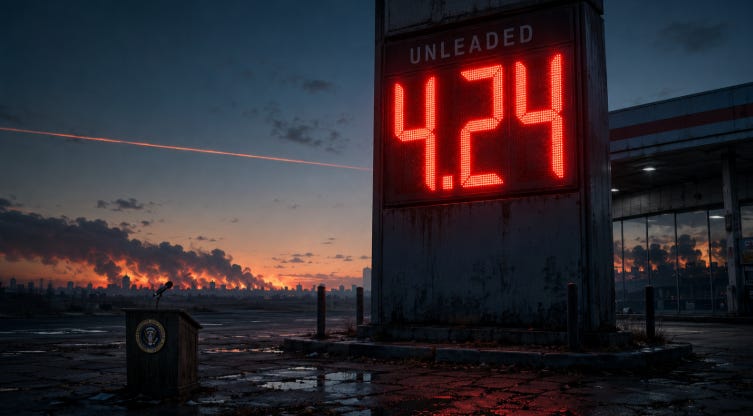
There was always one number that governed this war, and it was never the count of centrifuges or the tonnage of ordnance or the dead stacked on either shore of the Strait. It was the national average price of regular unleaded, posted in foot-high digits outside every gas station in every contested district, updated daily, legible to a voter from behind the wheel without a clearance or a briefing. That figure is the only metric this administration has ever genuinely respected, because it is the only one that votes.
Recall the overture, back when the missiles still photographed well. The campaign opened in late February as “major combat operations,” a phrase selected for its Churchillian heft and deployed by a man who has never once been mistaken for Churchill. There were maps with arrows. There was the familiar theater of resolve, the jaw set toward Tehran, the promise that strength was its own reward and that anyone who flinched at the cost was a coward or a Democrat or, most damning of all, Tucker Carlson. The war was sold as a demonstration. The product being demonstrated was the President’s spine.
Then the arithmetic arrived, which it always does, because arithmetic cannot be pardoned. West Texas Intermediate sat at sixty-seven dollars a barrel the day before the strikes and crested above one hundred and two by mid-May, a fifty-three percent ascent that the futures markets registered with the enthusiasm of a falling elevator. Gasoline climbed in lockstep. A national average that had been three dollars and thirty cents in the spring of 2025 stood at four dollars and twenty-four cents a year later, the highest since the opening months of the Ukraine war and a full dollar above where it sat in February, before the President decided that peace required setting the Persian Gulf on fire. The Strait of Hormuz, which carries roughly a fifth of the world’s seaborne oil, went dark. The International Energy Agency, an organization not known for its flair, called it the largest supply disruption in the history of the global oil market. More than a billion barrels vanished from the world’s plumbing. This is what the President, surveying the wreckage, described to a television interviewer as a little glitch.
A little glitch. He also called it a detour we had to take, and a small price to pay for the safety and peace of the United States and the world, which is a remarkably generous thing to say about someone else’s grocery bill. The phrasing is worth lingering on, because it contains the entire ideology in miniature. The cost is small. The cost is temporary. The cost is borne by an abstraction called the world, never by the specific retiree in Bucks County deciding between the air conditioning and the prescription. Strength, in this dialect, is always a thing other people pay for, in installments, at the pump, while the man invoicing them poses in front of an aircraft.
And then the spine, so recently rigid, began to soften with the curious timing of a politician reading his own internal polling. The cost of living is the single largest issue heading into the November midterms, where the President’s party is defending majorities thin enough to read a newspaper through. His approval on inflation and the cost of living has collapsed to thirty-six percent, against sixty-two percent who disapprove, the worst marks of his second term. The Democrats are running double digits ahead. Somewhere in that data, a war that was strength in February became a liability by April, and the administration discovered, as if by revelation, a sudden appetite for peace. A ceasefire was announced. It was fragile. It broke and was reannounced. Negotiators shuttled to Pakistan. The Strait stayed closed. None of the underlying physics changed, only the proximity of the election, which is the one variable this White House has ever been able to feel in its bones.
The tell is the desperation of the workarounds. Unable to actually lower the price of a barrel, it spiked on purpose, the administration reached for the gimmick drawer and proposed waiving the volatility rules to flood the summer with cheap, corn-heavy E15, the policy equivalent of cutting the milk with water and hoping the children do not notice. This is not an energy strategy. It is a man trying to fix the dashboard light by smashing it with a hammer before the inspector arrives.
Central bankers have an old line about fuel, that prices rise like rockets and fall like feathers, and the administration is now praying with genuine fervor that the feathers reach the ground before the first Tuesday in November. That is the whole of the policy. Not the disarmament of Iran, which has not happened. Not the reopening of the strait, which experts say will take months under the rosiest scenario. Not safety, not peace, not any of the nouns that decorated the press releases. The objective is a number on a sign falling far enough, fast enough, to be forgotten by the time the polls open.
So let us name the thing precisely, since the administration will not. This was never a war that started with strength and conscience ended. It was a war that polling started, and polling stopped, with the centrifuges and the corpses as set dressing for a referendum on the President’s brand. They are not negotiating the end of a conflict. They are negotiating the timing of a price cut. And the only question that has ever mattered to them is whether the feathers can be made to fall before the voters do.
The war isn’t over until Trump and Bibi are both dead. And even then it still might continue.