


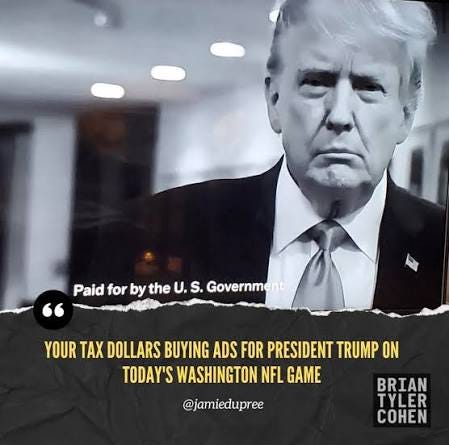
Sometime during the NFL games on Sunday, between the beer and the truck commercials, a thirty-second spot ran in black and white showing the President of the United States walking down a hallway while his own voice said that this is the final battle, that we will demolish the deep state, that we will throw off the sick political class that hates our country, that we will rout the fake news media, and that we will liberate America from these villains once and for all. The screen carried a tag: “Paid for by the U.S. Government.” That tag is the entire story, because everything else in the ad is old. The words are a passage Trump first delivered at the Conservative Political Action Conference on March 4, 2023, as a candidate for the office he now holds, and repeated at campaign rallies through the following year. What is new is who paid to put it on television, and the answer is everyone.
What the campaign is
The “final battle” spot is the third ad in a series the White House began airing in September with federal money. The first, set to a song called “Love Me” by the artist JMSN, showed images of Trump over messaging against communism, socialism, and Marxism, and ran on Fox News and Newsmax, later on CBS. JMSN has said he never authorized the use of his song for political purposes and is exploring his options. A second, one-minute version put Trump in front of Mount Rushmore using clips from a Fourth of July address. The third is the one that ran Sunday, during the games and on Fox News Sunday.
The money has grown as the campaign has. When Axios first reported the “Love Me” ad, AdImpact’s tracking put the buy at about $14,000. By September 25 it was at least $443,000. Time reported Monday that it had passed $920,000, with the “final battle” spot adding more than $362,000 on its own. The ads are produced by the White House, which is not an agency with a public-information mission in the way that, say, the Centers for Disease Control is; it is the president’s office. Democrats on the House and Senate appropriations committees asked that the spots be pulled, describing them as “government propaganda one might expect in North Korea.” Senators Maggie Hassan and Andy Kim demanded an accounting of the production costs and the funding source. Public Citizen filed complaints with the Government Accountability Office and the Office of Special Counsel. Representative Jamie Raskin said the spending “may be felony criminal theft and conversion of government property for political campaign purposes,” which is an allegation, and one no court has yet considered.
The White House’s case, which deserves to be stated fairly
The administration’s defense has three parts, and none of them is frivolous on its face. First, the president is not on the ballot in November, so an ad about the president is not a campaign ad. Second, the spots contain no call to action, no “vote for,” no candidate’s name, no election date. Third, they are disclosed: the “Paid for by the U.S. Government” tag is on screen, and the Government Accountability Office has long held that the sin in government advertising is concealment, not content. A White House official put the position plainly: the PSAs “are clearly not political,” and they are “educational and unapologetically patriotic.” Another added that their purpose is “reminding Americans to love their country.”
There is also the precedent argument, which the White House has not made explicitly but which underlies its position. Every administration runs public service announcements. Smokey Bear is a government ad. So are the census reminders, the flu-shot campaigns, and the Medicare open-enrollment spots, and each of those was produced by an administration that benefited from the public believing the government was doing its job. This administration’s own Department of Homeland Security spent $220 million in 2025 on a national television campaign telling undocumented immigrants to leave the country, a campaign in which Secretary Kristi Noem appeared prominently, and when Senator John Kennedy pressed her on it in March she said the ads had “went through the legal processes” and were “extremely effective.” That campaign drew criticism and no legal consequence, and the White House can reasonably ask why this one is different.
Why it is different
The answer is in the law the appropriators cited, and in how the government’s own auditors have read it for seventy years.
Every annual appropriations act since the early 1950s has carried a version of the same sentence: no appropriated money may be used “for publicity or propaganda purposes” inside the United States unless Congress has authorized it. An older statute, from 1913, bars agencies from paying a “publicity expert” without a specific appropriation for one. Congress never defined “propaganda,” so the definitions come from the GAO, which has built them up case by case in legal opinions since the Eisenhower administration. Those opinions identify three kinds of communication the rider forbids. The first is covert propaganda, government messaging that hides its source, which is what GAO found in 2004 and 2005 when the Medicare agency and the drug-policy office produced fake news segments, narrated by contractors posing as reporters, that local stations ran as their own reporting. The White House is right that its ads fall outside that category; the tag on the screen defeats the covert test.
The other two categories are the problem. GAO has held for decades that the rider bars communications that are “purely partisan in nature,” meant to aid a political party or candidate, and communications that amount to “self-aggrandizement” or “puffery” of an agency, its personnel, or its activities. Those tests look at content, and they say nothing about whether anyone’s name is on a ballot. An ad in which the president, in his own voice, describes his enemies as villains and vows to demolish, throw off, rout, and liberate is self-aggrandizement by the plain meaning of the phrase; there is no policy in it, no program, no information a citizen could use, only a man and his adversaries. And the adversaries are specific. The “deep state” is the career federal workforce the administration has spent twenty months firing. The “sick political class that hates our country” is the opposition party, in a year that party is on the ballot in every district. The “fake news media” is a category the White House defined operationally two weeks ago when it banned CNN, MS NOW, and Politico from the building. A spot naming those three enemies, five weeks before an election in which one of them is the alternative on offer, is partisan without ever saying “vote Republican.”
The DHS campaign fails that comparison for the same reason the White House invoked it. Whatever one thinks of $220 million spent telling people to self-deport, the ads had a governmental purpose a court could name: they communicated a policy to the people it applied to. The “final battle” spot communicates nothing except the president’s view of the people who oppose him. That is the distinction GAO has drawn since the 1950s between informing the public and extolling the official, and it is not a subtle one.
The words themselves
It matters where the script came from, because the White House’s defense rests on the ads being something other than campaign material, and the script is campaign material in the most literal sense available. On March 4, 2023, at CPAC in Maryland, Trump told the crowd that “this is the final battle,” and that with the crowd at his side “we will demolish the deep state,” “expel the warmongers from our government,” “drive out the globalists,” “cast out the communists, Marxists, and fascists,” “throw off the sick political class that hates our country,” “rout the fake news media,” “evict Joe Biden from the White House,” and “liberate America from these villains once and for all.” He was a declared candidate. The speech was a campaign speech, delivered to a political conference, in service of winning an election. He repeated the passage at rallies through 2023 and into 2024. The lines reported from Sunday’s ad are those lines. Whoever cut the spot took a stump speech, removed whatever needed removing, laid it over footage of the president walking, and billed the public for the airtime.
The administration has treated the difference between the office and the campaign as a formality before. This is the first time it has done so with a script that was literally written for the campaign, aired at the price of a campaign buy, during the most expensive advertising inventory in American television, and stamped with the government’s name.
The Republicans who noticed
What separates this week from most of the administration’s fights over norms is that the objections did not come only from Democrats. Senator Kennedy of Louisiana, who had already gone after Noem’s ads in March, said that no public official should “spend public money on private ads for themselves.” Representative Thomas Massie of Kentucky posted that using taxpayer dollars this way “has been done before,” adding, “in banana republics.” And Senator Thom Tillis of North Carolina, who called the Xi state visit “a WTF moment” last week, called the “Love Me” ad “inappropriate” and compared the use of public funds to Hungary under Viktor Orbán.
Tillis’s comparison is more specific than it sounds. Orbán’s government has for a decade run publicly funded advertising campaigns, on billboards and television, aimed at the prime minister’s named enemies: George Soros, Brussels, the opposition, the press. They carry the government’s name. They contain no call to action. They are, in the government’s telling, public information campaigns. Their function is to keep the leader’s adversaries in front of the public as adversaries, at the public’s expense, between elections and during them. That is the model Tillis was pointing at, and a Republican senator from a swing state chose to point at it on the record, which is a measure of how far outside the ordinary this is. It is hard to find another question this year on which Kennedy, Massie, and Tillis ended up saying the same thing.
What can actually happen
Less than the outrage suggests, and it is worth being exact about it. The publicity-and-propaganda rider has no enforcement agency. Nobody at Treasury or Justice monitors compliance. Congress asks the GAO for an opinion, usually months after a story breaks, and the GAO decides whether the rider was violated. When it finds a violation, the consequence is that the spending also violated the Antideficiency Act, which requires the agency to report the violation to Congress and the president. That is the whole mechanism. In 2005, when GAO found the Bush administration’s fake news segments illegal, the segments stopped and the reporting happened and nobody was prosecuted. The Hatch Act, which bars federal employees from using their positions for partisan ends, exempts the president and vice president entirely; it could reach the White House staff who produced the spots, which is presumably what Public Citizen’s complaint to the Office of Special Counsel is for, and the current Office of Special Counsel answers to the president.
So the realistic paths are three. The GAO issues an opinion, likely after the election, finding that the ads violated the rider, and the White House disputes it or ignores it. Congress writes the rider more tightly in the next appropriations bill, which is due December 11, and the bill passes with the new language or does not. Or the ads keep running, the spend keeps growing, and the answer to whether the government can buy airtime for the president’s campaign rhetoric gets settled the way everything else this year is getting settled, by whoever wins in November.
That last path is the one the administration appears to be betting on. The ads did not stop when the appropriators objected. They expanded. The buy went from $14,000 to nearly a million dollars in three weeks, moved from cable news to the NFL, and added a script written for a rally. Each step was a test of whether anyone could make it stop, and so far the answer has been no.
The number that matters
The dollar figure is the wrong one to argue about. A million dollars is a rounding error in a federal budget, and the administration knows it, and anyone arguing this on cost is arguing on the ground the White House would choose. The number that matters is thirty-six, the days between Sunday’s broadcast and the election. The rider exists because Congress, in the 1950s, understood that an executive branch with a budget and a broadcasting license could use one to buy the other, and that the danger was greatest exactly when an election was closest. The people who wrote it did not imagine a president reading his own rally speech into a government-funded spot during a football game. They imagined something more modest, and they banned it anyway. This week the administration tested whether the ban still means anything. The test is still running. The next spot, whatever it says and whatever it costs, is the result.
You know, I could be wrong but I think the best chance the Republicans stand in winning the midterms is if THEY impeach President Dimwit. The Republicans could look like heros and steal the glory from the Democrats.