


America turned two hundred and fifty years old this weekend. Here is, in the most literal and unadorned terms available, what that looked like.
The weather. A heat dome settled over the eastern half of the country with three-digit temperatures, forcing the cancellation of Philadelphia’s Salute to Independence Semiquincentennial Parade, the flagship celebration for the city where independence was actually declared. The Great American State Fair on the National Mall experienced a temporary closure due to heat, twice. Washington activated an extreme heat alert running through July 5, and Saturday was on track to be the hottest Fourth of July the capital has ever recorded, breaking the previous record of 100 degrees set in 1919. About four in ten American adults told pollsters they feel proud of the anniversary. Roughly three in ten said excited. Nobody was surveyed on the word muggy, though it would have scored well.
The fair. The Great American State Fair, the sixteen-day centerpiece of the celebration built specifically along the two-mile stretch of the National Mall, has by multiple independent accounts drawn sparse and disappointing crowds since its June 25 opening, prompting what CNN sources described as growing internal panic among White House officials over turnout. A Confederate flag appeared in the North Carolina pavilion, built by state businessmen after North Carolina itself declined to participate for lack of funding, and was removed only after the state’s governor publicly condemned it. Mt. Olive Pickle Co., a food sponsor, withdrew from the fair over the same flag. A man was arrested at the fair after witnesses reported him filming an acrobatic performance with his hand in his pants. The Friday concert, one of only two original headline acts that had not already dropped out of the lineup, featuring Vanilla Ice, was canceled for weather and will not be rescheduled. Sections of the Reflecting Pool liner, already the subject of a separate national saga involving blue paint and hydrogen peroxide earlier this summer, were found cut with what the White House described as razor blades, in an act it characterized as vandalism.
The approval rating. A Quinnipiac poll released in June found the president’s approval at 38 percent, with 55 percent disapproving, an improvement from a prior low of 34 to 58 but still a minority position, with majorities disapproving of his handling of immigration, the economy, foreign policy, and the war with Iran. He greeted the milestone of American self-governance by making sure the ticketed section directly facing his podium was full, using free tickets distributed in advance specifically to guard against the possibility that, invited to watch the president speak at his country’s two hundred and fiftieth birthday, people would simply not come.
The pope. Pope Leo XIV, the first American to lead the Catholic Church, accepted the 2026 Liberty Medal via livestream from the Vatican on the eve of the anniversary and used the occasion to urge the United States to recommit to its founding ideals of human dignity, liberty, and unity, specifically as they apply to how the country treats immigrants. He did not attend in person. He did not need to be in the room to make the point more directly than anyone who was.
The president’s first speech. On Friday, the eve of the anniversary, the president traveled to Mount Rushmore, a monument carved into a mountain that is not his likeness, though CNN reports he has mused about changing that. He delivered a speech in which he described communism as “a mortal threat to American liberty,” ranking it above World War I, World War II, Pearl Harbor, and September 11th, a ranking system whose methodology has not been disclosed. He announced a plan to “send them into exile,” referring to an unspecified domestic population he characterized as “illegal immigrants, criminals, and everybody that doesn’t want to work,” which is either a description of the Communist Party or a description of a Tuesday, it is difficult to say. He closed by recommending the elimination of the filibuster and the passage of a bill requiring photo identification to vote, presented as a unity message.
The president’s second speech. On Saturday, the actual anniversary, he gave a second, longer speech on the National Mall, having promised in advance that the 107-degree heat would not stop him. “I’m going to make a really long speech,” he told reporters beforehand, “just to show that I can do anything.” Nothing has ever stopped him from speaking, which several nations have found out the hard way, and the fireworks display that followed, 850,000 individual pyrotechnic effects billed by organizers as the largest in the history of the National Mall, went off on schedule regardless of what anyone in the audience thought of the preceding two hours.
The march. While the second speech was being prepared, several hundred masked members of Patriot Front, a white nationalist group founded after the 2017 Charlottesville rally, marched through Capitol Hill and rode the Washington Metro carrying Confederate flags, inverted American flags, and shields, chanting “Reclaim America.” A Reuters photograph showed them filling a train car around a Black woman. Vice President Vance, elsewhere on the Mall the same day, delivered remarks about “radical gender ideology.” The Metropolitan Police Department said it was “tracking First Amendment activities.” Mt. Olive Pickle Co. withdrew as a sponsor of the Great American State Fair over the Confederate flag controversy, which means a regional pickle company demonstrated a firmer moral position on domestic extremism than most of the federal government managed to hold that day.
The documents. Two days before the anniversary, the Department of Justice missed a second court-ordered deadline to release Epstein files, this one set by U.S. District Judge Emmet Sullivan after the department had already missed the original December 19 deadline required by the law Congress passed and the president signed. The department’s filing defended the redactions, requested a sixty-day extension, and announced an appeal. Still blacked out: at least eight email exchanges discussing what one message calls a “torture video,” a 2007 draft indictment with co-conspirators’ names obscured, and the underlying FBI interview notes from a woman alleging she was assaulted by the president as a minor, notes the department says it located but will not release, distinct from summary reports of the same interviews it has released. A DOJ spokesperson called the judge’s order “perverse.” The judge had ordered no such thing regarding victim names specifically. This is the current state of a law that says all files must be public.
The senator. Senate Majority Leader Emeritus Mitch McConnell was found unconscious at his Washington home on June 14 and rushed to the hospital in what dispatch audio described as a cardiac arrest. He has made no public appearance since. Three days after his hospitalization, his wife, former Transportation Secretary Elaine Chao, traveled to Beijing and met with Chinese Vice President Han Zheng to discuss U.S.-China relations, according to photographs circulated in Chinese state media. McConnell’s office has not disclosed his diagnosis. It has said his condition “continues to improve.” Nobody has explained the Beijing meeting. This essay will not speculate about what it means. It will simply note that it happened, on those dates, in that order, and invite you to draw your own conclusions about the general state of institutional competence on display.
The major. On July 1, an active-duty Air Force major named Jason Watson stood on the Capitol steps in uniform and called for the impeachment and removal of the president and vice president, citing the War Powers Act violations in the Iran and Venezuela strikes and the deaths of thirteen service members. He was arrested for demonstrating without a member of Congress present, after the congressman who had escorted him left the area. He is three years from retirement. A defense fund set up on his behalf raised over $139,000 within two days. He may face court-martial. The Air Force said commanders “will ensure appropriate disposition.” He said, before his arrest, that he could afford to do this because he is “just not important enough” to matter, which is either the most modest sentence spoken in Washington this week or the most quietly devastating one, depending on how you feel about a major in the United States military concluding that his own insignificance is what makes dissent survivable.
The allegation. A woman named Beatrice Keul, who has previously alleged the president assaulted her at a 1993 pageant, told an interviewer this week that she believes the president’s late first wife, Ivana, functioned in Epstein’s social world the way Ghislaine Maxwell did, steering young women toward exposure to Epstein’s circle. The outlet that published the claim stated plainly that it has not independently verified the allegation and has found no evidence that Ivana Trump knew of or participated in any crime. Ivana Trump died in 2022. She was never charged with anything related to Epstein. This item belongs in the record because it was said, publicly, by a named accuser, and because the outlet’s own disclaimer is part of the story. It does not belong in the record as an established fact, and treating it as one would be exactly the kind of unverified escalation that makes the verified material harder to take seriously. The verified material does not need the help.
The exile. Returning to the Mount Rushmore remarks, because they deserve a second look on their own terms: the sitting president of the United States, at a national monument, vowed to “vanquish communism” and “send them into exile,” using the pronoun without ever specifying a legal mechanism, a defined population, a constitutional basis, or a destination. Exile is not a power granted to the executive branch by any document available for inspection, including the one being celebrated that weekend. Whether this was rhetoric or a stated intention is a distinction the audience was left to determine for itself, live, at a national park, under a flyover of F-35s.
The count. Two missed Epstein deadlines. One unconscious senator and one unexplained trip to Beijing. One major arrested for defending the Constitution against the administration currently governing under it. One heat dome, one broken temperature record, two closures of the flagship fair for excessive heat. Two Confederate flag incidents inside eight days. One pickle company with a functioning moral compass. One canceled parade in the city where the country began. One vow of exile with no stated recipients or mechanism. One unverified allegation, correctly labeled as such by the people who published it. One American pope, delivering the sharper message from four thousand miles away by livestream. One approval rating in the high thirties, propped up at the anniversary event with free tickets to guarantee a visible crowd. Several hundred men in Confederate flags and white masks riding public transit on the day everyone else was celebrating freedom. One reflecting pool, already green from paint and peroxide, additionally (allegedly) found razor-cut.
Two hundred and fifty years. The fireworks went off on schedule, all 850,000 of them. Almost everything else did not.
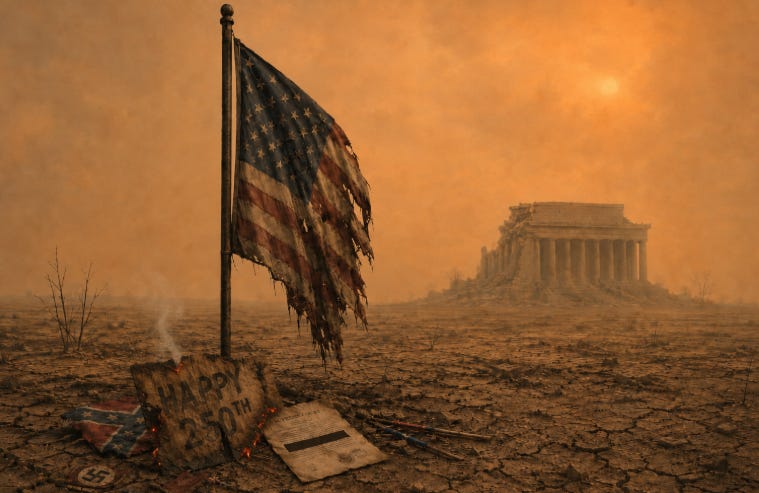
hey, i'm working on a 4th piece for common dreams. i've been looking for an image to go with it and yours is great; is there a credit i can use? actually, also, all your stuff is great - or at least what i've seen - so thanks. i'm at azimet18@gmail.com. take care az
Really well written! Thank you!