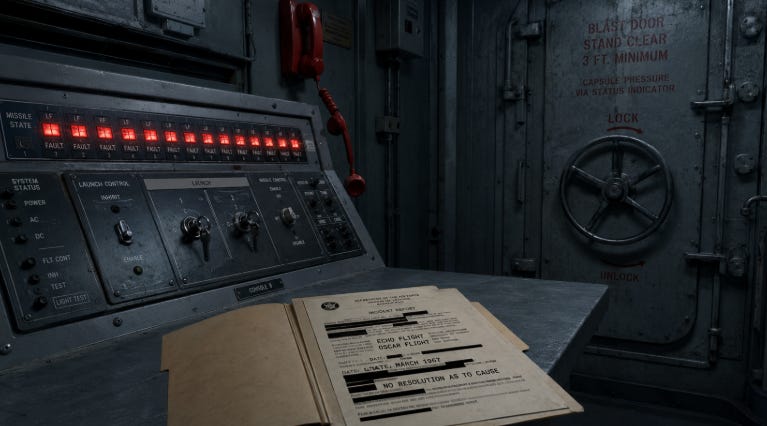
On the night of March 24, 1967, Captain Robert Salas, a deputy missile combat crew commander in the U.S. Air Force Strategic Air Command, was on duty sixty feet underground at the Oscar Flight Launch Control Facility outside Malmstrom Air Force Base in Montana, in nominal control of ten Minuteman I intercontinental ballistic missiles, each tipped with a thermonuclear warhead. Around ten o’clock that evening, a security guard at the surface gate placed an alarmed call to the underground capsule reporting a glowing, reddish-orange, oval-shaped object roughly thirty to forty feet in diameter, hovering silently directly above the front entrance to the facility. Within seconds of the report, the launch board in front of Salas began to register a cascading series of fault indications. All ten of the Minuteman missiles under the facility’s control went offline, one after the other, in rapid sequence. Each missile system was independent of the others. Each had been hardened against electromagnetic interference and engineered to remain operational in the immediate aftermath of a nuclear exchange. Their simultaneous failure was, on the basis of the engineering, technically impossible.
It happened anyway. The missiles remained inoperative for approximately twenty-four hours. The Air Force Office of Special Investigations debriefed Salas in the days following and instructed him not to speak of the incident. He was bound by nondisclosure until 1996, signed a public sworn affidavit in 2010, and in 2023 was interviewed by the Pentagon’s All-domain Anomaly Resolution Office. A Boeing engineer named Robert Kaminski, who conducted the engineering investigation into the cause of the shutdowns, has stated publicly that no resolution as to cause was ever reached. Eight days earlier, on March 16, 1967, an analogous incident known as the Echo Flight shutdown had occurred at a nearby Malmstrom launch control facility, in which all ten Minuteman missiles at the Echo Flight site dropped offline within seconds of each other. The unit histories for 1967 confirm the shutdowns. No explanation for the Echo Flight incident has been provided either.
A man employed by the United States Air Force, sixty feet underground, in charge of one tenth of the nation’s land-based nuclear deterrent, watched a craft of unknown origin neutralize the most heavily defended weapons system the country possessed, was ordered not to speak about it, and complied for twenty-nine years. He is alive today, eighty-five years old, and continues to testify publicly. He is one witness, in one incident, at one base. The retired Air Force investigator Robert Hastings has documented, with named witnesses and corroborating military records, more than one hundred and fifty incidents involving unidentified aerial phenomena at U.S. nuclear weapons facilities since the late 1940s. The pattern is not contested in its existence. It is contested only in its interpretation.
Understanding why a country with the analytical apparatus of the United States has spent seventy years declining to seriously investigate that pattern requires going back to a single document. In January 1953, in the wake of the Washington, D.C. UFO incidents of the previous summer, the Central Intelligence Agency convened a panel of five prominent scientists, chaired by the Caltech theoretical physicist H.P. Robertson and including the Nobel laureate physicist Luis Alvarez, the astronomer Thornton Page, the nuclear physicist Samuel Goudsmit, and the geophysicist Lloyd Berkner. Over five days of closed meetings at the Pentagon, the panel reviewed Air Force gun-camera footage, radar reports, and witness testimony from the Project Blue Book files. Its report, originally classified Secret, was later declassified in part in 1966 and more fully in 1978. The report concluded that UFOs were not a direct threat to national security but might pose an indirect threat by overwhelming Air Defense communications channels with witness reports. Its central recommendation, on the public record in the now-declassified text, was that a public education campaign be undertaken to reduce public interest in the subject, and that civilian UFO investigation groups be monitored by the appropriate authorities.
The mechanism of the public education campaign, as the implementation documents make clear, was ridicule. The recommended program, in the panel’s own language, was the “training” of the public out of its tendency to report. Project Blue Book in the years that followed reclassified its case categories so that “probable” and “possible” identifications were folded into a single “identified” tally, and from 1953 to its closure in 1969 functioned, in the words of the official Air Force oral history, primarily as a public relations operation. The 1966 internal CIA memorandum by Deputy Director of Scientific Intelligence Karl Weber, written in response to an Air Force request for fuller declassification, contains a line of unusual clarity: “We are most anxious that further publicity not be given to the information that the panel was sponsored by the CIA.” The agency wished its role to remain obscure because the implementation of the panel’s recommendations was a long-running and successful psychological operation conducted on the American public for the suppression of a category of information that, by the panel’s own assessment, was not in fact threatening to national security.
The cost of that operation has been paid, across seventy years, by the witnesses. Dr. J. Allen Hynek, the astronomer who served as the official Air Force scientific consultant to Project Blue Book from 1948 to 1969, spent the first half of his career publicly debunking sightings on the Air Force’s behalf and the second half writing books explaining why his earlier work had been wrong and why the phenomena merited serious scientific investigation. Dr. James McDonald, an atmospheric physicist at the University of Arizona who became a leading scientific advocate for UAP research in the late 1960s, was systematically marginalized within his profession and died by suicide in 1971. Dr. Garry Nolan, a Stanford University immunologist who is among the most published scientists in his field, has stated publicly that the professional cost of his involvement in UAP research has been substantial and that he is approached privately by colleagues who will not speak publicly. Dr. Avi Loeb, the former chair of the Harvard astronomy department and founder of the Galileo Project, has documented the academic resistance to the topic in detail. Lue Elizondo, the former director of the Pentagon’s Advanced Aerospace Threat Identification Program, resigned in 2017 in protest of what he described as the Defense Department’s continued failure to take its own investigative findings seriously. David Grusch, the former Air Force and National Geospatial-Intelligence Agency intelligence officer whose July 2023 sworn testimony before the House Oversight Committee asserted that the United States holds non-human craft and biological remains, has reported subsequent professional and personal consequences that several outlets have characterized as a retaliation campaign.
Below the elite tier, the cost is borne by working people. Commercial pilots who report UAP through the Aviation Safety Reporting System are routinely grounded for psychiatric evaluation. Air traffic controllers who acknowledge anomalous radar returns face career consequences. Military pilots learn, often informally, on their first squadron rotation, that the institutional cost of reporting an unidentified contact through official channels is greater than the cost of declining to write it up. Civilians who report to local law enforcement encounter the version of the same dynamic, scaled down. Friends learn to look elsewhere. Marriages strain. Promotion tracks quietly close. The ridicule program designed in 1953 has, by 2026, achieved precisely the deterrent effect its architects intended. Reports flow downward through the chain of organizational embarrassment until the channel ends in a wastebasket. The people who saw what they saw learn, by the end of the first telling, not to tell again.
This is the operational environment in which the events of the past three years have unfolded, and the events themselves are now public record. Beginning on the evening of December 6, 2023, and continuing for seventeen consecutive days, a swarm of unidentified aerial systems penetrated the restricted airspace over Joint Base Langley-Eustis in Virginia, home to the F-22 Raptor stealth fighters of the First Fighter Wing and adjacent to the nuclear-capable Naval Station Norfolk. The Pentagon, through Deputy Press Secretary Sabrina Singh, has publicly confirmed the incursions. The Air Force, through its own Safety Center reporting obtained via the Freedom of Information Act, has confirmed that on January 4, 2024, a U.S. Air Force F-22 had a near mid-air collision with an unidentified object in the same airspace and was forced to alter its flight path. The objects were variously described by base personnel as approximately twenty feet in length, exhibiting coordinated movement patterns, present in numbers ranging from a handful to several dozen at a time. Assets brought in to investigate included a NASA WB-57F high-altitude research aircraft. Two months earlier, in October 2023, five unidentified drones penetrated the airspace over the Energy Department’s Nevada National Security Site, the facility used for U.S. nuclear weapons experiments. The Air Force’s Plant 42 in California, the highly classified aerospace development facility associated with the B-2 and B-21 programs, has experienced unidentified drone incursions of its own scale across 2024, prompting flight restriction adjustments. The New Jersey drone wave of December 2024, which produced sustained mass sightings across the state’s northern counties and reached the threshold of public alarm sufficient to occasion congressional hearings, was never satisfactorily resolved.
In none of these cases has the United States government publicly identified the operator, the origin, or the technological basis of the incursions. Federal law restricts the military’s ability to engage uncrewed aerial systems over domestic bases unless the systems exhibit “hostile intent,” a standard that the Langley incursions, the Plant 42 incursions, and the Nevada incursions did not, in the Pentagon’s own characterization, meet. The drones hovered. The drones surveilled. The drones declined to do whatever it would have taken to qualify, under current statute, as hostile. The institutional response, across more than two years of repeat incidents at the most sensitive military installations in the continental United States, has been to confirm the occurrences when forced to do so by reporting, to decline to attribute them, and to proceed with the standard operational rhythms of bases whose airspace has been demonstrated to be penetrable at will by an unknown party.
The analytical pivot, articulated most clearly by Christopher Mellon, the former Deputy Assistant Secretary of Defense for Intelligence under Presidents Clinton and George W. Bush, is the observation that the institutional reluctance to take such incidents seriously is no longer a moral failure with respect to the witnesses. It is a strategic failure with respect to the country. In a 2023 essay for The Debrief, Mellon wrote that “our vaunted multi-billion-dollar intelligence system was paralyzed by ineffable stigma, as effectively as any electromagnetic warfare weapon, placing U.S. personnel and the nation at risk.” He compared the institutional posture to the warning failures preceding Pearl Harbor and 9/11, in both of which intelligence in fact existed inside the system but failed to move upward through the chain of analysis because of factors that, in retrospect, were institutional rather than informational. Mellon is not a UAP enthusiast in the popular sense. He is a former senior intelligence official with two decades of service inside the apparatus, writing in a publication of record, identifying a structural vulnerability he has observed firsthand.
The strategic logic, once stated, is simple. The CIA-designed ridicule policy of 1953 was intended to suppress public and institutional reporting of unidentified phenomena. It succeeded. The success means that, in 2026, an American military officer who observes an unidentified aerial system performing anomalous maneuvers near a hardened facility faces a documented and personally costly disincentive to report what he or she has seen, and a chain of command that has been institutionally trained, across three generations, to dismiss such reports as the product of fatigue, misidentification, mass hysteria, or the embarrassment of the witness. An adversary aware of that fact, and any serious adversary intelligence service is aware of that fact, now has an operational opening that no electronic warfare system or stealth program could provide. The development of a surveillance platform, a sensor probe, or an incursion vehicle whose flight characteristics fall outside the conventional aerodynamic envelope of identified aircraft would not need to defeat American radar. It would need only to defeat American reporting, and American reporting has, by deliberate state policy, been pre-defeated.
This is the inversion. The stigma manufactured in 1953 to reduce reports of unidentified phenomena to a level that would not clog Air Defense communications is, in 2026, the most reliable single feature of the operational environment around the United States’ most sensitive installations. The country that built the stigma is now operationally vulnerable to any actor who exploits it. The drones at Langley, the drones at the Nevada National Security Site, the drones at Plant 42, the drones across New Jersey may have been Chinese, may have been Russian, may have been a non-state actor, may have been something else. The Pentagon does not know. The reason the Pentagon does not know is not that the intelligence system is incompetent. It is that the intelligence system has been trained, for seventy years, not to inquire seriously into a category of phenomena now demonstrably present in the most secure airspace in the United States.
The historical pattern documented by Hastings in the nuclear weapons facility incident catalog is not merely a Cold War curiosity. The 1967 Malmstrom shutdowns, the 1966 Minot AFB incident documented by Captain David Schindele, the 1975 cluster of unidentified-craft sightings at Loring Air Force Base in Maine, Wurtsmith Air Force Base in Michigan, and the Montana and North Dakota Minuteman fields, the December 1980 Rendlesham Forest incident adjacent to the nuclear-armed RAF Bentwaters/Woodbridge complex documented in the contemporaneous memorandum of Lt. Col. Charles Halt, the October 23, 2010 communications failure that took all fifty Minuteman III ICBMs at F.E. Warren Air Force Base offline simultaneously, are not isolated anomalies. They form a sustained category. Each was witnessed by credentialed military personnel. Each was, on the documentary record, institutionally suppressed or quietly de-prioritized in the years following. Each is now, in light of the past three years of base incursions, a data point in a longer pattern that the country’s intelligence apparatus has been institutionally disabled from analyzing.
The conclusion follows directly from the premises, without dependence on any particular theory of what unidentified phenomena are. The country does not need to resolve the metaphysics in order to act on the strategy. It is not necessary to believe in extraterrestrial visitation, in non-human intelligence, or in any specific exotic-technology hypothesis to recognize that an operational environment in which the most heavily defended facilities of the United States have been demonstrably penetrable, repeatedly, by parties the Pentagon cannot identify, while the personnel best positioned to report incidents are operating under a seventy-year-old stigma policy designed by the CIA to discourage reporting, is an operational environment that is no longer tolerable on the security grounds the country claims to prioritize.
What needs to happen is therefore not a metaphysical disclosure but a procedural one. The Robertson Panel recommendations, having achieved their objective, need to be formally retired. The reporting channels for military personnel, base security officers, civilian airline pilots, air traffic controllers, and credentialed witnesses need to be hardened against career retaliation. The institutional posture that has, for seventy years, been organized around the suppression of reports needs to be inverted into one organized around their honest evaluation. The witnesses whose testimony has been catalogued by Hastings, by Salas, by Schindele, by Borland in the January 2026 House testimony at Langley, by Nuccetelli in the same hearing on the Vandenberg incidents, need to be debriefed properly, with the institutional seriousness their service has earned. The stigma needs to die not because the witnesses deserve to be believed, although they do, but because the country cannot afford the strategic cost of the stigma’s continuation.
The most striking feature of the situation in the spring of 2026 is that the case for ending the stigma has been made, on the public record, by the people who built and managed it. Mellon has made it. Elizondo has made it. Grusch has made it under oath. Mike Rounds and Chuck Schumer made it in the bipartisan UAP Disclosure Act amendments. The Trump administration’s February 2026 executive order on Presidential Unsealing has acknowledged it in legal form. The Pentagon’s own AARO has, in its more honest moments, conceded the structural problem even as its public posture has continued to deflect. The dissenters from the seventy-year consensus include, at this point, a great many of the people who would, in any prior decade, have been its principal defenders. The remaining institutional inertia is increasingly difficult to characterize as anything other than habit.
Captain Salas is eighty-five years old. He spent twenty-nine years bound by nondisclosure on an incident in which, in his sworn testimony, an unidentified craft of unknown origin disabled one tenth of the nation’s land-based nuclear arsenal in front of him. He has spent the past thirty years since trying to be heard. The country owes him, and the hundreds of named witnesses who followed him into the public record, an institutional answer commensurate with what they observed. The country also, separately, owes itself the strategic clarity to recognize that the ridicule policy under which Salas was silenced is now the policy under which its most secure installations have been demonstrated to be open to penetration by parties whose identities the country’s intelligence apparatus cannot determine.
The stigma was the policy. The stigma is now the threat. The retirement of the stigma is the precondition for any serious examination of what is, in fact, flying in American airspace, and of who has been flying it, and for how long.