


At the still center of Stalker’s most dangerous passage — a flooded laboratory, a telephone with no line, a room that shouldn’t exist — a barely educated guide sits down and recites a lyric poem. He attributes it to a dead man. The dead man is fictional. The poem is real, written by the director’s own father. This is the kind of moment that rewards the kind of attention Tarkovsky demands: the closer you look, the stranger it gets, and the stranger it gets, the more precisely it means something.
The false attribution
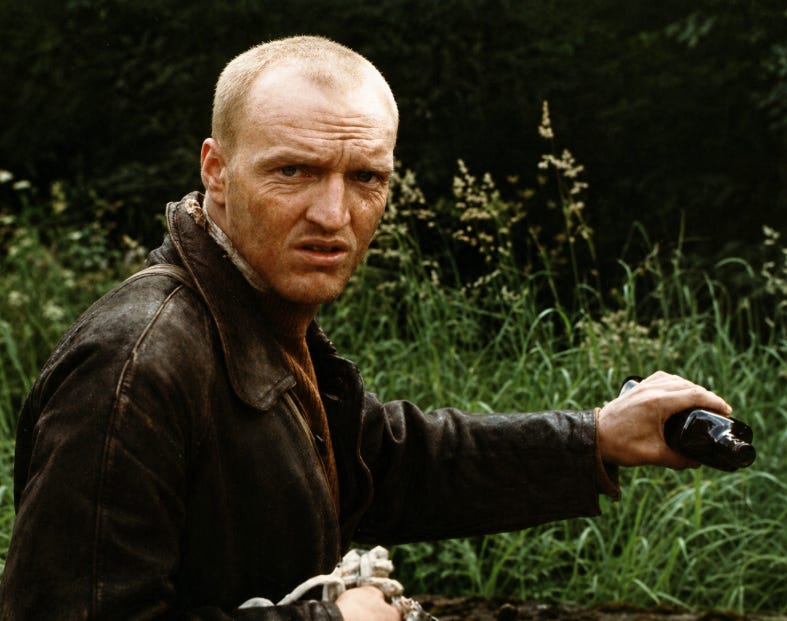
The poem recited by the Stalker, supposedly written by Porcupine’s brother, was actually written by the director’s own father, Arseny Tarkovsky. So Andrei Tarkovsky placed his father’s real poem into the mouth of a fictional dead man killed by the Zone. The Stalker delivers it as a poem by the brother about mourning things that have passed over. The poem didn’t emerge from the Zone’s mythology — it was smuggled in from reality, from the director’s own family. That boundary collapse between the real world and the film’s fiction is deeply disorienting once you know it.
The wrong room, the wrong man
As he enters the telephone room, the Stalker recites “But there has to be more,” implying that all of this hasn’t happened without a reason and that the Zone still has something to offer. It comes immediately after the Writer survives the meat grinder, which kills anyone whom the Zone deems morally unworthy. The Stalker recites a poem about insatiable longing in a room with a telephone that has no plausible line to connect it to anything. Two impossible things, sitting next to each other.
What the poem actually says
The poem poses the question: what is “more”? The Stalker can all but hope for an omnipotent power which surpasses even that manifesting inside the Room. The refrain “but there has to be more” is the engine of the Stalker’s entire faith — and his tragedy. He believes the Zone is sacred. The poem voices that belief and simultaneously undermines it, because “more” is never defined and never arrives.
The deepest strangeness
Tarkovsky’s films are full of poems, mostly written by his father Arseny, and these do not reconstruct religion so much as mourn its ruins. The recitation feels bizarre because the Stalker — a character who lives entirely by instinct and physical nerve — suddenly performs a meditative lyric poem in a flooded laboratory. It violates his established register entirely. He’s not reciting it to communicate. He’s reciting it the way someone prays in private: compulsively, because they need to hear it said aloud in that place. The telephone room becomes a confessional, the dead brother a saint, and Arseny Tarkovsky’s words a liturgy the Zone has swallowed and given back.
The series: https://tomwellborn.substack.com/s/stalker-a-tarkovsky-film