


A note before this one. Nothing here is political. It’s personal, first person, no sourcing, no argument, just an account of an afternoon that turned out to be about more than I expected. If that’s not what you came here for today, no hard feelings, the regular stuff is back next post.
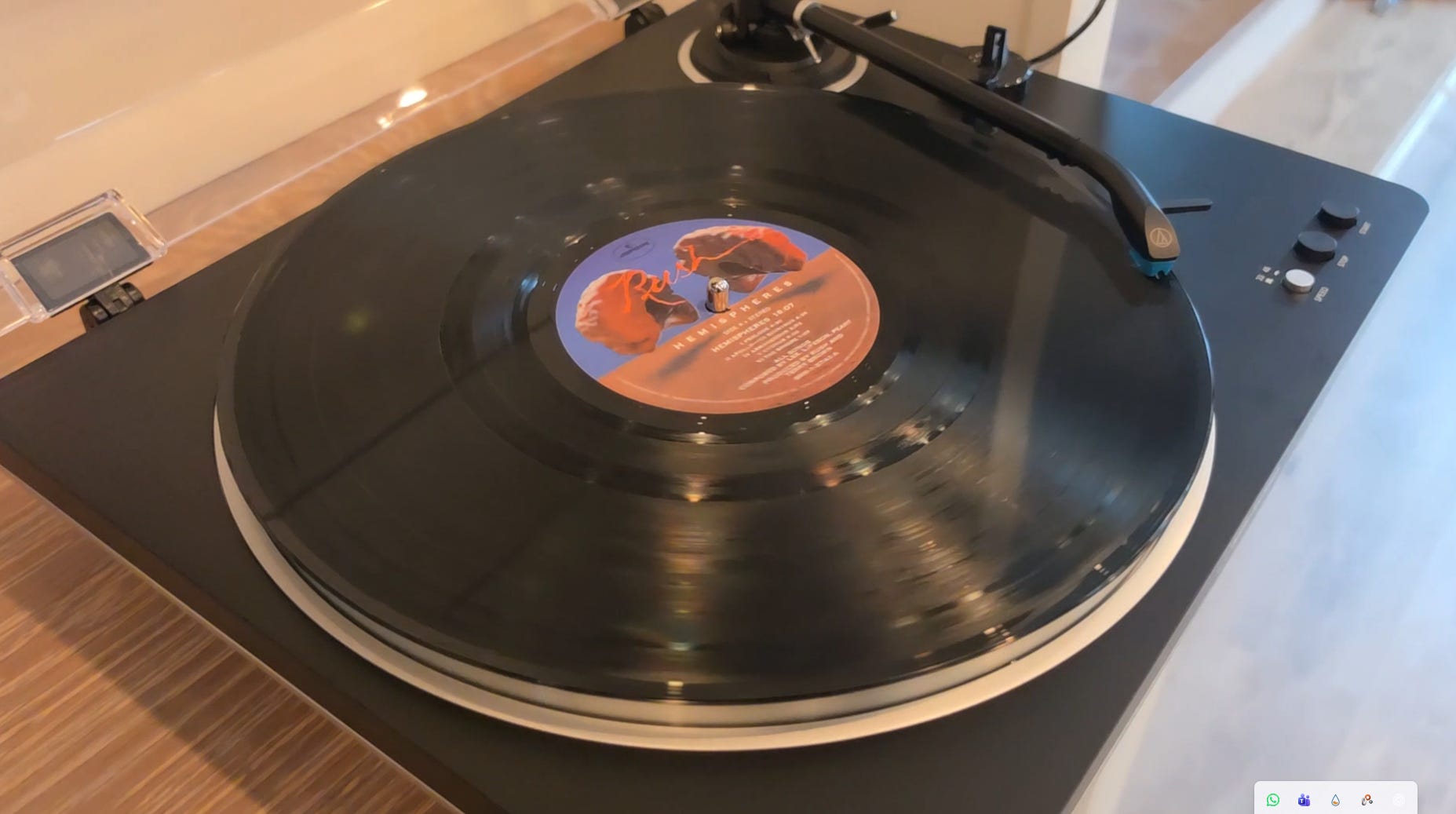
I bought a turntable a few weeks ago. It is Bluetooth, it has a phono out, it has a headphone jack, and by every review I read it is a well-made piece of equipment for the price. None of that is the story. The specs are the kind of thing you mention to a friend who asks what you bought. They are not the reason I have not stopped thinking about this.
I am fifty-eight. I converted my CD collection to digital a long time ago, the way most people my age did, ripping discs onto a hard drive and telling myself the music was the same music, just easier to carry. Most of my vinyl went the way most people’s vinyl went in the nineties, but I kept a handful of records, for reasons I never examined closely. I noticed the resurgence everyone has been noticing, the record stores doing business again, the younger people buying turntables of their own, and I decided to get one and see what was left of that experience for me.
I put on Hemispheres first. Rush, 1978. I wanted, consciously and on purpose, the full experience from being a kid with this record, not a nostalgic gesture toward it but the thing itself as closely as I could get it back.
The ritual came back before I expected it to
I noticed myself handling the record with a kind of care I had not used in decades and had not decided to use again. Taking it out of the sleeve a certain way. Checking it for dust and going over it with a microfiber cloth, which I genuinely do not know existed when I was doing this the first time around, but the gesture of cleaning it before playing it came back on its own, unprompted, like a habit my hands remembered before I did.
It felt strange and it felt good at the same time, and I want to be honest that I did not plan for either reaction. I thought I was buying a way to hear some old albums again. I got that. I also got a body that apparently filed this procedure away decades ago and pulled it back out the moment it was needed, which is not something I expected a turntable to teach me about myself.
The skip
Then I dropped the needle, and partway through the record, it skipped. The same skip. In the same place it always skipped, thirty-five years ago, on this exact copy of this exact record.
I want to be precise about what that did, because it was the most unexpected part of the whole afternoon. A skip is not a flaw in vinyl as a format. Another copy of Hemispheres does not skip where mine does. The skip belongs to my copy specifically, and it got there because of something I did, or something that happened to it, at some point in the last three and a half decades that I could not tell you the details of now. It is a flaw with a biography, and the biography is mine.
And it did exactly what memory does when something specific triggers it rather than something general. I was not thinking, vaguely, about being a teenager with this record. I was remembering, specifically, being annoyed at that skip, at that exact point in the song, a very long time ago. The skip did not remind me of an era. It reminded me of a moment, and it was the same moment it had always lived in, waiting on a piece of vinyl in a closet for thirty-five years to be dropped back into.
There is a small, almost throwaway lesson in there about taking care of your things, since I know exactly what put that scratch there and I know exactly what I would do differently now. But the bigger thing is what the skip actually is. It is proof that this particular object shares a history with me. A digital file does not scratch. It does not remember being handled carelessly by a nineteen-year-old. Mine does, and it told me so, out loud, forty seconds into side one.
What I got wrong on the way in
I noticed myself thinking, that first afternoon, that the record sounded richer than the digital version, warmer, more full. I have thought about that claim since, and I am not sure I believe it. It is entirely possible that the warmth I was hearing is not a property of vinyl at all, but an artifact of how heavily remastered digital music has become, and that I have simply gotten used to a sound that never actually existed on the original recording in either format. I do not know which of those is true, and I think the not knowing is worth more than picking the answer that flatters the nostalgia.
What actually changed
I listened to that whole side the way I used to listen: actually listened, rather than having music arranged around whatever else I was doing. I did not skip ahead to the song I remembered liking best, because skipping ahead meant getting up, crossing the room, and doing it by hand, and that friction turned out to matter. I heard songs I had not actually heard in years, not because I had avoided them but because a playlist never made me sit through them to get to the ones I wanted. And when the side ended, I got up and turned the record over, which is a small physical act that a phone has never once asked me to perform.
I expected an afternoon of nostalgia, pleasant and a little wistful, and I got that too. Catharsis was never part of the plan. What arrived instead was an object that had been sitting quietly for thirty-five years, telling me something true about a specific moment in my own life, unprompted, in a place I had forgotten to expect it.
I am going to keep doing this. I am going to go to the record stores that have come back and find more of what I used to own, and I am going to sit and listen to music that belongs to me, on my own schedule, with nobody logging what I played or when I played it, and no monthly bill attached to any of it. That part is not nostalgia. That part I am doing on purpose, with my eyes open, because I liked how it felt to own the thing rather than rent access to it.
The skip is still there. I am not going to fix it.
Ah, muscle memory. I also remember when album tracks were specifically crafted to flow from one to the other - a musical trip. You had to listen in that order for it to make sense. I'm thinking specifically of Pink Floyd. Those were the days, eh?
I feel you. I recently got a similar turntable and started playing my old Rush albums again. I think what we love is the ritual of music, as you alluded to. Handling vinyl becomes an active process rather than a passive one.