


The answer is that I only have one method, and it is the whole point
I recently published a book called Concluding Atheism. It is exactly what the title suggests: an argument, built over many pages, that the thousands of gods humanity has proposed across its history do not exist, and that the honest response to the total evidentiary record is to say so plainly.
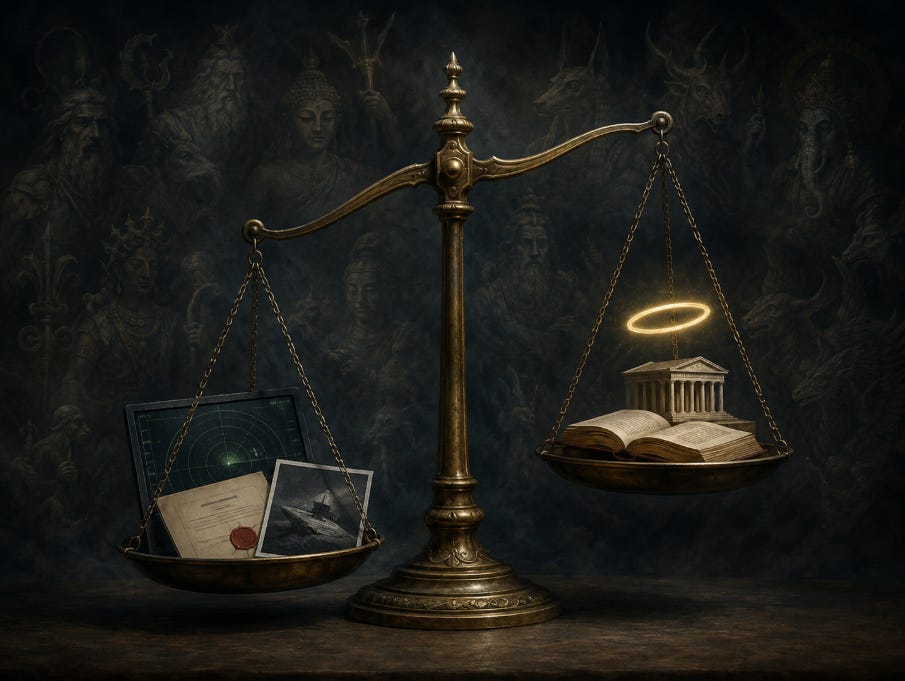
I have not written about it here, on PolitiMix, and a few readers have gently noticed the omission. They have noticed it because the rest of what I do here runs on a particular engine, one I make no effort to hide. I take unidentified aerial phenomena seriously as a real question deserving real investigation. I build political arguments on documented records, sworn testimony, and the weight of accumulated fact. I say, over and over, that when the evidence for something becomes strong enough, whether that evidence is a stack of hard data or an overwhelming mass of circumstantial detail all pointing the same direction, the intellectually honest move is to believe the thing exists.
And so the question arrives, sometimes politely and sometimes with a raised eyebrow: how can the same person who believes the UAP evidence is compelling also have written a whole book concluding that no gods are real? Isn’t that a contradiction? Aren’t you believing in little green men while dismissing the Almighty? Pick a lane.
It is a fair question, and I want to answer it directly, because the answer is not a dodge or a clever escape. The answer is that there is no contradiction, because there are not two standards operating here. There is one. I have exactly one method for deciding what is real, I apply it to everything, and it produces different verdicts on different questions for the simple reason that the evidence is different. The consistency is the entire point. If you understand how I arrive at atheism, you understand how I arrive at everything else I write here, and vice versa. This piece is the bridge between the book and the rest of the work, and it has been missing, and I want to build it now.
The Method, Stated Plainly
Here is the whole of it, and it is not complicated.
I try to proportion my belief in a claim to the evidence available for that claim. When the evidence is strong, I believe. When it is weak, I withhold belief. When it is overwhelming, I believe strongly. When it is absent, I do not believe, and I am willing to say the thing probably is not real. That willingness, the readiness to reach a negative conclusion when the evidence for a positive one never materializes, is not arrogance. It is the other half of honest reasoning. A person who will believe on good evidence but will never disbelieve no matter how the evidence fails is not being open-minded. They are being unfalsifiable, which is a different thing, and a worse one.
Evidence, in my usage, is not limited to a photograph or a lab result. Most of what any of us knows rests on circumstantial evidence, on convergence, on many independent lines all pointing at the same conclusion. This is not a lesser form of knowing. It is how courts convict murderers when no one filmed the crime. It is how science establishes things no one can directly see. When enough independent facts can only be explained well by a single underlying reality, that convergence is itself powerful evidence, sometimes more powerful than any single direct observation could be. I trust circumstantial reasoning. I stake political conclusions on it constantly. I would stake a verdict of guilt or innocence on it, because our whole system of justice does.
So the method has two moving parts. Proportion belief to evidence, and count convergent circumstantial evidence as real evidence. That is it. That is what I bring to Trump, to UAP, and to the gods. The method does not change when the subject changes. Only the evidence changes, and so only the verdict changes.
Watch it work across all three.
How the Method Treats Politics
When I write that this administration is running Venezuela as a colonial possession, or that a senator’s decades of documented reversals amount to a betrayal of everything he claimed to believe, I am not sharing a feeling. I am reasoning from a record. There are statements on video. There are votes in the Congressional record. There are financial disclosures, sworn testimonies, court filings, and the reporting of journalists whose work can be checked. When I reach a hard conclusion about a public figure, it is because the convergent weight of that documented record leaves little room for a gentler reading.
And crucially, I hold those conclusions provisionally, in proportion to the evidence. When the evidence for a claim is thin, as it was with the single-sourced report that the president would declare two senators illegitimate, I say so, and I refuse to build a firm conclusion on a shaky foundation, even when the firm conclusion would be more satisfying to my side. The method disciplines me against believing things merely because I want them to be true. That discipline is not optional. It is the thing that makes the method worth anything at all.
How the Method Treats UAP
Now apply the identical standard to unidentified aerial phenomena, and notice that it does not soften or bend to let something in. It simply encounters different evidence and returns a different result.
What is actually on the table with UAP is not, despite the eye-rolling shorthand, little green men. It is a body of evidence that has grown steadily and that clears a meaningful threshold. There are multiple sensor modalities recording the same objects at the same time, radar and infrared and human eyes converging on a single anomaly, which is exactly the kind of independent corroboration that makes a circumstantial case strong. There are witnesses with decades of aviation experience and security clearances, people trained specifically to identify what is in the sky, reporting objects they cannot categorize. There are official government documents conceding that a substantial fraction of examined cases remain unresolved after genuine investigation. There is sworn congressional testimony. There is a decades-long pattern of these objects appearing over nuclear facilities, documented from Los Alamos in 1949 to Pantex in 2015 in the government’s own files.
I want to be careful and honest here, because the method demands it. None of that proves non-human intelligence is visiting Earth. I have never claimed it does. What it does is clear the bar for taking the question seriously, for saying that something real and unexplained is being observed and that the evidence is strong enough to warrant investigation rather than dismissal. My position on UAP is not belief in a conclusion. It is the judgment that the evidence has crossed the threshold where honest inquiry is mandatory and reflexive denial is no longer intellectually defensible. That is a calibrated position, proportioned to a real and growing body of evidence. It is the method working exactly as it should.
How the Method Treats the Gods
And now the gods, treated by the same rules, with the same seriousness, and with real respect for how much this question has mattered to how many people for how long.
First, the framing, because it matters enormously and is almost always dodged. The question is not whether one particular god, the one that happens to be culturally dominant where a given reader was born, exists. The question is whether any of the thousands upon thousands of gods that human beings have proposed across the millennia are real. Humanity has invented an enormous pantheon: sky gods and sea gods, sun gods and storm gods, gods of war and harvest and death, supreme creators beyond counting, each believed in utterly and sincerely by people every bit as intelligent and heartfelt as those who believe today. Any honest accounting has to reckon with the whole record, not just the one deity that feels default from the inside of a particular culture. Nearly every believer who has ever lived was already a firm atheist about the overwhelming majority of gods. The atheist simply extends the same reasoning one god further.
So apply the method. Where is the convergent evidence? Not the feeling of the divine, which is real as an experience but which every mutually contradictory tradition reports with equal sincerity, and which therefore cannot establish any of them over the others. Not the beauty of the world, which is equally compatible with a universe that has no author. Not the ancient texts, which are the claim, not the evidence for it, and which contradict one another across traditions in ways that cannot all be true. Not personal transformation, which happens inside every faith and none, and inside recovery programs and love affairs and mountain climbs, and so points to something about human beings rather than about any god.
When you strip away the things that feel like evidence but are not, you are left looking for the convergent, independent, cross-checkable lines that would make a circumstantial case, the kind of case I would accept in a courtroom or a UAP file, and they are not there. The gods do not leave sensor returns. They do not appear over nuclear facilities. They do not generate documents that survive independent scrutiny. What they generate is testimony that contradicts other testimony, feeling that contradicts other feeling, and text that contradicts other text, with no external anchor by which to adjudicate any of it.
And there is a contrast here that I find decisive, and I want to state it carefully because it is the heart of the whole matter. The UAP evidence has grown as investigation has intensified. The more seriously it is examined, the more there is to examine. The case for the gods has moved in exactly the opposite direction across the entire history of human knowledge. Every domain that gods once explained, disease and weather and the origin of species and the motion of the planets and the emergence of life, has, one after another, yielded to natural explanation. The territory assigned to divine action has not held steady and it has certainly not grown. It has receded, continuously, for centuries, retreating into the shrinking gaps where knowledge has not yet reached. A hypothesis whose explanatory domain shrinks every time we look harder is a hypothesis failing the test. A phenomenon whose evidence accumulates every time we look harder is one passing it. UAP and the gods are not two cases of the same thing. They are moving in opposite directions under investigation, and the method notices.
That is why the book reaches the conclusion it does, and why the title is a verb. Concluding atheism. Not asserting it as a starting bias, but arriving at it as a destination, at the end of the same evidentiary road I walk on every other subject. The gods are not real, as far as any honest reading of the total evidence can determine, for the same reason the UAP question is real: because that is where the evidence points, and I have committed to going where it points regardless of where I would prefer to end up.
The Honest Concessions
The method requires me to concede what it cannot deliver, and I will.
It cannot deliver certainty, in either direction. I cannot prove no gods exist, in the strict sense, any more than I can prove no teapot orbits a distant star. What I can say is that the evidence for them is absent where it should be present, that their explanatory power has collapsed under investigation, and that after millennia of sincere searching by billions of people, the case has not been made. Proportioning belief to evidence, that adds up to disbelief, held as firmly as the evidence warrants and no more firmly than that. If compelling evidence for a god arrived tomorrow, of the kind that converges and survives scrutiny, the method would require me to update, and I would. That it has not arrived, across all of recorded history, is itself the most telling evidence of all.
And I want to be clear that none of this is contempt for the billions who believe. Faith has carried people through griefs I would not wish on anyone. It has built the hospital and the hospice and the soup kitchen. It has produced staggering art and genuine moral courage. I am not saying believers are stupid, because they plainly are not, and many of the finest minds in history have been devout. I am saying only that sincerity and benefit are not evidence of truth, that a belief can be precious and sustaining and load-bearing in a person’s life and still not correspond to a real being in the universe. Those are different questions, and running the method honestly means keeping them separate even when doing so is uncomfortable.
Why This Matters Beyond Metaphysics
Here is where the loop closes, and where a piece that might seem like a detour from PolitiMix’s usual subjects turns out to be its foundation.
I spend most of my writing here documenting a political movement that runs on the abandonment of evidence. A movement that asks its followers to believe the last election was stolen despite every court, recount, and audit finding otherwise. That asks them to believe vaccines are poison against the overwhelming weight of medical science. That asks them to accept that a man is a stable genius while the recordings of him confusing Iran with Japan play in the background. The defining cognitive move of this era’s politics is the request to believe a thing not because the evidence supports it but because believing it signals loyalty, because the leader asserts it, because your tribe requires it.
And I have come to think that the capacity to make that move, to believe on command and against evidence, is not native. It is trained. It is a muscle, and it is built through practice, and one of the oldest and most powerful training grounds for it is the demand to believe propositions about the world on the basis of authority and feeling rather than evidence. A person who has been taught, from childhood, that belief without evidence is not merely acceptable but virtuous, that doubt is a failing and credulity a form of grace, has been prepared, whether anyone intended it or not, to accept the next authority who asks the same of them. The habit of mind that accepts a claim because a trusted voice insists on it, and treats the demand for evidence as a kind of betrayal, is the same habit whether the voice belongs to a pulpit or a podium.
This is not an attack on religious people, who are as capable of sharp evidentiary thinking as anyone and who often lead the resistance to exactly the political lies I am describing. It is an observation about a mode of reasoning, one that can be cultivated or neglected, and that a democracy depends on far more than it usually admits. A citizenry practiced in proportioning belief to evidence is a citizenry that is hard to lie to. A citizenry trained to believe against evidence, in any domain, has been made ready to be lied to in every domain. The evidentiary habit is not just an epistemology. It is a civic defense system, and it either operates everywhere or it erodes everywhere.
That is why I cannot cordon off the gods from the rest of what I write, and why the omission needed correcting. The same standard that leads me to take UAP seriously, and to hold this administration to account, and to withhold belief from a shaky single-sourced rumor even when it flatters my side, is the standard that leads me, at the end of a long and careful road, to conclude that the gods are not there. It is one method. I did not adopt a special hostile standard to reject the gods and a generous one to accept the aliens. I adopted one standard and followed it everywhere it led, and it led to atheism on the one question and to open, evidence-driven inquiry on the other, and to relentless documentation on the third.
Pick a lane, the challenge goes. I have. It is the same lane I have been in the whole time. The lane is called: believe what the evidence supports, in proportion to how strongly it supports it, and have the courage to say so out loud even when the conclusion is unwelcome, on any subject, without exception.
That is the whole method. The book and the blog were never two different things. They were always this one.