


The jobs report came in on the twenty-third, which was a Tuesday, which was a problem, because the month had eight days left in it.
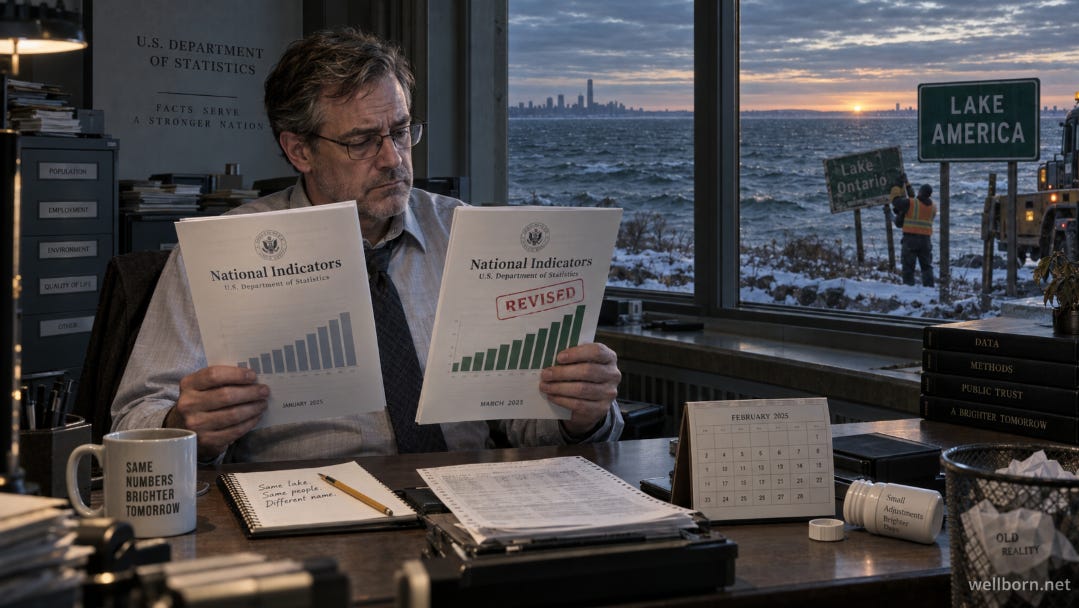
Dell Prager looked at the number for a while. It was a good number. It had been a good number for eleven consecutive months, which was itself a kind of number, and he had started keeping that one privately, in a notebook, with a pencil, because the notebook did not sync to anything and the pencil did not require a subscription.
“It’s early,” he said to Frannie Oduya, who had the desk across from his in the Bureau’s third-floor annex and who had been there four years longer than he had.
“It’s on time,” Frannie said, not looking up. “They moved the month.”
“You can’t move a month.”
“They moved the lake,” she said, and that was the end of that conversation, because it was true, and because the coffee machine in the break room had begun charging by the sip and Dell had forgotten to renew.
The lake had been the first thing he noticed, and he had noticed it the way you notice a tooth is gone, by putting his tongue where it used to be.
He had been driving his daughter Wen to her aunt’s in Rochester, and the sign on the interstate had said LAKE AMERICA 4 MI, and he had said, out loud, to nobody, “Ontario,” and Wen had looked up from the tablet and said, “What’s that?”
“The lake. That’s the lake.”
“That’s Lake America, Dad.”
“It was Lake Ontario. It was Lake Ontario your whole life until about a month ago.”
Wen considered this with the particular patience of a nine-year-old who has decided her father is having one of his things. “Was it named after a guy?”
“It was named after a word. Iroquois. It means something. Beautiful water, I think.” He was not sure of that. He had been sure of it once.
“Well, it’s Lake America now,” Wen said, and went back to the tablet, on which a small pixel man in a blue suit was collecting other small pixel people along a river and arranging them behind him in a line, and every time the line got longer a counter in the corner went up by one and made a sound like a coin.
The thing about the count, Dell thought, sitting at his desk on the twenty-third with the report for a month that had not finished, was that it used to come from somewhere.
There had been surveys. Actual people, sixty thousand households, called or visited, asked whether they had worked in the past week, and if so how many hours, and whether they were looking. The people said things. The things went into a system. The system produced a number, and the number was, in a way Dell had once found almost religious, a description of something real. A photograph of a country, blurry at the edges, taken on a particular day.
Then the commissioner was fired, in the summer of the year before, after a number came out that the Executive did not like, and after that the numbers had improved substantially and had stayed improved, and the surveys had been consolidated, and then the consolidated surveys had been streamlined, and then Dell had come in one Monday and the survey team’s floor had become a wellness suite with a ping-pong table nobody used, and the numbers had kept arriving anyway, on schedule, then slightly ahead of schedule, then, this morning, before the month was over.
He opened the report’s metadata. Source fields were blank. Not zero. Blank, the way a field is blank when nothing was ever entered because nothing was ever collected.
“Frannie,” he said. “Where does it come from now?”
“Where does what come from.”
“The number. If nobody’s asking anybody anything, where does the number come from?”
Frannie finally looked up. She had a face that had been through several administrations and had developed, somewhere around the second one, an expression of durable, ironic peace. “Dell,” she said, “have you taken your Steady?”
“I don’t take Steady.”
“Everybody takes Steady.”
“I don’t.”
She looked at him for a long moment. “That explains a lot,” she said, and went back to her screen, on which the Fourth Quarter Consumer Sentiment Index had already been finalized, in the third week of the third quarter, and was, she noted aloud, very encouraging.
Steady was a tablet. It was small and off-white and had the letters PROV stamped on one side, which stood for something, or had once. It was available without prescription at any pharmacy and increasingly at gas stations, in a rack near the register next to the lottery tickets and the lighters, and it did one thing, which was to make the difference between what you saw and what you were told feel like weather. Not a lie. Not a truth. Just a condition, out there, that you could not do anything about and that would pass.
Dell had tried it once, the previous winter, after the plane.
The plane had been on the news for three days. The Executive’s plane, a gift from a foreign king, retrofitted at public expense, which the Executive’s own guards had pulled him off of during a war because it could not be trusted over the sea. The Executive had said the plane was fine. The Executive had said he would fly it to his golf course in Ireland. The Executive had said, when asked about the guards, that he was number one on an enemy’s list and that the life of an Executive was very dangerous, and then he had said the plane was fine, and then he had flown it to Ireland, and then it had been fine.
Dell had watched all of that, and then he had watched the two-minute war, which came on after the weather every night and which consisted of American ordnance landing on things, set to music, with no maps, no casualties, no context, and no losses, ever, in eleven months, and he had felt something in his chest that he could not name, a pressure, like a hand, and he had gone to the pharmacy and bought a bottle of Steady and taken one.
It had worked. That was the horrible part. For about six hours the plane had been fine and the war had been going well and the count had come from somewhere, and Dell had sat in his kitchen feeling, for the first time in a year, like a citizen of the country on television rather than the one outside his window.
Then it wore off, and the window was still there.
He had not taken another one. He had kept the bottle, though, in the drawer with the notebook and the pencil, because throwing it out felt like a decision and he was not ready to make it.
On the twenty-fourth the report was revised.
This was normal. Reports were always revised. What was not normal was that the revision came before the original had been released, so that the public saw a good number and the Bureau’s internal system, which Dell could still access through a legacy portal nobody had remembered to close, showed a better one, dated two days later, superseding a figure that had never been published.
He printed both. The printer was in the hallway and still worked, being too old to require an account.
He laid them side by side on his desk and looked at them and understood, in the way you understand a smell, that the numbers were no longer a photograph of anything. They were a portrait. They had a subject and the subject was sitting for them.
“You’re doing the thing,” Frannie said.
“What thing.”
“The thing where you look at two pieces of paper like they’re going to confess.”
“Where do I file this?”
“File what?”
“A discrepancy. There used to be an office. Inspectors. You filed a form, someone with a badge came and asked questions.”
Frannie made a small sound that was not quite a laugh. “Dell. There were seventeen of them and they were fired on a single night a year and a half ago, and the judge said it was illegal, and they are still fired, and the man who investigated the man who did the firing is the only one who kept his job. You want to file with him?”
“Then who checks?”
“Nobody checks. That’s the streamlining.” She leaned back. “It’s not a conspiracy, Dell. I know you want it to be, because a conspiracy has a room and a door and a guy. This doesn’t have a guy. It’s just that everyone who used to say no was told to go home, and they went, and the machine kept running without them, and it turns out the machine never needed the truth, it only needed the format. The format’s fine. Look at it. It’s beautiful.”
She was right. It was. The report had been designed by professionals and it was clean and legible and had a chart, and the chart went up.
That night Dell drove out to the lake.
It was the same lake. That was the thing he had needed to see and could not have explained to Frannie or to Wen or to anyone who took Steady. The water had not been consulted. It was cold and dark and enormous and had a smell, and it lay there under a sign that called it something else, and it was not, in any way that a lake could be, different. The name had come off it like a label off a jar. What was in the jar was in the jar.
He stood on the shore for a long time.
A truck came along the access road and stopped. A man got out, in a vest, with a clipboard, and walked down to the water, and then began, methodically, to pull up the small posted signs that lined the beach, the old ones, the ones that still said the old name in white letters on green, and stack them in the back of the truck.
“You’re taking those?”
“Correcting,” the man said. “There’s a list.”
“Who made the list?”
The man shrugged, a full-body shrug, the shrug of a person paid by the sign. “It came down.”
“From where?”
“Down,” the man repeated, as though that were a location, which Dell supposed by now it was.
He drove home. The interstate sign said LAKE AMERICA 4 MI. The road was the same road. The exit was the same exit. Somewhere in a database the lake had a new name and in every truck a man had a list and the water had not been asked.
Wen was still awake when he got in, in the dark, the tablet lighting her face blue.
“Dad. I got to level nine.”
“What happens on level nine?”
“You get a plane.” She showed him. The little man in the blue suit now stood on a tarmac beside a little gold jet, and the line of pixel people behind him wound off the edge of the screen, and the counter in the corner said 1,847, and every time a new figure joined the line the game played the coin sound and the number went up.
“That’s a lot of people.”
“It’s not people, Dad. It’s points.”
He looked at her face in the blue light, and he understood that she was not wrong, inside the game, and that the game had been designed by someone who wanted her to be right about that, forever, and that the pharmacy sold the same product in a bottle for adults.
“Where does it end?” he said. “The game. Is there a last level?”
Wen thought about it. “I don’t think it ends,” she said. “I think the number just gets bigger.”
He did not sleep. He sat at the kitchen table with the notebook, the one that did not sync, and he wrote down what he knew.
The count came before the month. The revision came before the count. The lake was the lake. The plane was not fine and had been fine. The war had no losses and 775 families. Seventeen people had been fired for checking and one had been kept for not. The chart went up. His daughter had a plane.
He looked at the list. It was not a conspiracy. Frannie was right. It had no room and no door and no guy. It was a country that had let every person whose job was to say no go home, and had discovered, with a kind of dumb wonder, that nothing had stopped. The forms still came. The signs still changed. The number still went up. The only thing missing was the thing the number had once described, and that thing was outside, dark and cold and enormous, with a smell, not consulted.
At six the sun came up over a lake with the wrong name and it was still water.
At eight the report was revised again. He did not read it. He put the notebook in his pocket and the Steady in the trash, finally, and drove to work, and on the interstate the sign said what it said, and he said, out loud, to nobody, the old word, the beautiful one, the one that meant water, and kept driving.
It would not change the sign. He knew that. But somebody had to keep the count.