


Let us begin with the gasoline.
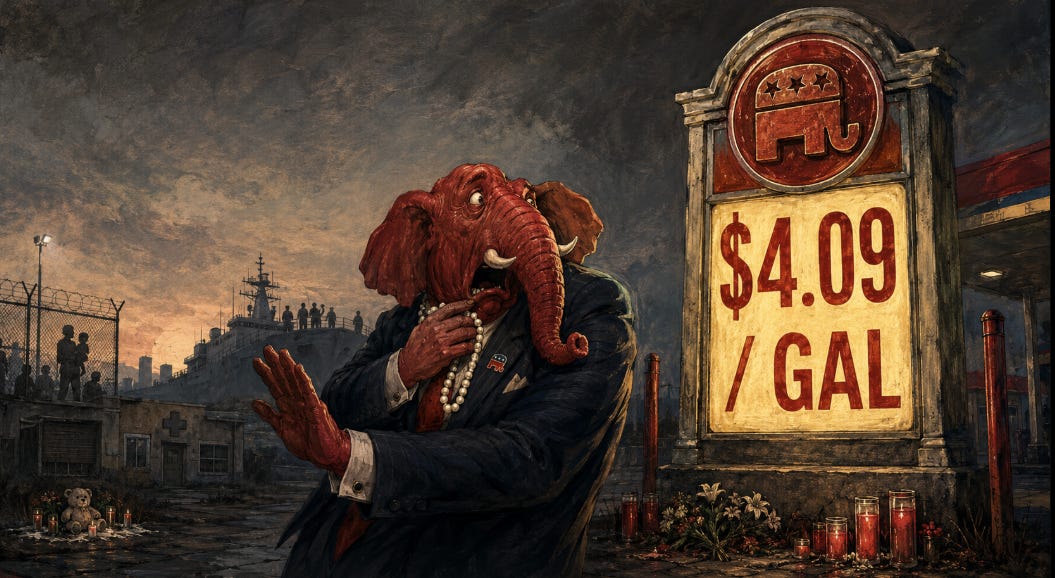
After eighteen months, the Republican Party has located a moral boundary. It has been searched for at length by a great many people, in a great many places, and it turns out to have been at the pump the whole time, somewhere north of four dollars a gallon, clearly marked, in large illuminated numerals visible from the road.
Senator Jim Justice of West Virginia announced its discovery to reporters on Monday. He called the administration’s handling of the war a mess. He said that everybody had sat back for months saying it will be okay, it will be okay, and that he had been the voice saying you people are living in a cave if you do not see that the folks out there are hurting.
Then, reaching for the ordinary Americans he had in mind, he produced two of them by name.
The Toby and Ediths out there, he said.
I have thought about Toby and Edith more than is strictly necessary. They do not exist. They were invented at a podium, in real time, by a sitting United States senator who needed a couple of civilians on short notice and could not immediately produce any actual ones, and who therefore assembled a pair out of the names his mind offered, which were Toby and Edith. They are presumably in their seventies. They presumably have a Buick. Somewhere in the Republican imagination they are at this moment standing at a filling station in Beckley, watching the numbers roll, wondering where it all went wrong, and they have been made up specifically to be worried about.
The inventory
It is worth recording what did not produce this reaction, because the list is not short and it took eighteen months to compile.
The three judge advocates general removed on a single afternoon did not produce it. The fifty-two people who died in immigration custody, at the highest mortality rate in more than a decade, did not produce it, nor did the quiet amendment in June that stopped the deaths being reported at all. The abolition of an agency that the best available study credits with preventing ninety-one million deaths did not produce it. The five thousand sailors kept at sea for more than 260 days with two days ashore, moldy showers, and no fresh milk since May did not produce it. The children who died of measles did not produce it. The order recommending a vaccine that does not exist and cannot be purchased did not produce it.
Cutting military exercises with a treaty ally on the grounds that a nuclear-armed dictator had been personally respectful to him did not produce it, and that was Saturday.
None of it. Not a murmur. The party observed all of that with the settled equanimity of a man watching weather happen to somebody else’s house.
Gasoline went up and the entire structure began to make noises.
The strategist
The single best sentence produced by any Republican this year came from Barrett Marson, a strategist in Arizona, speaking to CNN.
There is one person in this country who doesn’t care about gas prices, he said. Just one. And unfortunately that one person kind of controls our fate.
I want to be fair to Mr. Marson, who was attempting to describe a professional difficulty and who accidentally produced the finest available summary of American governance in 2026. He then added that for Republicans it is a balancing act on the thinnest of wires to still support the president but also feel the pain that voters are going through.
That is not a balancing act. A balancing act involves two things of comparable weight. What he is describing is a man attempting to hold a position and its opposite at the same time, in public, on television, until November.
The confirmation
Barrett Marson said this out loud on a Monday.
Within days the one person who does not care about gas prices went to a rally in Garden City, New York, and told the assembled crowd that paying a tiny little bit more for your gasoline was a fair price to keep a very evil country from getting a nuclear weapon.
A tiny little bit more.
The man has not personally purchased a gallon of anything since the Ford administration. He is driven everywhere in a vehicle he does not own by a person he does not pay, in a motorcade whose fuel costs appear on a federal ledger he will never look at, and he has arrived at the settled conviction that the increase is tiny, with the specific confidence of a man who has never once in his life stood at a pump and watched the number pass the amount he had budgeted for it.
His strategists asked him for one thing. They asked him to pretend, for eleven weeks, that he had noticed.
The briefing
The best scene in this entire affair took place behind a closed door.
Senate Republicans had begun openly criticizing the White House’s emergency request for seventy billion dollars in war funding, and demanding that the Pentagon explain both its strategy and the reports of critical missile shortages. So the Vice President of the United States was dispatched to a private briefing to settle them down.
His message, according to reporting on the meeting, was that the shortage reports were misdirection, intended to embolden the enemy.
Consider the structure of that claim for a moment. If the reports are false, the enemy learns nothing from them, because they describe a stockpile that is fine. If the reports are true, the enemy already knows, because the enemy is the one shooting at the interceptors and can presumably count. There is no arrangement of facts in which the sentence does any work, which is possibly why several senators reportedly left the room unconvinced and began warning colleagues that denying logistical realities leaves their candidates defenseless on the campaign trail.
The party’s position is now that the missiles are unlimited, that saying otherwise is treasonous, that reports to the contrary are enemy misdirection, and that Congress should urgently appropriate seventy billion dollars to buy more of them.
All four of those are being maintained simultaneously, by the same people, in the same week.
The numbers
Reuters and Ipsos closed a four-day poll on Monday. Eleven hundred and sixty-six adults, margin of error three points.
Thirty-three percent approve. Sixty-four percent disapprove. It is the lowest of his presidency and it ties the worst month of his first term.
Eighty percent of Americans think the involvement in Iran will go on for an extended period, and that eighty includes seventy-one percent of Republicans. Sixteen percent think it ends in a few weeks.
He promised a few weeks.
So roughly seven in ten of his own voters have privately concluded that the central promise of the war was not true, which is a thing they will not say into a microphone and have already said to a pollster, anonymously, from home.
Two House Republicans, Tom Barrett of Michigan and Brian Fitzpatrick of Pennsylvania, have voted with Democrats to limit his war powers. Others in swing districts are asking publicly for a quick resolution, which is the phrase you use when you would like a war to stop without being caught wanting it.
What it cost
Here is the part that is not funny and it is the reason any of this is worth writing down.
The Republican Party has, this week, established its price in public, and the number is available to anyone who wants it.
It is not measured in fired officers or dead detainees or children with measles or five thousand sailors who have not been ashore since November. Every one of those was absorbed without a single senator inventing a fictional constituent to worry about.
It is measured in dollars per gallon, and the figure lies somewhere between what gasoline cost in February and what it costs today.
That is the entire moral architecture, exposed, in an election year, by an oil market. And the thing they want now is not for the war to end, or the sailors to come home, or the interceptors to be replaced. What they want is for the price to come down before November so they can go back to not noticing the rest of it.
Toby and Edith are not real. They were made up on Monday, by a senator, to stand in for people whose suffering could finally be mentioned out loud because it had begun to show up in a poll.
Everyone else has been real the entire time.
Very well said! The cost of gas compared to the entire list of atrocities is absolutely miniscule. Yet the price per gallon is the ONE thing the R's can latch onto and appear to get behind for the sake of their forgotten constituents. It says, "Look at me, I am in your corner. Don't look behind the curtain because there's nothing there."
One would think that the murderous mass bombings claiming the lives of little children; the murder of American Civilians by ICE; the horrors being inflicted on INNOCENT people to make Miller's ghastly quota; the apparent neglect of our own military aboard a ship.... One would think any one of these would be a choice people doing a quiz might tick off as being the number one item to address.
But NO! In this insanely warped realm we inhabit, they do not merit even a murmur from the congressional cowards. The price of gas gets the nod because it is highly visible and ubiquitous, and people have short memories...except those who are dead; incarcerated-or living in fear of same; or busily attempting to do their duty without proper nutrition.
One would be wrong!