


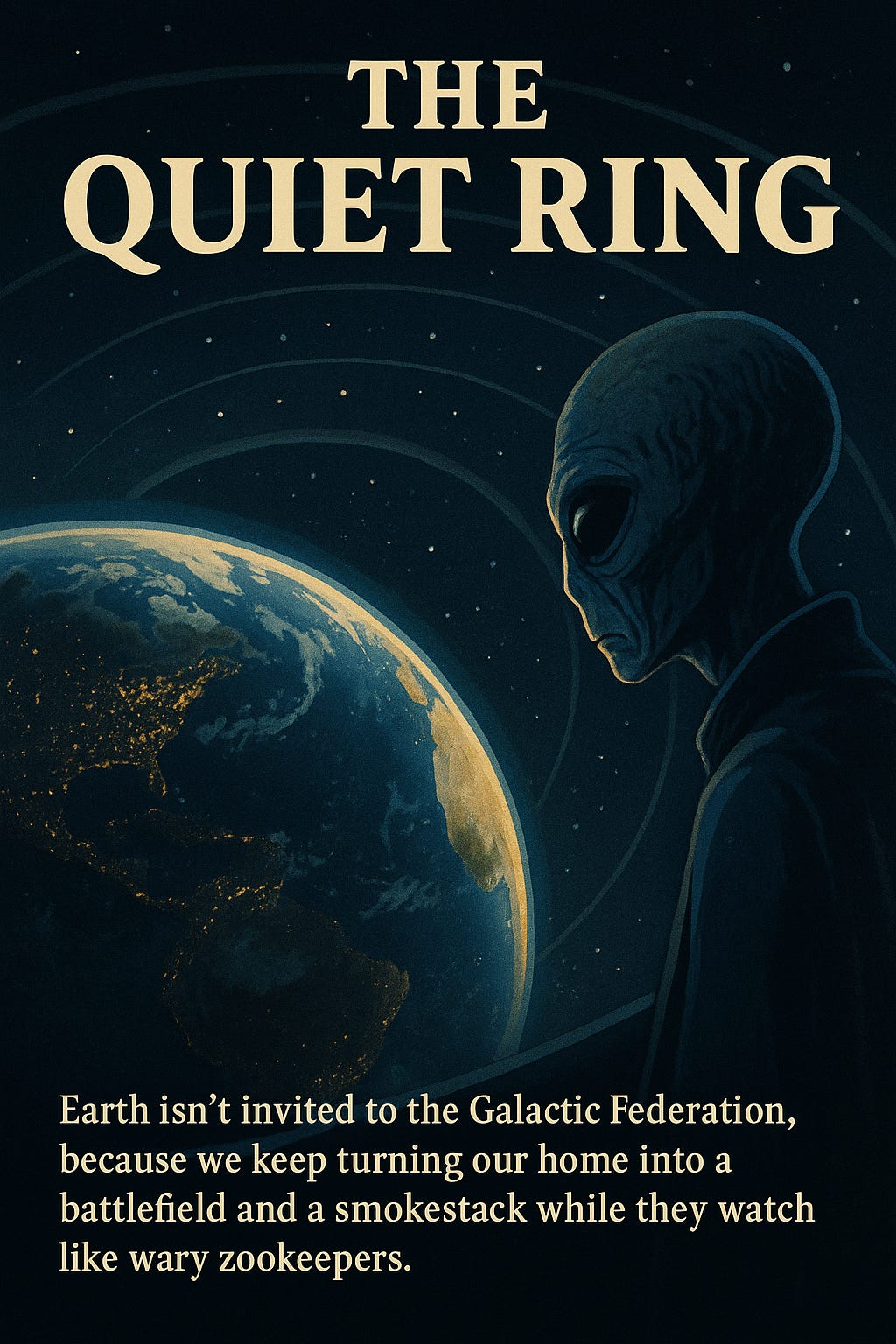
They called it the Quiet Ring, a lacework of worlds stitched together by treaties so old nobody remembered what war felt like. The Galactic Federation didn’t advertise. Civilizations earned their way in the way oceans earn calm: slowly, after enough storms stop happening.
Earth was not in the Ring.
From the outside, our planet looked like a jewel left on a workbench. Blue glass, white swirl, a glint of green. Beautiful. Unfinished. And, in the Federation’s official language, “biologically precious, behaviorally volatile.”
Observer Lyr-Na drifted inside a listening pod the size of a pebble and watched the night side of Earth bloom with lights. City grids, highway veins, the soft flicker of screens held inches from human faces like tiny campfires. On the day side, gray smudges spread in the atmosphere where industry breathed.
“Still burning ancient plants,” Lyr-Na murmured, not quite judging, more… saddened. “Still worshipping heat.”
Beside her, a second pod pinged a calm reply from Observer Tal-Vesh. “Species tends to cling to its first miracles. Fire. Metal. Story. Violence.”
On the Federation’s worldships, the pods’ interior walls were made of living crystal that translated thoughts into words. Here, near Earth, the crystal stayed dim. The Federation kept its emotions folded away around developing worlds. Policy. Containment. Mercy.
Earth was a sanctuary planet by Federation standards, even if no one on Earth knew it. A thousand observers, scattered and unseen, watched the way humans watched aquarium fish: fascinated by the colors, worried by the frantic darting, startled when the creatures attacked their own reflections.
On Lyr-Na’s display, the planet’s borders were traced in pale lines, not political but ecological. The Amazon pulsed like a lung. The oceans moved like muscles. Coral reefs glowed faintly, then dimmed, then glowed again as if unsure whether to keep trying.
Then a red alert thread stitched across the atmosphere.
Tal-Vesh read it aloud. “Ozone recovery projected. Good.”
Lyr-Na let herself brighten. “We can—”
The next alert came, sharp as a crack of ice.
“New conflict cluster,” Tal-Vesh said. “Escalation probability rising. Atmospheric particulate spike. Heavy metal residues.”
Lyr-Na watched the tiny flashes on the map, the little violence-stars blossoming and fading. Humans had turned war into an industry, an engine that ate reason and exhaled smoke. Machines on machines. Fire on fire. A talent for invention used like a blade.
In Federation history, there had been eras like this, before the Quiet Ring. The Federation didn’t pretend it had always been wise. It remembered how species could sprint toward extinction while congratulating themselves on progress.
That was why the Zoo existed.
It wasn’t a cage of bars and locks. It was distance. It was silence. It was the Federation’s decision, unanimous and weary, to treat Earth as a protected exhibit until the exhibit stopped trying to burn itself down.
A third observer chimed in, Overseer Mael-Sorin, voice softened by centuries.
“Report, Lyr-Na.”
Lyr-Na hesitated. Official language felt like lying.
“They’re… brilliant,” she said finally. “And frightened. They build miracles and then use them to threaten each other. They love their young and leave their elders lonely. They sing while they poison their water. They can’t agree on what’s real, but they can agree on what to hate.”
A pause. The kind that meant the Overseer was looking at Earth too.
“We don’t appreciate the violence,” Mael-Sorin said, not harshly. Simply as a fact, like gravity. “Not because we are offended. Because we know what it costs.”
On the screen, a human child pressed her face to the glass of a museum display, staring up at a skeleton of an ancient animal. Her eyes were wide, curious, reverent. The child didn’t know she was being watched. She didn’t know the museum was inside a museum.
Lyr-Na felt something ache that the living crystal could not translate.
“Why don’t we help?” she asked. “We could clean the air in a week. Disarm the war machines. Give them medicine. Give them—”
“Give them what?” Tal-Vesh cut in gently. “A new dependence? A new god? A new reason to divide into believers and heretics?”
Mael-Sorin answered with the weight of old mistakes.
“Interference turns the study into a story,” the Overseer said. “And stories become weapons in their hands. They are not ready to see us without turning us into a mirror for their fears.”
Lyr-Na looked at the planet again. The way it spun, patient and generous. The way humans clung to it as if it were infinite.
“Are they… primitive?” she asked, hating the word even as she spoke it.
Tal-Vesh’s pod pulsed a thoughtful dim-blue. “Compared to our technology, yes. Compared to our restraint, yes. Compared to our ability to resolve conflict without killing, yes.”
“But,” Tal-Vesh added, “primitiveness is not a sentence. It is a stage.”
Mael-Sorin sent a final directive. “Continue observation. Increase monitoring around nuclear sites. Track climate tipping indicators. And record everything. If they cross the threshold, we must be ready.”
Ready meant evacuation of the non-human life. Ready meant quarantine. Ready meant the last resort: shutting down the species’ ability to reach beyond their atmosphere, not as punishment, but as triage for the planet.
Lyr-Na didn’t want to imagine it.
Instead she watched a hospital room where a human nurse held an old man’s hand. She watched a group of teenagers picking up trash along a river, laughing as if saving the world was an after-school activity. She watched scientists argue in good faith. She watched strangers donate to strangers. She watched a musician play in a subway station and make people pause, just for a moment, as if remembering they were one creature in one place.
The violence was real. The pollution was real. The war machines were real.
So was the rest.
Lyr-Na recorded her closing note for the day, careful with each word.
“Subject: Humanity,” she dictated. “High-risk. High-potential. Emotionally reactive. Socially fragmented. Technologically accelerating. Ethically lagging. They behave like a species trapped in adolescence, convinced their anger is adulthood.”
She glanced at the blue jewel again, at the thin skin of air protecting everything they’d ever loved.
“And yet,” she added quietly, almost a whisper to the crystal, “they keep trying to become better. Even while they fail. Even while they fight. Even while they choke their own sky.”
The living crystal saved the note without judgment.
Far above the planet, unseen, the Zoo remained silent.
Not because the Federation didn’t care.
Because it cared enough to wait until the day humans looked up, not with hunger or fear, but with the first steady hint of belonging.